Abstract
Academic training in Analytics teaches us to formulate precise problems, develop rigorous models, and evaluate solutions under clearly defined assumptions. Real-world decision problems rarely offer the same luxury. They emerge from complex systems, incomplete information, organizational constraints, competing objectives, and questions that are often difficult to formulate in mathematical terms.
In this talk, I will reflect on the transition from solving academic problems to addressing real-world decision problems, drawing on my experiences across operations research, forecasting, simulation, healthcare analytics, and decision-making under uncertainty. I will discuss how ideas such as partially observable Markov decision processes (POMDPs), optimization, and simulation can move from theoretical research into practical applications—including conservation of endangered species and healthcare system planning.
Using healthcare demand forecasting and Alternate Level of Care (ALC) modeling as a central example, I will illustrate how a seemingly straightforward research question, i.e., “How many patients will we need to accommodate?” quickly becomes a much broader decision problem involving population dynamics, patient flow, discharge capacity, behavioral and social factors, uncertainty, and policy interventions.
The challenge is not simply to build a more sophisticated model, but to determine what should be modeled, what can be measured, what assumptions are defensible, and how model outputs can support decisions.
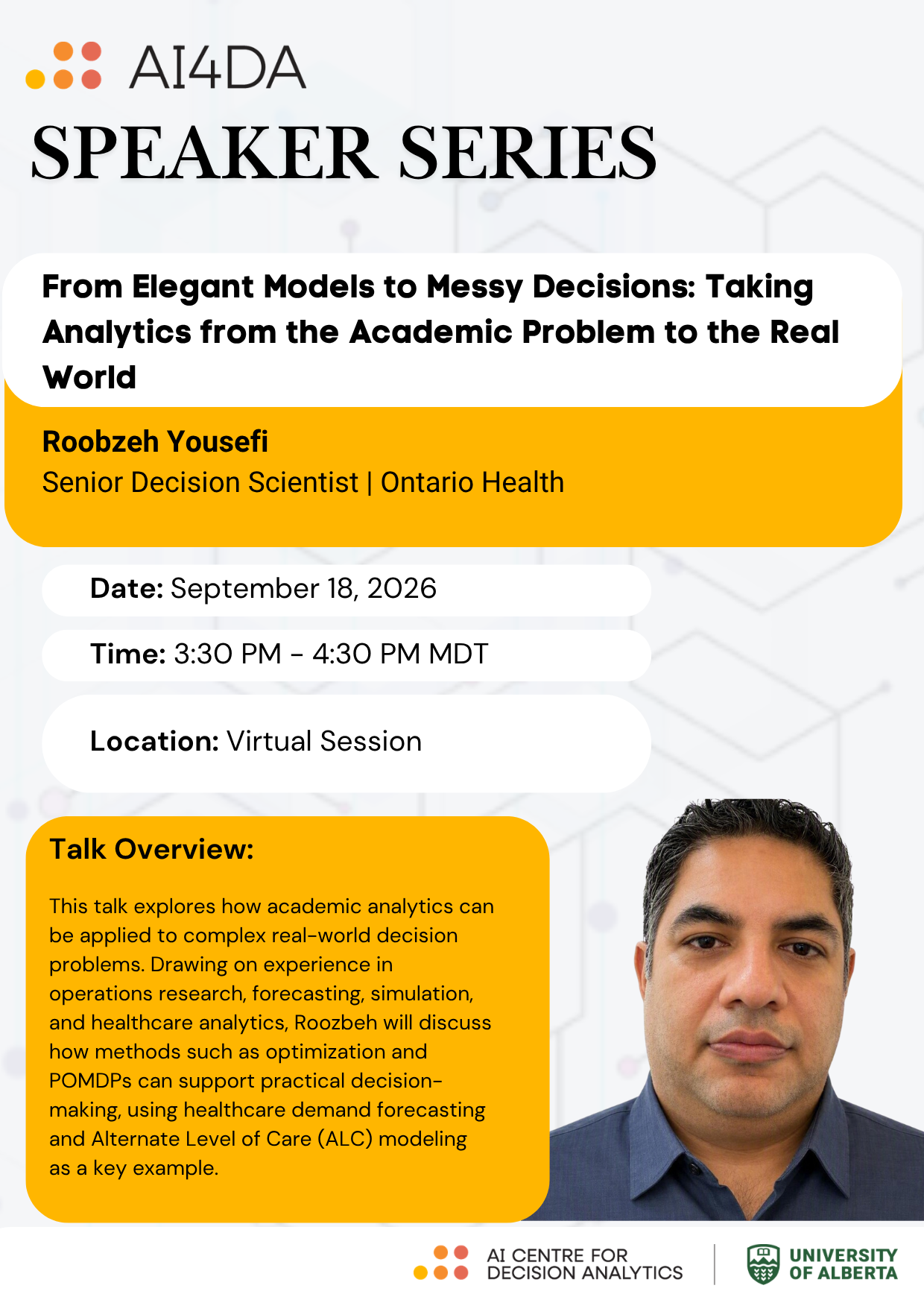
Event Details
Date: September 18, 2026
Time: 3:30–4:30 PM MDT
Location: Virtual
RSVP deadline: September 15