Dr. LaPointe's Lab Reveals Co-operation Isn’t Always Key
Dr. Adrianne Watson - 22 December 2025
The Changing of Motifs in Aha1
Despite modern advancements in detection and treatment, cancer remains one of the largest threats to human health. Roughly half of Canadians are predicted to develop cancer in their lifetime, with an approximately 20% probability of succumbing to this disease. It remains a public health priority worldwide.
The trouble starts when alterations to our DNA turn a normal, healthy cell into a cancerous one. But in order for the cancer to really take off, it needs some help from our cell’s own proteins. One such protein is known as a chaperone. It works inside the cell to help ensure proteins look proper and act as intended.
In cancer research, one of the more important turncoats happens to be heat shock protein 90, or Hsp90. It normally stabilizes client proteins such as protein kinases, transcription factors, and steroid hormone receptors. The overall result is proper cell signalling and function, especially in response to cellular stress. This is a good thing.
But Hsp90 also has been known to stabilize mutated proteins that can turn a cell cancerous. It can collaborate with another chaperone known creatively as Aha1 (but officially as Activator of Hsp90 ATPase) to facilitate the folding, stabilization and activation of cancer-causing proteins. This is not at all good.
When HSP90 and Aha1 work together in the cell, a vicious circle begins. First, Hsp90 can stabilize the proteins that help the cancerous cells survive and reproduce, ensuring its uncontrolled spread. In turn, the cancer cells can increase the amount of Hsp90, further facilitating its malignancy or spread. Not surprisingly, for cancer researchers, a major goal is to understand how Hsp90 and Aha1 work together to allow its nefarious clients to survive so we can target them using therapies.
Enter Dr. Paul LaPointe’s lab. They wanted to take a look at the Hsp90 and Aha1 collaboration at the molecular level to find potential targets for therapy. Their results are published in the journal, Protein Science.
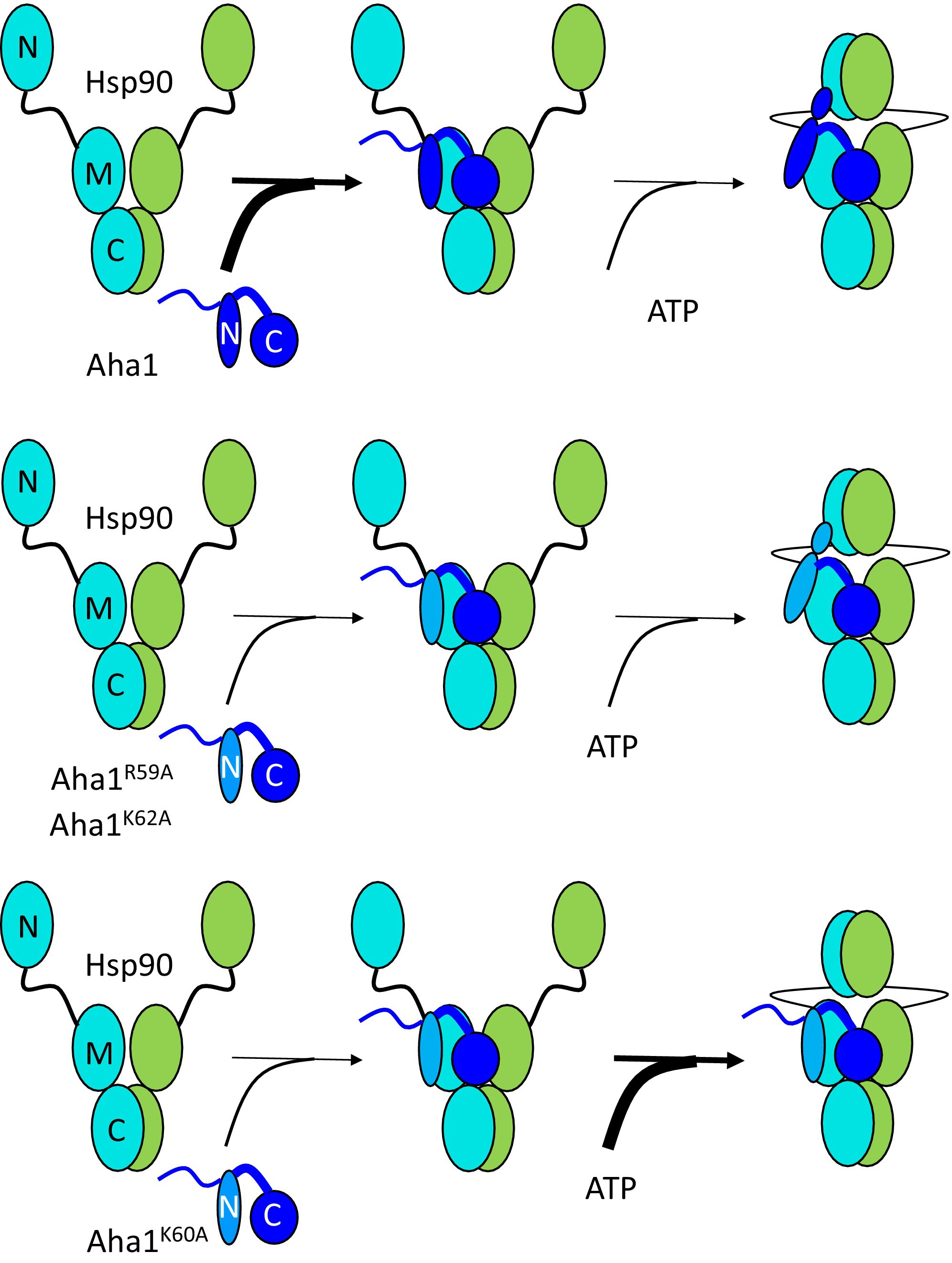
The team chose to work with yeast as their chaperone proteins are relatively the same as those found in humans. As for the focus of the research, it was two highly conserved motifs found in Aha1. Motifs are like distinct departments in a Fortune 100 company. Each is designed to meet a different need of their clients. But unlike companies, the motifs are named based on their amino acid makeup. For example, one motif they studied in Aha1 is called NxNNWHW. This is known to engage one of Hsp90’s client services, ATPase activity. When Hsp90 is helping stabilize a protein, it uses the cell’s energy molecule, adenosine triphosphate, or ATP. On its own, Hsp90 uses that energy slowly. When Aha1 gets involved, the use of energy is sped up, like a switch.
The other motif, known as RKxK, is less understood. It seemed to be involved in the ATPase activity but no one was sure how. LaPointe’s student, Desmond Prah Amoah played with the amino acids that make up the motif (RKxK) and changed them to another amino acid known as alanine, or, A. The result was three different departments, AKxK, RAxK and RKxA. When he did this, there was a noticeable difference in function. The RAxK motif somehow stunted Aha1’s overall function. On the other hand, AKxK and RKxA had little effect. For Amoah, this was a huge deal but he needed to be sure that the effects were real.
They accomplished this by testing this change in the one place they knew Hsp90 would tend to shine - heated environments. When that happened, yeast with the RKxK, AKxK and RKxA departments survived while those with the RAxK did not. Not only was Aha1 proven to be needed for protein stabilization, it seemed the survival of the cell was also dependent on this motif. It also pointed as to how the two motifs ensure Hsp90 and Aha1 can work well together to help cancer cells survive.
Cancer cells are sly and sedulous, but by understanding the mechanisms by which they function, we can better understand how to disable and destroy them. This study shows that zooming in on very particular elements of our body’s master regulators can reveal specific interactions that explain how they work. We can use this to build a library of targets, for which we can design an arsenal of highly specific treatments to stop cancer cells in their tracks. Thanks to Amoah and LaPointe, we now have a few motifs we can target to help ensure in the future that cancer goes bankrupt before it can even thrive.