TCI QuickTake: Canada as East Asia's Future Energy Shock Absorber in a Conflict-Prone World
Daniel Lincoln, Weisu Yu - 9 March 2026
Highlights
- The US–Iran conflict: Disruption around the Strait of Hormuz is turning energy trade into “risk trade”, where shipping insurance, freight rates, and route security become as decisive as the underlying supply of oil and LNG. Iranian attacks on refineries and other energy infrastructure in the Gulf are exacerbating this conflict-borne pressure on markets.
- China’s logistical dilemma: China faces acute exposure to maritime chokepoints such as the Strait of Hormuz, reinforcing the strategic importance of supply diversification.
- Russia acts as China’s short-term shock absorber: When facing supply shortages, China has historically turned to Russian overland crude and LNG supplies that bypass maritime disruption.
- Canada’s nascent opportunity: Canadian Pacific-facing energy exports could emerge as a medium-term diversification option, for both China and the broader Indo-Pacific region.
Introduction
War in energy-producing regions often reveals the hidden architecture of globalization. The ongoing US-Iran conflict is doing precisely that. Disruption around the Strait of Hormuz has begun transforming energy trade into “risk trade,” where freight insurance, shipping routes, and geopolitical exposure can become as decisive as underlying supply.
For China and other Asia-Pacific importers, this shift has two strategic implications. In the short term, Beijing can rely on Russian crude delivered overland, which largely bypasses maritime chokepoints. But over the medium- to long-term, China has strong incentives to avoid becoming structurally dependent on a single supplier that exposes it to both sanctions and geopolitical risk. This creates a crying need for alternative supply lines.
Canada’s Pacific-facing energy infrastructure enters the picture in precisely this context. It does not replace Middle Eastern supply, but it could provide Asian buyers – including China – with an additional layer of diversification in a conflict-prone world, particularly if Canada can move more volumes to tidewater.
Asia’s Exposure to Hormuz Disruption
Roughly a fifth of the world’s oil normally passes through the Strait of Hormuz, and China receives 37.7% of the oil exported through the waterway, more than any other country. When disruption hits the Strait, the effects propagate quickly across Asian energy markets.
Figure 1: Volume of crude oil and condensate transported through the Strait of Hormuz by export destination
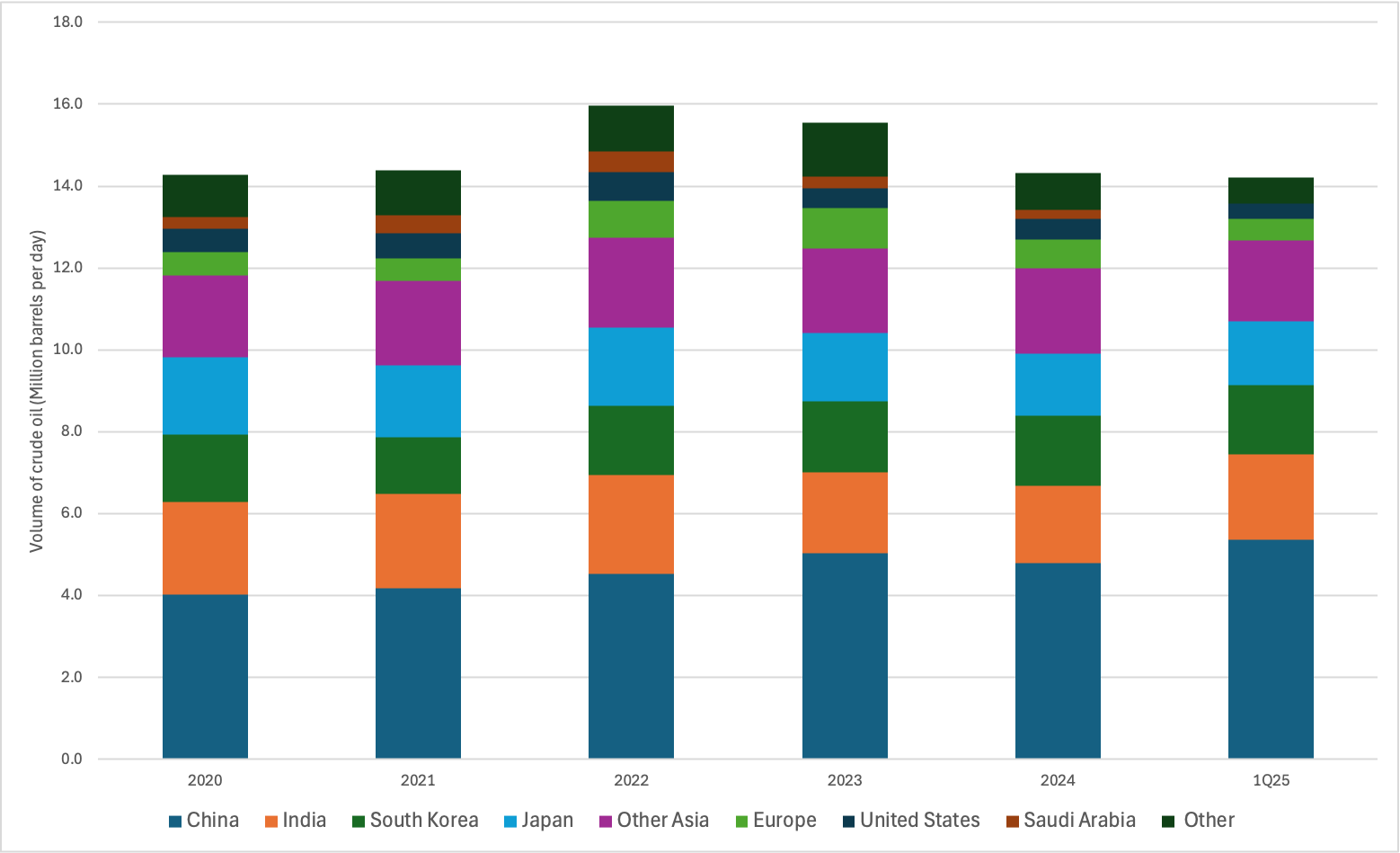
Source: U.S. Energy Information Administration (million barrels per day). Accessed on 2026-03-04.
This vulnerability matters because Asian economies are among the most import-dependent in the world. China imports roughly three-quarters of its crude oil, while Japan and South Korea import more than 90%. Strategic petroleum reserves provide temporary insulation – Japan holds roughly 250 days of reserves and South Korea around 210 – but these stockpiles are designed to smooth shocks, not replace long-term supply flows.
Once disruptions persist beyond the immediate crisis window, buyers inevitably begin searching for alternative supply routes.
From Commodity Trade to Risk Trade
For LNG trade, the naval warfare headlines matter less than the market mechanics they trigger. Once insurers and shipowners start treating certain routes as liabilities, the key question becomes not simply who has gas, but who can move it safely and at what cost.
That transmission mechanism is already visible. Reuters reports LNG spot prices and shipping rates jumped more than 40% after Qatar halted production during the conflict. Such non-linear moves signal a transition from conventional commodity trade to risk-adjusted energy trade, where insurance premiums, freight costs, and geopolitical exposure shape delivered prices.
Under normal conditions, Chinese buyers can optimize across a broad seaborne portfolio of suppliers. Under wartime conditions, that portfolio narrows considerably. Cargoes transiting high-risk lanes carry a premium, and the incentive grows to diversify toward supply perceived as safer, contractable, and politically stable.
Canada’s Pacific LNG Enters the Strategic Equation
Canada’s Pacific energy exports begin to look different in that context.
Canadian LNG exports from the Pacific coast have now begun, though the system remains in an early ramp-up phase. LNG Canada’s facility in Kitimat, BC shipped its first cargo in mid-2025 and recently marked the departure of its 50th cargo, ramping toward Phase-1 capacity of roughly 14 million tonnes per year.
Notably, the project already embeds a China connection: PetroChina is a joint-venture participant in LNG Canada.
Canadian trade data historically hints at this relationship as well. China once dominated Canada’s rather modest LNG export volumes before shifting patterns in the early 2020s. That volatility suggests that a China-Canada LNG trade channel exists but remains underdeveloped. A wartime disruption is precisely the kind of system-level shock that can cause buyers to permanently revalue route diversification.
Figure 2: Canada LNG Exports by Destination: China and Other Markets
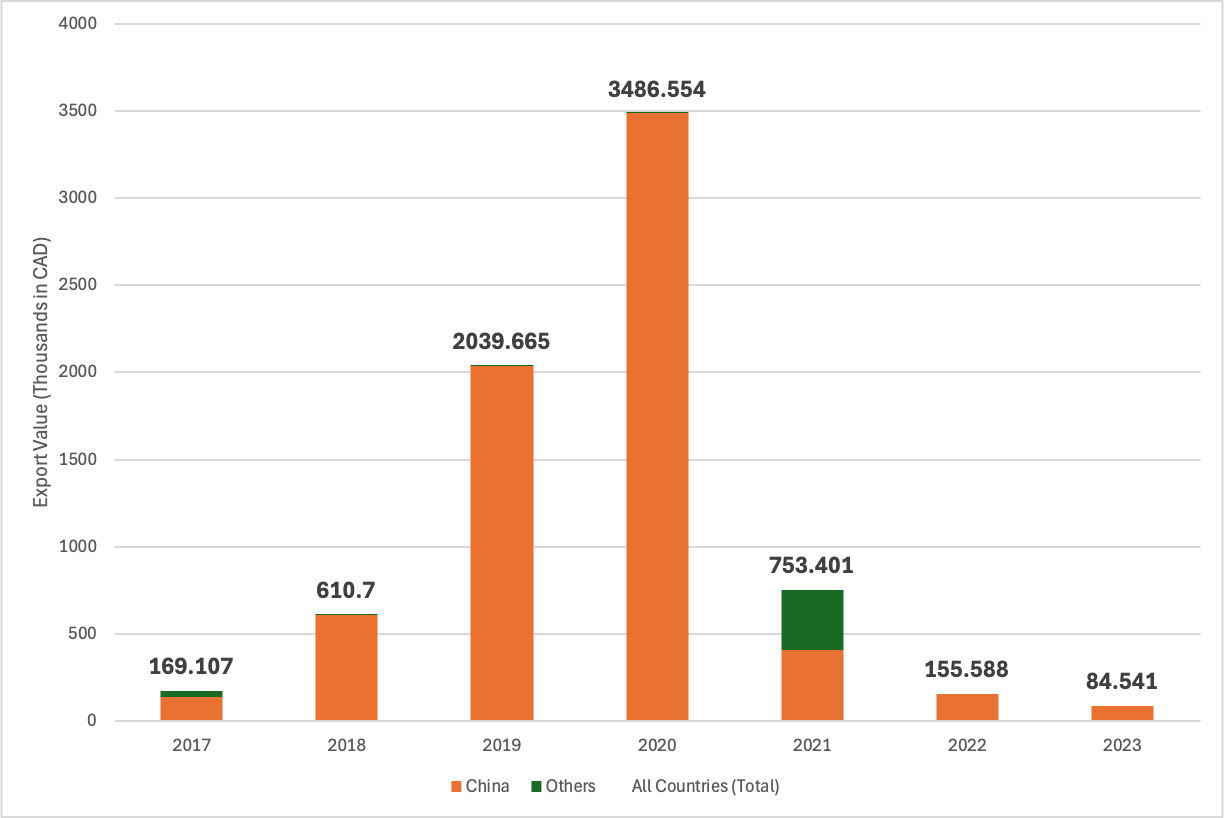
Source: Report - Trade Data Online From Statistics Canada (CAD, thousands). Accessed on 2026-03-03.
TMX and Canada’s Strategic Pacific Crude Opportunity
The implications extend beyond LNG.
Canada’s crude exports via the Trans Mountain Expansion (TMX) pipeline could also gain elevated strategic importance in an Indo-Pacific supply crunch. If Middle Eastern flows remain uncertain, Japan and South Korea may be willing to pay a premium for barrels arriving from politically stable suppliers like Canada, even if freight costs across the Pacific remain significant. This dynamic could reduce Canadian oil exports to China, as producers chase higher bids from markets with fewer supply alternatives than China typically enjoys during times of crisis.
Strategic reserves allow these countries to delay purchases temporarily, buying time to secure alternative supply contracts. Canadian heavy crude shipped from the Pacific coast could represent one such option.
China’s Energy Balancing Act
China’s role in this adjustment is complex.
On one hand, Beijing has access to Russian crude supplies delivered overland, which largely bypass maritime chokepoints and therefore serve as an immediate shock absorber during periods of shipping disruption.
On the other hand, China’s refining capacity is among the largest and most flexible in the world, and it is very costly for refineries to stay idle. This raises the possibility that China could import additional crude – including Canadian barrels – and export refined products back out to the region, effectively acting as a refining intermediary during a period of market stress.
In practice, however, the current conflict in the Middle East appears to be pushing Beijing in the opposite direction. Chinese authorities have reportedly directed major refiners to halt exports of petroleum products as the crisis unfolds, prioritizing domestic supply security over regional redistribution.
From this perspective, Russia may provide a short-term source for additional hydrocarbons in moments of acute disruption, but it is unlikely to serve as a durable foundation for China’s long-term energy strategy. As policymakers absorb the lessons of crises such as the present one and reassess supply chain resilience, countries like Canada – capable of providing stable, seaborne supply from a politically reliable partner – emerge as more attractive partners over the longer term. Indeed, this way of thinking has been given explicit policy endorsement this very week, with resource and energy security resilience language further elevated as areas for key priority and focus in the latest National Development and Reform Commission report to China’s on-going National People’s Congress.
Canada’s Pacific Energy Strategy in a Risk-Prone World
For Canada, the strategic takeaway is that Middle Eastern instability reinforces the underlying logic of Pacific-facing energy infrastructure.
Firstly, China and other Asian importers remain wary of becoming excessively dependent on Russian hydrocarbons over the medium- to long-term, even if discounted Russian shipments provide short-term relief.
Just as importantly, vulnerabilities in the global energy system extend beyond the Strait of Hormuz itself. The Strait of Malacca and the South China Sea remain among the world’s most exposed maritime chokepoints. While they are not currently theatres of kinetic conflict, their strategic fragility underscores the value of supply chains that minimize transit through vulnerable or contested waterways.
Canadian exports arriving directly across the North Pacific therefore gain even broader appeal as a function of both logistical security and geopolitical diversification. For Canada’s Pacific energy strategy, unfolding events are more of a test than a windfall – an opportunity to align diplomacy, commercial engagement, and infrastructure planning in a manner conducive to converting geopolitical risk into sustained Indo-Pacific energy trade flows. An added bonus is that such an achievement would also enhance Canada’s diplomatic relevancy and traction in the region, allowing it to advance broader regional objectives more effectively in tandem with its increased energy exports.
Author

Daniel Lincoln
Policy Research Analyst
Daniel is a graduate of the University of Alberta, holding a BA With Distinction in Political Science, Economics, and History. His main research interests include Canada-China trade, Chinese investment patterns abroad, China's role as an emerging leader of the Global South, and Canada's engagement with the Indo-Pacific region broadly.

Dr. Weisu Yu
Postdoctoral Scholar
Weisu holds a Ph.D. in Finance from the University of Alberta, and her academic interests lie in Corporate Finance and Sustainable Finance. Her current research focuses on Canada–China trade relations, the electric vehicle industries in Canada and China, and Chinese investment in Canada.