Mathematical and Statistical Sciences
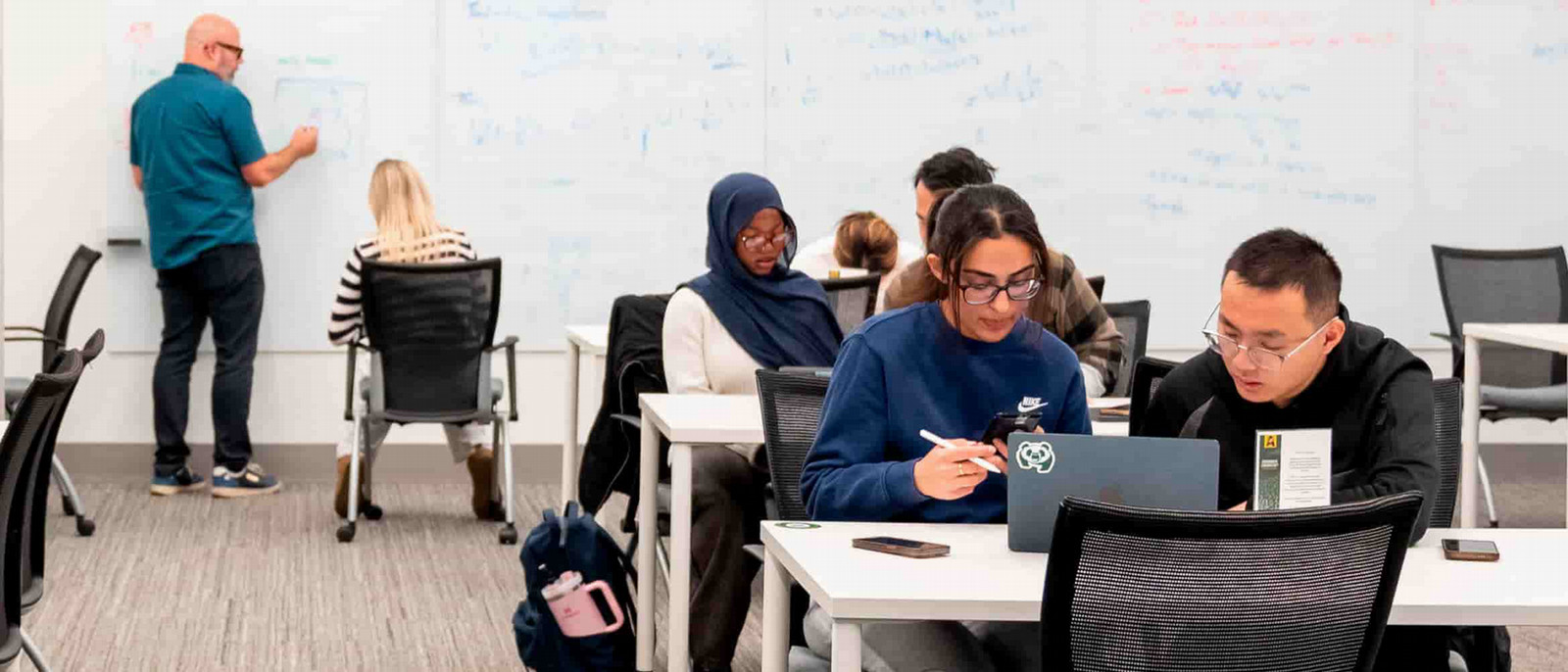

We are the Department of Mathematical and Statistical Sciences
Mathematics and statistics provide the language for patterns, data and models that shape discovery and innovation. In the Department of Mathematical and Statistical Sciences, students learn to explore structures, develop quantitative methods, reason rigorously, analyze complex data and solve problems across science, industry and society. As one of Canada’s largest mathematics and statistics departments, we offer a broad range of undergraduate and graduate programs across pure mathematics, applied mathematics and statistics. Our faculty and students pursue internationally recognized research in a collaborative environment where curiosity, creativity and rigorous thinking thrive.
Academic Programs
Undergraduate Studies
Explore undergraduate programs in mathematics, statistics and their applications. Our Honors, Major and Minor programs provide strong foundations in rigorous reasoning, modelling, computation and data analysis, with pathways to graduate study, professional programs and quantitative careers.
Graduate Programs
Our graduate programs prepare students for advanced study, research and professional work in mathematics, statistics, data science and related fields. Students can pursue the professionally-oriented course-based Master’s Program in Modelling, Data and Predictions (MDP) or our research-focused thesis-based master’s or doctoral programs. The Embedded Certificate in Data Science allows eligible students to strengthen their skills in data analysis.
Winter 2027
MATH 499 - Research Project
This course provides students in Major, Specialization and Honors programs an opportunity to pursue research in mathematics under the direction of a member of the Department. Course requirements include at least one oral presentation and a written final report.
Highlights
Research Impact
The department spans pure mathematics, applied mathematics and statistics, advancing fundamental theory and driving discovery in AI, health, finance, biology, cryptography, abstract mathematics, machine learning and scientific computation.
Data Science Education
Our new undergraduate data science programs build on strengths in mathematics, statistics and computing to prepare students for data-driven careers and graduate study.
Community Engagement
Through outreach programs, student events and connections with professional communities, we help students see how mathematics and statistics matter beyond the classroom.


Message from the chair
Welcome to the Department of Mathematical and Statistical Sciences!
As mathematicians, we tell stories. Stories about patterns, numbers, shapes, data and symmetries. We observe the world and try to model it, we think about how various patterns can be elegantly unified in a single abstract structure and we extract deep meaning from complex data. We are free to roam in the world of ideas, only bound by the limits of the mathematical language, which is constantly evolving. As Cantor once said: “The essence of mathematics lies entirely in its freedom.”
Mathematical stories are everywhere. But stories are told within a community. Whether it is for a single course or a sequence of courses, a full undergraduate or graduate program, or a research initiative, we invite you to be part of our community and share your own mathematical story!
Come visit us and see for yourself what the beauty of math and stats is all about!
Vincent Bouchard
Professor and Interim Chair
Statement on Access, Community and Belonging
The Department of Mathematical and Statistical Sciences is deeply committed to creating a welcoming, supportive and inclusive environment in which all members of our community can thrive. Through teaching, research, mentoring and outreach, we work to broaden participation in mathematics and statistics and to support a culture of access, community and belonging.
Science Talks: Can Influenza forecasts be more reliable than weather forecasts?
In the Science Talks webinar series, Department of Mathematical and Statistical Sciences researchers Marie Betsy Varughese and Michael Li share how modelling can be used to understand and plan for the spread of respiratory viral infections, helping manage the burden on Alberta hospitals.
Giving
Leave a Legacy
Your donation supports new learning opportunities and experiences for students, funds research and builds spaces for innovation and education.