Researcher wins prestigious grant, uncovers fundamental biology that could help treat pregnancy complications
13 March 2026
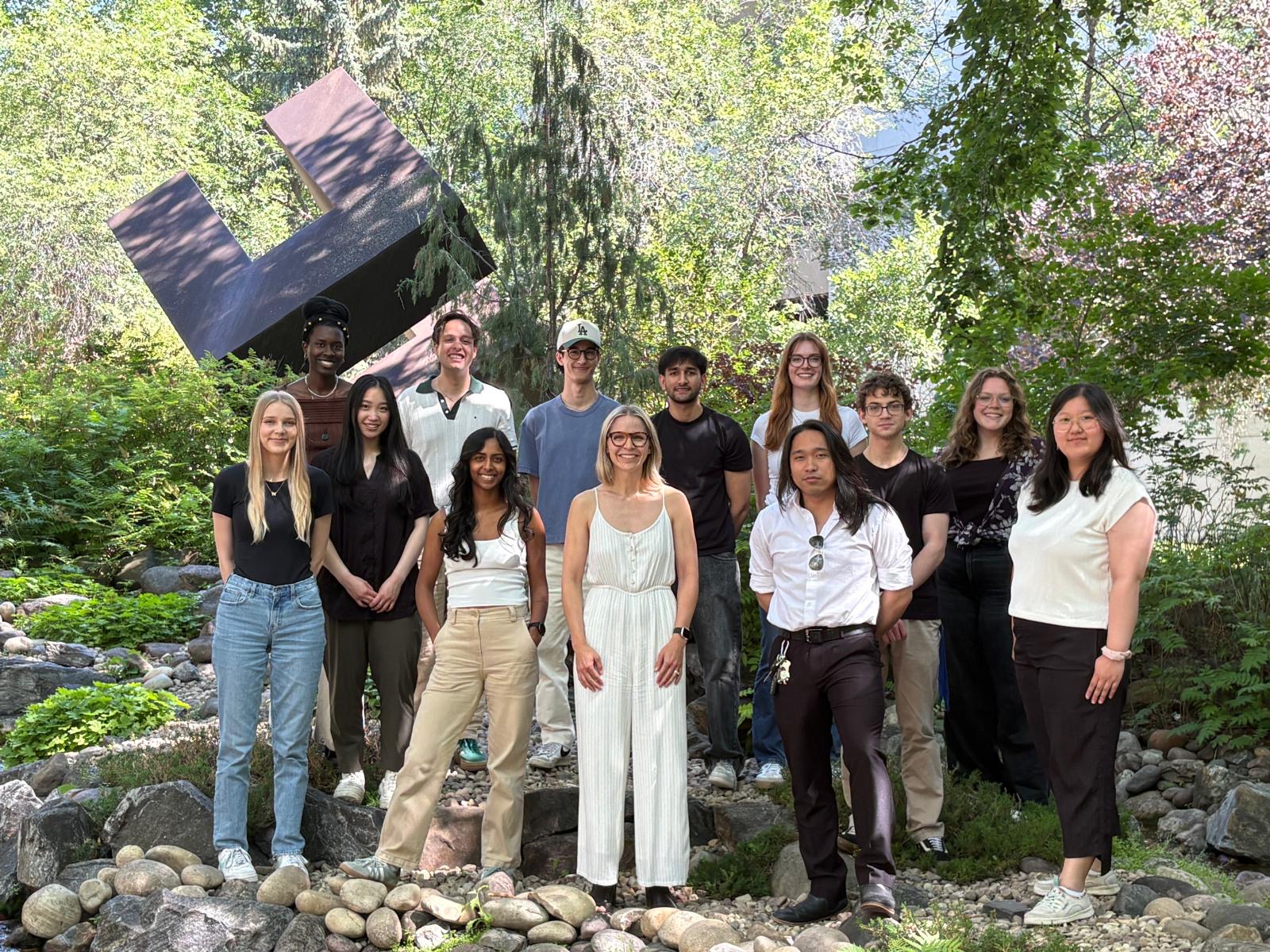
Meghan Riddell (front, centre) and her laboratory team
An unexpected lab discovery earned Meghan Riddell, associate professor in the Faculty of Medicine & Dentistry, and her team a prestigious grant, leading to more research and revelations about the placenta — a historically understudied organ.
“There’s a specialized cell in the placenta, called the syncytiotrophoblast, that forms the maternal-fetal interface, creating the primary barrier between maternal blood and fetal tissue,” says Riddell, a member of the Women and Children's Health Research Institute. Her research — funded by the four-year Burroughs Wellcome Fund Next Gen Pregnancy Initiative — examines how syncytiotrophoblast cells die and how their death may be contributing to placental inflammation during pregnancy.
“The type of death that we discovered is occurring in this highly specialized cell causes inflammation; and at the same time, it can also be caused by inflammation,” she says. “It’s like a snowball running down a hill.”
Even though the placenta has the same DNA as other organs, it’s structurally unparalleled and, quite literally, incomparable to other tissues in the human body. For example, when forming an outer layer, like our skin, our cells are “lined up like nice little soldiers to create a barrier,” explains Riddell. But the placenta’s barrier, rather than having many different little soldiers, is just “one gigantic cell.” Eventually, the singular syncytiotrophoblast cell covers a surface area that, in any other human tissue, would normally include millions of cells — making the way that the syncytiotrophoblast functions and forms different than all other cell types.
In their first year of funding, Riddell and her team unexpectedly discovered that this placental tissue acts very differently over time, “so much so that it can seem like completely different tissues,” she says.
The team believes these discoveries of fundamental biology, along with learning more about what controls placental inflammation, can help them uncover what underpins the development of pregnancy complications such as preeclampsia and intrauterine growth restriction, and identify ways to treat placental inflammation due to infection by pathogens like Zika virus.
“You can't treat a pregnancy unless you actually know what's happening,” says Riddell, who is also a Tier 2 Canada Research Chair in Maternal-Fetal Interface Biology in Health and Disease. “We're really good at treating hearts, and we're getting better at treating brains, because we know all the cells that exist, when they develop, and what goes wrong. In human pregnancy, we're only just starting to understand that. And that's why this funding is really important.”
Now heading into the second year of the funding, Riddell and her lab will look deeper into the intricacies of syncytiotrophoblast death and the relationship between Zika virus exposure in early pregnancy and the inflammatory pathway, and how they may relate to congenital Zika syndrome causing developmental abnormalities. “We’re excited to see where some of our unexpected preliminary data takes us,” adds Riddell.
Riddell received the highly competitive Burroughs Wellcome Fund grant in 2024. She chalks up some of her application success to expanding access to pregnancy research to experts in other disciplines, including the Faculty of Medicine & Dentistry's Tom Hobman, professor in cell biology and an expert in virology, and Olivier Julien, associate professor in biochemistry.
“What we are discovering is fundamental human biology. Getting to learn about an organ that is so different is extremely motivating,” says Riddell.