The Northern Alberta Medical Program at one year
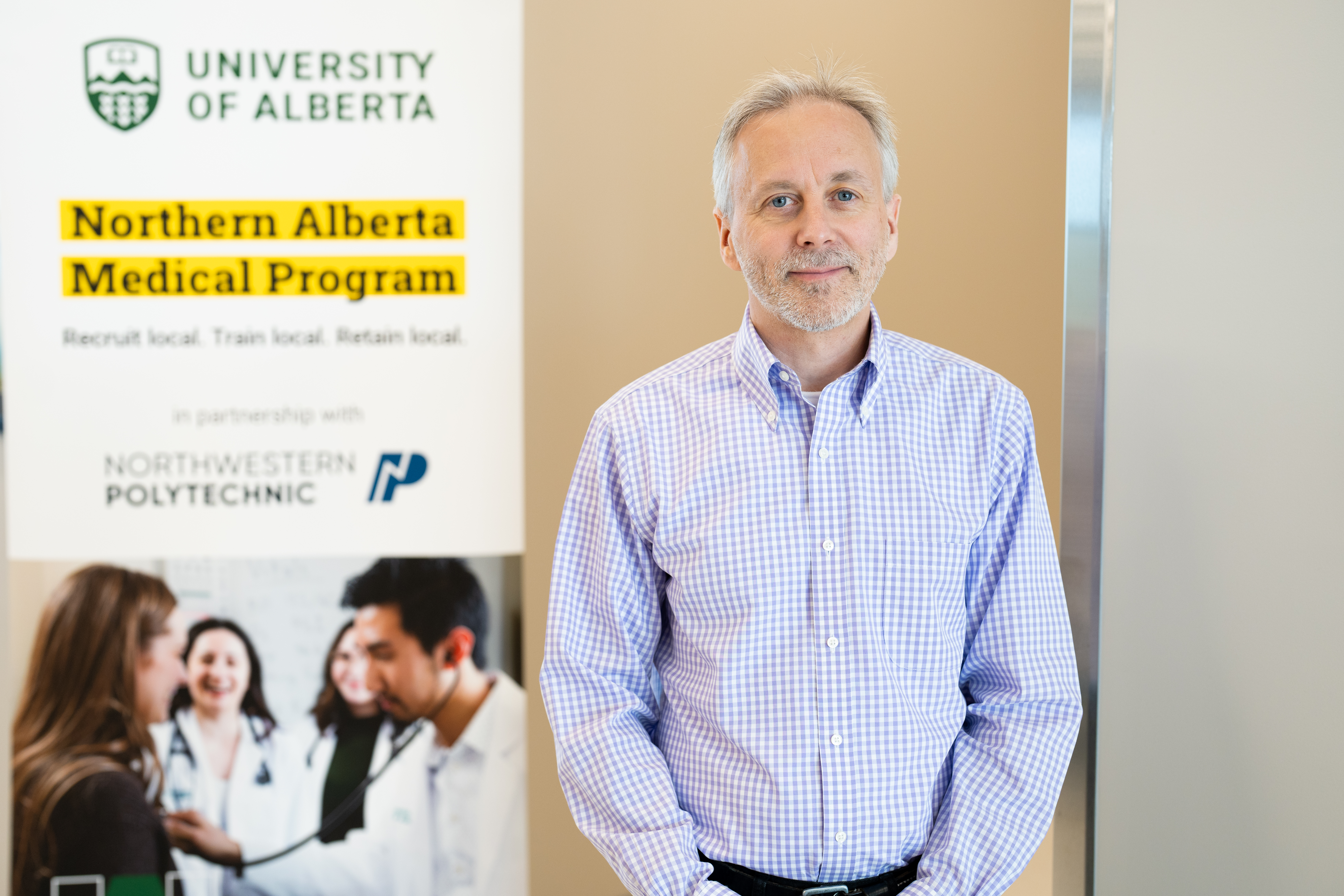
Dr. Richard Martin, assistant dean of the Northern Alberta Medical Program.
The assistant dean at the University of Alberta’s Northern Alberta Medical Program (NAMP) in Grande Prairie, Richard Martin was a city boy from Edmonton who fell in love with small-town life after two weeks in Whitecourt during his medical residency back in the 1990s. He’s been a practising family physician in northern Alberta ever since — and his passion for rural and remote health care made him the perfect choice to help lead the NAMP through its first full year.
Martin is the first to admit that his path as a physician from big city to small town is the exception to the rule. Most would-be doctors who come from large urban centres tend to be drawn to practise in similar environments, a situation that, over the decades, has contributed to the shortage of health professionals in rural and remote regions across Canada. The solution is simple, says Martin: Provide embedded training within those regions and more future doctors will stay and build their lives and practices there. With the knowledge that students coming from smaller places are twice as likely to return there to practice, and the ever-increasing number of rural and regional applicants to the medical program in Edmonton steadily climbing over the years, the idea of a regional training site outside of the city made perfect sense.
Thus was born the NAMP, funded by the provincial government as part of a concerted strategy to develop collaborative regional medical training sites outside of metropolitan centres. (The University of Calgary, as of July 2026, also offers a full medical degree out of the University of Lethbridge to serve southern communities.) The NAMP offers a complete medical degree from the University of Alberta in northern and central Alberta — two years of classroom instruction hosted at Grande Prairie’s Northwestern Polytechnic campus followed by two years of clinical placements across rural and regional communities from Innisfail to High Level.
As the first cohort of 30 students prepare to enter their second year, Martin looks back at one year of the NAMP.
What do you remember about those very early days, building the NAMP from the ground up?
It has been a collective effort by the entire Faculty of Medicine & Dentistry with the work really beginning in earnest the summer of 2024 when Holly Handfield came on as project manager for the expansion. That summer, together with Dr. Darryl Rolfson (associate dean, MD program), we drove nearly 20,000 kilometres across northern Alberta, engaging with physicians and communities, as well as in Ontario and B.C. to observe existing regional medical campuses. This included the University of British Columbia’s Northern Medical Program in Prince George, the longest-running in Canada.
What was the overarching vision for this program, and how has the reality lived up to that vision?
Together, we wanted to build off the solid foundation that exists in Edmonton, thanks to the strong undergraduate medical education team already in place.
We felt strongly that we needed to go about this project not simply from the lens of being able to deliver curriculum to students, but how do we create the culture of a campus? How do we embed the campus within a community? I think being able to connect learners to communities is where success ultimately lies.
One of the solid successes of our team has been in helping to create the culture of community integration and support, and helping students feel like this is their home. The curriculum remains essentially the same, but how we go about providing that education, how the students are connected to patients, mentors, the community, how they see themselves within the community — that really varies with the location. The context here — especially the small cohort of 30 — allows us to craft an experience that is distinctly different, and in which the students see themselves as one unified group.
How have you tackled the challenges that came with launching?
There are of course many challenges involved with building a new program in a different location — especially when you do it in only 16 months, like we did. The biggest challenge was shifting the U of A’s traditional approach, to adapt to offering one program in two distinct spaces. Thankfully, we have been able to draw on the knowledge and experience of many other institutions not just in Canada but around the world, which has helped us steer clear of problems and, in a way, supercharged our success.
The shared vision, flexibility, openness and creative spirit of our entire team — from Dr. Verna Yiu (the U of A’s provost and vice-president, academic) and Dr. Brenda Hemmelgarn (dean of the Faculty of Medicine & Dentistry) to the mayor of Grande Prairie to a team of local administrators that I think could run just about anything! — have also allowed us to overcome any concerns.
What have you heard from students and instructors about their experiences with NAMP?
In that first cohort, two-thirds came from a non-metropolitan background — and this fall, nearly three-quarters will be. We’ve heard from them that the strongest factors that drew them to this regional program were the location and the size of the cohort. One of the risks from a regional campus is that students might feel disadvantaged because they’re not part of the original cohort. But we’ve been told we’ve created an incredibly healthy, supportive and encouraging space for them. The instructors say they feel the same thing — that being connected to teaching in new ways, in these small, intimate settings, is energizing and fulfilling.
What does it mean to you to be part of this unique program?
I believe people working in the health system can see the needs of the system no matter where they work, but the smaller the community the harder it is to ignore those gaps. Working in Whitecourt and Grande Prairie we could immediately see where help was needed and would work to support each other. Unfortunately, that means that everyone feels those stresses — and the recognition of the intense needs of the health system is definitely a powerful driver for me to help be involved in system change like the targeted approach of this program toward improving the future of health care.
What are your hopes for the future of the NAMP?
Our ultimate goal is to make sure everything we’re doing is focused on the health needs of all Albertans. We want to go forward in the hope that by connecting students to these communities, we will continue to show our students the benefits and excitement of career choices they may not have thought of without a program like this.
It’s also possible to imagine a future state where the U of A is able to host medical student campuses in many more communities — perhaps even further north into the Territories.
There are so many potential opportunities for positive change, thanks to the foundation of healthy relationships we already have — the heart of our success.