Convocation 2025: Roberta Alook
Donna McKinnon - 14 November 2025

While resilience comes naturally to some, for most — including Roberta Alook — it is a quality forged in struggle and adversity. Faced with profound challenges, most notably the devastating death of her beloved mother, it took immense strength for Roberta to not only to pursue, but to successfully complete, her combined bachelor degree in Native Studies and Secondary Education.
Resilience is her defining characteristic, but she is the first to admit she did not do it alone.
Roberta’s capacity to find, create and build community also stands out as a core quality that has distinguished her personal and academic journey. When she was struggling, she leaned on her instructors in the faculty, sought companionship at First Peoples’ House and reached out to her sober and community connections when she needed additional support.
One way or another, it was always reciprocated. As a Cree language major, she signed up as a tutor and became an Indigenous cultural arts facilitator, bringing what she had learned in her classes, like traditional beading, to communities in and around Edmonton. She also made time to volunteer with various U of A initiatives and events, such as Orange Shirt Day, the Transition Year Program for First Nations, Metis and Inuit students (where she had begun her studies) and Week of Welcome, primarily as a public speaker.
Roberta’s efforts paid off. She excelled in her program, and is now working full-time as a Cree language instructor with Amiskwaciy Academy. She even has a 10-year plan to build resources for Cree language secondary teachers across Alberta.
“The education system once sought to take my language away, and although my first language is English, the healing spirit of my language still lives, and always will.”
Congratulations Roberta!
What led you to choose this area of study, and why the U of A?
I chose to apply to the U of A due to location and, at first, I wasn’t sure what I wanted to study or what type of degree I wanted to pursue. I grew up in Prince Albert, Saskatchewan, and hastily moved to Edmonton with my late mom and siblings in 2017. In a way, we were fleeing a life of poverty and addictions. I personally struggled with addictions, mental health and living in homeless shelters or on the streets in my adolescent years. My family didn’t have any plans lined up as to what we were going to do in Edmonton — we simply abandoned ship and ended up living in a motel with a duct-taped car.
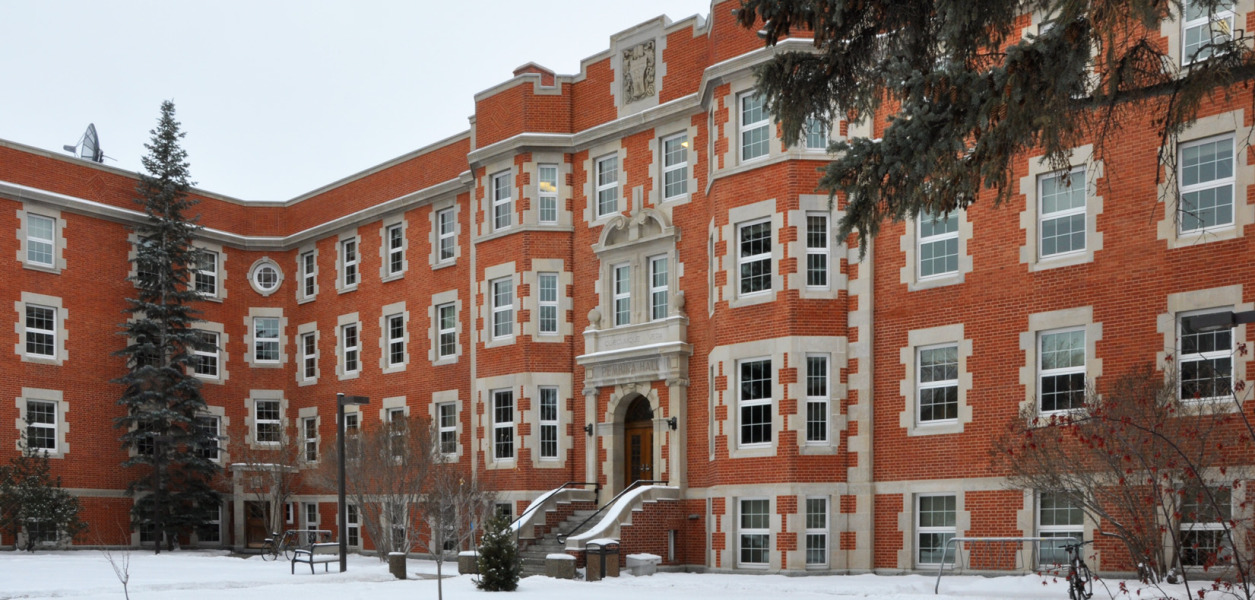
After getting sober and completing a women’s program at the Bent Arrow Traditional Healing Society, I got my first job and decided I should try to apply for university just for something to do. So, by myself, I went to the U of A to the first building I saw — which happened to be undergraduate student services. I told the receptionist that I wanted to come to school here but wasn’t sure how or what I needed to do. I was sent straight to the Faculty of Native Studies which was in Pembina Hall, just behind the building. I often giggle when I think back to that day and bitterly grateful they directed me there.
I met with a lovely student advisor whose name I’ve since forgotten. She was Native and spent an hour or so with me just talking. By the end of it, she had heard a little bit about who I was and where I came from, and she told me exactly what to do and which program I should take — the Transition Year Program for First Nations, Metis and Inuit students (TYP). She looked at my transcripts and said that I would excel in a Native studies program, so that’s what I chose.
After my first year, the advisors for the TYP program, the faculty and my Cree professor told me that I should make the Cree language my major and change my degree to a combined degree in Native Studies and Secondary Education. This was due, they told me, to my high grades in the Cree language and finishing that year with a 3.8 GPA. They saw potential in me and I trusted their advice. Now I find myself grateful that things turned out the way they did.
Tell us about your favourite professor and/or class.
While obtaining a combined degree in a five-year program, I’ve had the opportunity to sit in a large number of different courses specific to my major in the Cree language, a minor in art and a specialty in secondary education. In retrospect, I can narrow down my top favourite courses to two of them.
In my first year, I immensely enjoyed English 125 for Indigenous Literatures with Brittany Johnson (now an assistant professor at MacEwan) and I got an A+. The reason this course stood out for me is because she dedicated a week of class to teach us how to bead. It was a little unconventional for a university level course but so is Indigenous learning. This opened my eyes to the holistic aspect of education. Sure, we can read, discuss and sit in class, but Indigenous learning also requires building community and, most times, actually doing something with our hands. It was the first time I tried beading, and because of that class I continued beading, crafting, sewing and hide-working. Eventually I became a well-known professional Indigenous cultural arts facilitator in Edmonton and area. This led to working with all ages from grade three to Aboriginal Seniors of Edmonton while I was still in university.
Another course I really loved was NS 440 - Indigenous Treaties and Agreements with Matthew Wildcat, where I got an A. I took NS 440 during my fifth year, and this course really opened my eyes to the history of treaties, sparking my belief in the importance of Indigenous languages and interpretation. Furthermore, it gave a real academic feel because each class was a discussion. I felt truly scholarly and slammed out the best term paper of my academic career — a paper that professor Wildcat has asked to use as a sample for future students and deemed worthy of submitting to a journal.
Did you take on any leadership or volunteer roles while you were a student? If so, please share your experiences.
After my second year in university, I signed up as a tutor through First Peoples’ House for students in NS 152 - Introductory Cree. By this time, I had built my own organized system and personal textbook for content learned in NS 152 and NS 252 - Intermediate Cree. I was only able to tutor one student but it was so inspiring for me. Through this experience, I saw my ability to organize information in an easy to digest way, drawing on a student’s prior knowledge to attain a second language. I was also incredibly enthusiastic and have been trying ever since to share with others the healing spirit of nēhiyawēwin. Since then, I knew I was on the right track to becoming a Cree language teacher. Aside from tutoring, I also had the opportunity to be interviewed and do some public speaking at the U of A on behalf of Orange Shirt Day, the TYP program and Week of Welcome on the topic of sobriety. Just google my name, and you will find some of my publications there (lol)!
Did you face any significant challenges while you were a student, and if so, how did you respond?
While I was in a five-year program, which took me seven years to complete, I faced the most difficult challenge in my life at the age of 25. At that time, I had just completed my fourth year in university and it was the summer of 2022. Even now, as I write this, I still cry. In November of 2021, my mom was placed into palliative care. She could still talk, walk and do her normal day to day life. It wasn’t until May that she was moved into the hospital then into a real palliative care facility in Edmonton. I knew this time would come. My mom had been diagnosed with stage 4 breast cancer during my first year in university. It was a shock and a devastating blow to my ambition to continue. I honestly don’t know to this day how I kept on putting one foot in front of the other. I was just beginning my life and the idea of my beautiful mom, the only parent I ever knew, passing away felt crushing to my spirit.
I was fortunate enough to have a good sober community around me and I also informed my advisors in the TYP program, my faculty, and my Band, who were funding my education. I told them that if my mom passed away, I might just fall apart and would need assurances in place. Thankfully, my mom did pull through and started treatment at the Cross Cancer Institute. So, for my first couple of years in university, I’d go to class on campus then walk over to the institute to visit my mom. The commute wasn’t far, just a few blocks apart. During those days, my mom was so positive and encouraging. She was a strong believer in God and was always praying. Even in the face of death, my mom was a rock against the waves. She wouldn’t budge, she never showed any fear or broke down crying. She’d joke with the nurses and talk seriously about life, all while proudly displaying me before all her doctors, nurses, her new friends and our family. One time the nurse asked how she was doing after her first chemo therapy, my mom said “It scared all the hair out of me” and we all started laughing. She was so fearless and funny. She was truly my anchor and I just kept moving forward because of her, and that continues to be true. We had already been through so much in life as Native people and I wanted to make her proud and be as strong as her.
As my mom battled breast cancer, she went through remission several times until she was diagnosed with brain cancer right after the passing of her older sister, my aunty Emelia, with whom she was very close. They’d both gone to residential school together, both been sick together, always visiting each other, and so it was really sad for my mom. After that, I watched her deteriorate. She was skinnier, more hollow. She had no hair and no teeth. I used to hold her and tell her she was my baby, then we’d both giggle. Whenever we said “I love you,” we’d always say “I love you too much.” In the end, while my mom was in palliative care I would sit next to her, holding her hand. I slept over many times and was always singing her favourite gospel songs and some new ceremonial songs I had learned at the sweat lodges.
On the last night she was conscious, my mom started to cry and was trying to raise her hands high. She was talking to God and I grabbed her hands so she knew I was there, because she couldn't open her eyes anymore. I said “mom, I’m here, let’s pray” and asked what she wanted to pray for, and she said “my kids… Amy.” Amy is my older sister who was homeless at the time (now she is two years sober and has her own house). So I prayed for her and she started to calm down and fall back asleep. The next morning was the last time she spoke and I was the last person she spoke to. She wasn’t making much sense, but then she said to me, “everything is going to be okay”. After that, she went completely unconscious. Me, my aunty Sarah, my brother Byron and my nephew Austin were all in the room during her last hours. We stayed up all night and slowly everyone started to fall asleep. I was the last one awake and so I crawled in bed with her at 7 a.m. and put my arm around her. She passed away in my arms at around 7:30 or 8 in the morning of June 27, 2022.
My mom passed away knowing I was okay, sober and in school. She knew what I’d become, and that's the greatest gift I could give her. I never let any of this stop me because I love my mom and I love who we are as strong Native people, even in the face of death. I think that’s the greatest thing my mom taught me. After this, everyone was informed and First Peoples’ House at the U of A gave me emergency funding to help pay for my mom’s rent and also funeral costs. She was then brought home to Dillon, SK, and buried in Michel Village, SK, in a beautiful graveyard on the beach overlooking the lake.
When I went back to school, my professors helped me to adjust my program. Sometimes I needed extensions, and sometimes I didn’t try my best but I still passed my classes. Sometimes, the grief would hit me and I needed to cry. One time, it was too big to contain and the Elder in residence at First Peoples’ House, Elsie, was there with me. She held me as I cried uncontrollably and even cried with me. She’s been in my life ever since, and she visits me at my new job as a teacher at Amiskwaciy Academy. Throughout university, I’ve gone to smudge at First Peoples’ House. Instead of letting the loss crumple me, I used the grief and wisdom that comes with loss to inspire my papers. After all, true wisdom doesn’t always come from school but rather, from life’s challenges.
What advice do you have for current or future students?
Some tips I wish I knew going in: if you can, don’t take a part time job, join a club, exercise and hit up all the events while being a full-time student. You just don’t have the time. If you take on too much, you WILL burn out — trust me, I’ve seen it time and time again with first- and second-year students. University demands independence and self-discipline and your time is going to be spent not only going to class during the week, but reading materials prior to class for discussions and doing your assignments which, most times, requires a lot of research. Aside from school, you might only have time for one or two shifts at a part-time job per week aside from sleeping, preparing food, eating and definitely relaxing. Also, sorry to say but if you love reading fictional roman-tasy books like me, university is going to suck the life out of reading for fun. It's best just to pick a TV show and zombie-it-out on the couch in your down time.
Really immerse yourself into university life — you are a scholar now and each course is an opportunity for wonder, debate, criticism and inspiration. Read your syllabus for each course at the beginning of classes and mark important due dates in your calendar in RED. Create a daily routine for yourself during week days and inform your family and friends of the important self-work you are doing. Put one foot in front of the other and, seriously, make some university friends and complain together — it’s fun. Also, if you are ever going through something in your outside life, please reach out to all the wonderful support in place at the U of A. They get a lot of money to help you and even entertain you, so take advantage of it. Lastly, if you have to, just change your degree if you’re not happy.
How do you plan on celebrating convocation?
Since my mom passed away three and a half years ago, and my father passed away when I was 14 years old, I’ve been “orphaned.” I came to realize this more and more after the first year of my mom’s passing came around. But, for some reason, the Creator has always been watching out for me — so it seems. Over the summer of 2025, I was ceremonially adopted by Trevor Gladue and his wife Felice Gladue. Both have known me for eight years and were there for me when my mom passed away — even going as far as being there for my sister Amy, my nephew Austin (who’s in my care) and my little brother Byron. I’ve been helping at their lodge for many years and have always considered them as my ceremony family. They surprised me with the offer to officially adopt me in the Native way and since then, have supported me, visited me at my new job, helped me fix my car and celebrated the holidays with me.
My adoptive parents want to host a celebration for me with our lodge family after I walk the stage. They’ve planned a sweatlodge to follow so I can share the moment with my late parents and I assume there will be a feast and speeches all out of town on their property. If it weren’t for them, I would have just gone to Earl’s or cried alone for my mom — I didn’t want to create something for others to celebrate me. My new mom now, Felice, told me not to worry about anything — basically to just show up and be celebrated. I’m happy, especially because I never celebrated or even walked the stage for my adult high school diploma. This time it will be different. I not only get to celebrate attaining a combined Bachelor of Arts in Native Studies and Bachelor of Education degree, but also the fact that I am graduating with Distinction.
What's next after graduation?
Now that I’ve completed all of my courses and even before I walked the stage for my parchment, I am already a full-time Cree language teacher at Amiskwaciy Academy. When I finished the last of my courses, I had six offers for different schools — it seems everyone wants a Cree language teacher, which is amazing! I had my interview over the summer and was told by the hiring team of Edmonton Public Schools that it is an honour to have me be a part of their division. And truly, it’s an honour for me as well. My nephew, who I take care of full-time, goes to Amiskwaciy Academy. So, this school is perfect for me and for my kid too, since it is very culturally immersive which is my area of expertise. Right now, I have 167 students from junior high to high school.
It is only my first year as a teacher but I already have a 10-year goal — I want to continue teaching the language and, during my summers, work with the Institute for Innovation in Second Language Education (IISLE) to build resources for Cree language secondary teachers in Alberta. I want to be a go-to person for Cree language resources, implementation, strategies and acquisition. One day, and I know I will do it, I want to be able to think in my Cree language. I want to do this so that I can prove to my students and educators that although the education system once sought to take my language away, and although my first language is English, I grew up Native, and had a rough beginning — the healing spirit of my language still lives, and always will.