The Architecture of Collaboration
30 April 2026
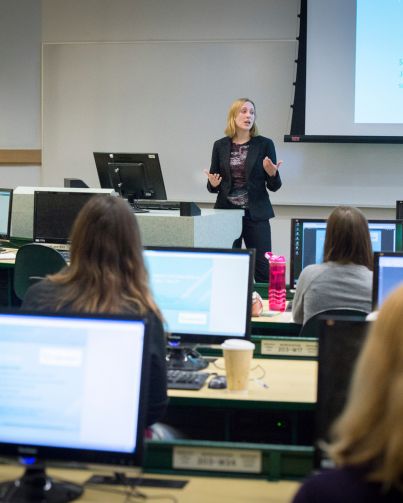
The College of Social Sciences and Humanities (CSSH), in alignment with the Centre for Teaching and Learning, has launched Teaching Squares, a program designed to enhance teaching development, strengthen mentorship and build inter-faculty connections across the college.
Focused on structured peer engagement and shared professional development, the initiative brings together small groups of instructors from various disciplines to share teaching strategies and insights, harnessing our diverse strengths to foster a collaborative and supportive learning community. Participants meet at least twice in a session and visit each other’s classrooms to observe and reflect on different pedagogical approaches.
“When I started in this role about three years ago, I spent several months talking to academic leaders and faculty members throughout the college, trying to understand how the college could be imagined,” says Dr. Helen Vallianatos, associate dean, education, for CSSH. “One of the things that I heard was a desire to learn from one another, to recognize the teaching excellence that exists throughout our college, and to have an opportunity to connect and learn from each other in ways that weren’t already happening.”
Through these conversations, she learned about Teaching Squares — an initiative championed by Dr. Anne McIntosh, associate dean, undergraduate at Augustana Campus, which had already seen many years of success. In collaboration with McIntosh, Vallianatos, along with Dr. Michelle Inness, associate dean in the Alberta School of Business, and Vanessa Grabia, director, Office of Education, tailored the program to meet the needs of the college, and the pilot was officially launched in Fall 2025.
While each point on the Square represents one of the four faculties, it is more than just a symbol, notes Vallianatos, explaining that it embodies an ongoing commitment to teaching excellence and the reciprocal flow of ideas across the college. In the context of evolving student demographics and the integration of AI in education, she adds, the need for community building and continuous pedagogical improvement is crucial.
“In the spirit of the One University model, we were very conscious of not reproducing anything already being done by the Centre for Teaching and Learning (CTL) or other faculties,” she says, noting that while participation is recognized in year-end evaluations, all discussions and feedback remain confidential among participants.
Vallianatos says one of the benefits of academics learning from their peers outside of their own disciplines is that it has the potential to spark an unexpected perspective or ‘fresh eyes’ on a pedagogical practice. She cites the example of a drama professor and a business professor discovering common ground in performance and storytelling. This exchange allowed them to reframe their instructional methods, proving that diverse disciplines often share the same core objectives when viewed through a new lens.
“We already have great teachers throughout our college,” says Valliantos. “And for those who see teaching excellence as an ongoing learning process, Teaching Squares fits within that philosophy. As instructors, we are also students and that learning never ends.” The response to the pilot project, she says, has been very positive from participants across all career stages.
A Fresh Perspective
Dr. Brian Rempel, an Augustana-based associate chemistry professor, is one of Teaching Squares’ most dedicated advocates. A repeat participant, he underscores his commitment to pedagogical growth with his long-standing involvement and passion for the program.
“I think it’s a really cool initiative,” he says, with palpable enthusiasm. “It’s a chance to go into a classroom and watch a colleague do what they do best, and then figure out how it can be adapted in my own classroom. You may not realize that some of the most interesting pedagogy is happening right next door.”
Rempel says that observing a discipline outside of one’s expertise provides a unique advantage: it detaches the observer from the 'what' of the lesson so they can focus entirely on the 'how.'
As a chemist, he found value in observing humanities and social sciences classes where, unburdened by subject matter expertise, he was able to step back and consider the teaching process itself. This fresh perspective led Rempel to implement active learning into his classrooms after observing students in these classrooms talking and engaging with the subject matter once rhetorical lecturing was replaced by structured discussions.
“It sparked me to introduce new, though modified, pedagogies into my own STEM classrooms, and I don’t think I ever would have moved beyond ‘sage on the stage’ without that experience.”
Once the observations are complete, participants meet up to trade insights and provide feedback. It’s a chance to shout out the clever techniques they loved and brainstorm a few ways to make their teaching even better. As Valliantos acknowledges, there are even opportunities for participants to imagine future research collaborations.
“It’s a structured opportunity for reflection and that’s what I love about it,” says Rempel. “It’s really hard to say, I'm going to sit down with my colleagues and we're going to talk about what’s working in our classrooms. But, with Teaching Squares, you actually do sit down over a cup of coffee, you slow down and talk about what works really well in our classrooms and what makes a good teacher. That opportunity for reflection is something we don't get enough of.”
“All of us feel time constraints, but our participants see it as a very valuable thing,” says Valliantos. “It will take time, and like Augustana, we hope to see people signing up over and over again, coming back in a different year to work on something else. We have an opportunity to assess the program and the needs of our participants to see what’s working and what can be improved upon, so hopefully, three years from now, it will be even better!”
Interested in participating?
The next cohort of Teaching Squares will be matched for courses in Fall 2026, with initial meetings taking place in August 2026. To receive more information or to sign up, please visit Teaching Squares.