Feminist Research Speaker Series

Talk Title: Community at Play. Re-imagining Social Structures in Tabletop Role-Playing Games
Speaker: Dr. Brigitte Rath, Professor of Comparative Literature at the University of Innsbruck (Austria)
Date: Wednesday, September 9, 5:00 - 7:00 PM
Location: Assiniboia Hall 3-30
Sponsors: Gender Studies in Digital Culture (GSDC-Joint Collaboration Between Gender and Social Justice and Digital Humanities) & Feminist Research Speaker Series (FRSS)-Department of Women and Gender Studies
Talk Description: Providing a frame for collaborative storytelling, tabletop role-playing game systems (like Dungeons & Dragons or Monsterhearts) influence both the kinds of stories, characters, and worlds which players invent and the ways players relate to each other around the table. The talk will focus on how tabletop role-playing games may encourage players to explore alternatives to, for example, gender systems, and why experiencing these alternatives in an imagined world may impact the real one.

Talk Title: The Right to Arm Bears: Animal Revenge and the Commodification of Misanthropy
Speaker: Dr. Emelia Quinn, Assistant Professor of English at the University of Ottawa
Date: Thursday, September 17, 4:00 - 5:15 PM - Reception to Follow
Location: UCOMM - 1-480
Talk Description: This presentation reflects on the intersections between misanthropy, camp aesthetics, and the contemporary popularity of animal revenge narratives via the revolutionary beavers to be found across the work of queer Indigenous artist Kent Monkman.
Bio: Emelia Quinn is Assistant Professor of English at the University of Ottawa. Her research is situated within the field of vegan theory and its intersections with animal studies, ecocriticism, and queer theory. Her monograph, Reading Veganism: The Monstrous Vegan, 1818 to Present (Oxford University Press, 2021), which won the 2022 Amsterdam School for Cultural Analysis Book Prize, focuses on the iteration of a trope that she calls “the monstrous vegan” across two hundred years of Anglophone literature. She is also the co-editor of Thinking Veganism in Literature and Culture: Towards a Vegan Theory (Palgrave Macmillan, 2018) and The Edinburgh Companion to Vegan Literary Studies (Edinburgh University Press, 2022). Emelia Quinn published "Notes on Vegan Camp" in PMLA (2020) and "Misanthropic Camp: or, What's so Queer about Misanthropy?" in GLQ (2025), and is currrently preparing a manuscript entitled Camping the Anthropocene that considers how camp aesthetics are deployed in the service of misanthropic and apocalyptic thinking in the age of the Anthropocene.
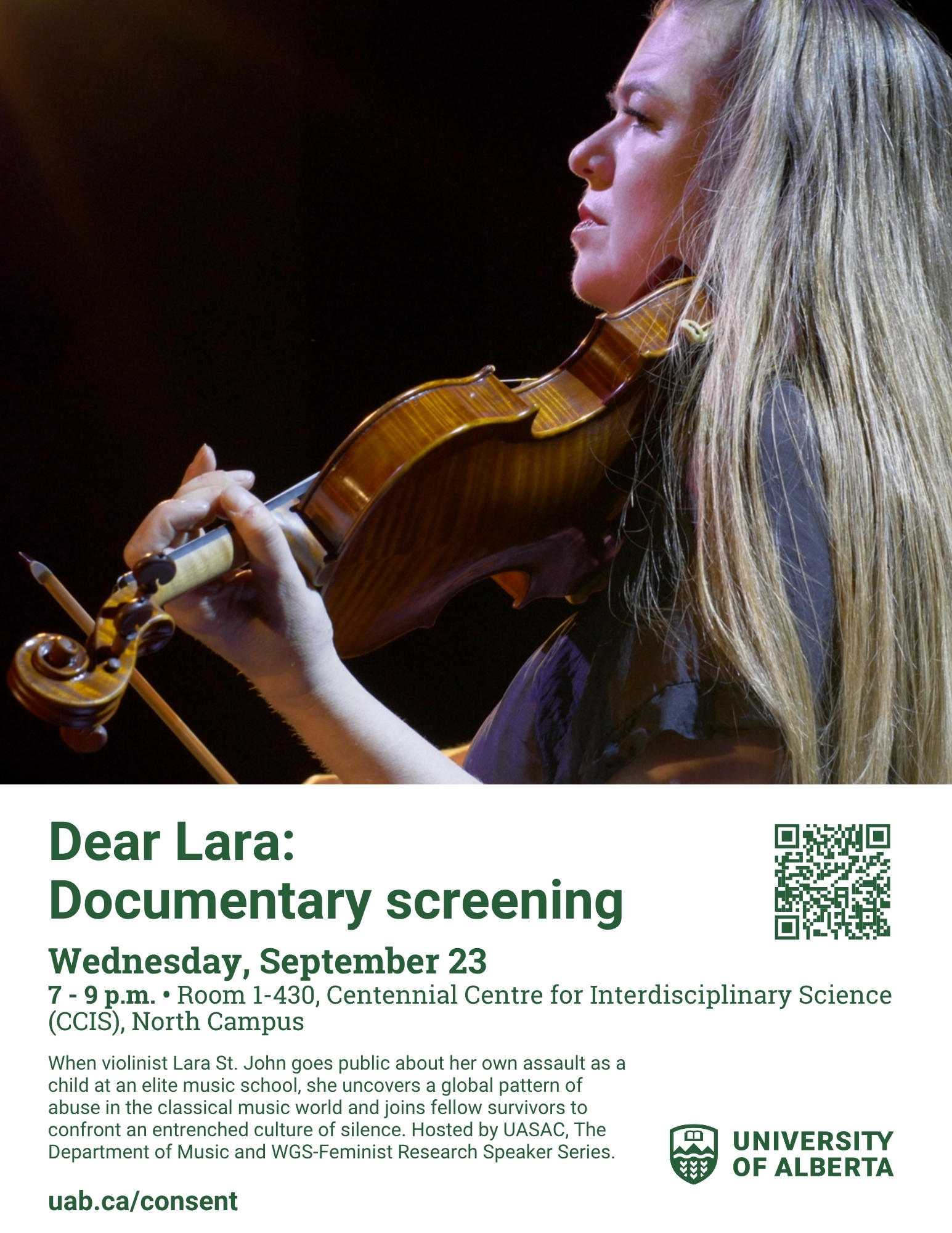
Film Screening: Dear Lara
As part of Consent Week, the University of Alberta Sexual Assault Centre, the Department of Music and WGS-Feminist Research Speaker Series are proud to present a screening of Dear Lara.
Date: Wednesday, September 23, 7:00 - 9:00 PM MT
Location: 1-430, Centennial Centre for Interdisciplinary Science (CCIS),
Location: 1-430, Centennial Centre for Interdisciplinary Science (CCIS),
Dear Lara is a deeply personal documentary that exposes decades of sexual abuse and institutional complicity in the classical music world.
The story begins in 2019, when renowned violinist Lara St. John speaks out about the sexual assault she endured as a 14-year-old student at the elite Curtis Institute in Philadelphia. After her story is published in The Philadelphia Inquirer, she is flooded with letters and outreach from fellow survivors. Determined to make these voices heard, Lara travels across North America and Europe to meet others who, like her, were failed by the very organizations meant to protect them. As these personal accounts accumulate, a pattern emerges of institutions shielding predators at the expense of the vulnerable. Blending unflinching testimony, investigative rigor, and a haunting original score, the film exposes ingrained practices of harm and cover-ups, rooted in power, silence, and the worship of reputation over justice.
The story begins in 2019, when renowned violinist Lara St. John speaks out about the sexual assault she endured as a 14-year-old student at the elite Curtis Institute in Philadelphia. After her story is published in The Philadelphia Inquirer, she is flooded with letters and outreach from fellow survivors. Determined to make these voices heard, Lara travels across North America and Europe to meet others who, like her, were failed by the very organizations meant to protect them. As these personal accounts accumulate, a pattern emerges of institutions shielding predators at the expense of the vulnerable. Blending unflinching testimony, investigative rigor, and a haunting original score, the film exposes ingrained practices of harm and cover-ups, rooted in power, silence, and the worship of reputation over justice.

Talk Title: Beauvoir and Black Feminism: the Gender Ideology of Bodily Force
Speaker: Dr. Beata Stawarska, University of Oregon
Date: Wednesday, October 14, 3:00 - 5:00
Location: Tory 3-15
Beata Stawarska is Professor of Philosophy at the University of Oregon. She has published widely on contemporary European Philosophy (especially phenomenology and post-structuralism), feminist philosophy (especially Beauvoir, Butler, Kristeva, and Irigaray), African and Africana philosophy (especially Fanon and Senghor), philosophy of psychology, dialogical philosophy, and philosophy of language (broadly construed).
Abstract: My talk engages Beauvoir’s understudied reflections on “the lessons of violence” in The Second Sex in dialogue with recent scholarship by Kathryn Belle (Belle and Beauvoir (2024)), Patricia Hill Collins (Black Sexual Politics: African Americans, Gender, and the New Racism (2004); Black Feminist Thought (2000 [1990])), and Oyeronke Oyewumi (The Invention of Women: Making an African Sense of Western Gender Discourses (1997); Family Bonds/Conceptual Binds: Making an African Sense of Feminist Epistemologies (2000)). In agreement with the Black feminist critics, a Beauvoirian femininity based on white middle class womanhood informs dominant contemporary feminist discourses, including on anti-gendered violence. This femininity is believed to be intrinsically ‘victimized’ and ‘powerless’ (Oyewumi 1997). However, in The Second Sex (1949), Beauvoir also tracks the historical, social, cultural, and scientific processes that have rendered bodily force, including violence, a masculine prerogative and a feminine taboo. Read through the lens of critical phenomenology (Gunther 2021), Beauvoir critiques social institutions (the nuclear family and state education) and scientific discourses (biology) for co-constituting quasi-transcendental heteropatriarchal structures such as a sexual hierarchy of the “stronger” and “weaker sex.” This hierarchy perpetuates the idea that “women” are intrinsically vulnerable to violence, which Beauvoir contests. Ultimately, her critique of sexual hierarchies can be recovered today in the spirit of feminist solidarity building to support Collins’ diagnosis of the dominant gendered ideology (2004) and Oyewumi’s call for dismantling traditional womanhood (2000).
Abstract: My talk engages Beauvoir’s understudied reflections on “the lessons of violence” in The Second Sex in dialogue with recent scholarship by Kathryn Belle (Belle and Beauvoir (2024)), Patricia Hill Collins (Black Sexual Politics: African Americans, Gender, and the New Racism (2004); Black Feminist Thought (2000 [1990])), and Oyeronke Oyewumi (The Invention of Women: Making an African Sense of Western Gender Discourses (1997); Family Bonds/Conceptual Binds: Making an African Sense of Feminist Epistemologies (2000)). In agreement with the Black feminist critics, a Beauvoirian femininity based on white middle class womanhood informs dominant contemporary feminist discourses, including on anti-gendered violence. This femininity is believed to be intrinsically ‘victimized’ and ‘powerless’ (Oyewumi 1997). However, in The Second Sex (1949), Beauvoir also tracks the historical, social, cultural, and scientific processes that have rendered bodily force, including violence, a masculine prerogative and a feminine taboo. Read through the lens of critical phenomenology (Gunther 2021), Beauvoir critiques social institutions (the nuclear family and state education) and scientific discourses (biology) for co-constituting quasi-transcendental heteropatriarchal structures such as a sexual hierarchy of the “stronger” and “weaker sex.” This hierarchy perpetuates the idea that “women” are intrinsically vulnerable to violence, which Beauvoir contests. Ultimately, her critique of sexual hierarchies can be recovered today in the spirit of feminist solidarity building to support Collins’ diagnosis of the dominant gendered ideology (2004) and Oyewumi’s call for dismantling traditional womanhood (2000).