Linking to assumed binaries: Violence and Humour
Lale Fassone - 17 September 2026
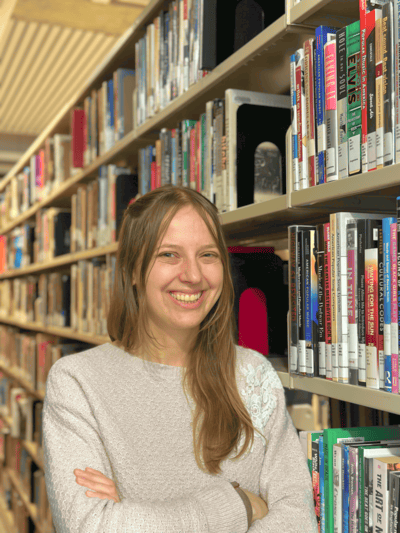
A member of the Sweetgrass First Nation of Cree and Swiss Mennonite descent, and an Augustana grad, Dr. Rissa Reist sees her involvement on campus as core to who she is today and for opening the door to deep research opportunities.
Reist completed her PhD in political science at the University of Alberta with her doctoral dissertation exploring the relationship between violence and humour. Through this research, Reist explored whether states and institutions behave as she does: using humour to tell their own narratives about settler-colonial violence in Canada. Her research has since expanded to the methods that Indigenous communities are using to challenge dominant narratives.
Now an assistant professor at Augustana, Reist is committed to giving back to the Augustana community and her students, and is eager to work together with students on her research.
How would you describe your research in one or two sentences?
My research centres on the broad theme of settler-colonial violence, exploring how social and political institutions uphold the crimes and privileges of Canada’s most powerful. I examine how different political systems reinforce the normalcy of settler-colonial violence and how Indigenous communities are challenging Canada’s culture of violence through cultural interventions that reinforce the humanity of the Indigenous lived experience.
What’s the most interesting facet of your research you’ve found so far?
My graduate work largely focused on the relationship between violence and humour. Typically, the two words don’t go hand in hand, but my research shows they are often linked. Political humour can frame certain groups as the “instigators” of political unrest in Canadian society, and as the putatively “deserving” victims of violence. My research also considers who political humour allows to exercise violence onto others while having the violence be excused as “just a joke.”
What initially attracted you to this field of research?
As an Indigenous person, I find we often use humour to cope with the pain we have experienced and to celebrate our resilience. As a student, I would make jokes about some of the challenges I experienced that would make people quickly turn their heads in shock. I kept wondering whether states and institutions behaved the same way – harnessing humour to tell a particular narrative about the violence of Canada’s settler-colonial past and present.
I started researching this in 2014 as a student at Augustana in my 300- and 400-level political studies courses, thinking more broadly about the role of the media in democracies. From there, it grew into two directed readings, multiple side projects, and several Student Academic Conference presentations. I really benefited from the culture of undergraduate research here at Augustana, something first-year Rissa would never have thought possible. As a former Augustana student and summer research assistant on campus for two years, I'm eager to explore opportunities to involve students in my research.
Who are some of the most interesting people or groups you’ve consulted with for your research?
As an Augustana student, I took a research methods course with Dr. Shauna Wilton and learned how to interview people and analyze survey data. I took the course and continued my career without realizing how much I would later depend on the knowledge I acquired in the class.
Years later, I took on a part-time contract with the federal government to research Canadian healing lodges. As part of our research, we travelled to Canadian healing lodges and interviewed Elders, residents and staff. The experience taught me a lot about the practical elements of research and how our experiences as students in the classroom shape the professionals we become later in life.
Which of your courses are you most excited about and why?
Is it wrong to say all of them? I get to teach across the spectrum of academic disciplines, which is really thrilling! This year, I am teaching in Indigenous studies, crime and community and political studies. It's been rewarding to bring different parts of my lived experience as an Indigenous public servant who has worked with local, provincial and federal governments into the classroom. I am excited to think about the classroom as a living community, consider how my experiences as a public servant can enhance my teaching practices, and learn from the incredible teaching community we have here at Augustana.
What advice would you give your undergraduate student self?
Take what you would consider “the weird classes” and get involved in the vibrancy of our amazing campus community early. My biggest moments of growth as a student came from taking those weird classes and signing myself up for things like owl banding and various student groups I thought were outside my interests. Now as an alumna, I hold on to those memories and think to myself years later, “I did that!”
Also, stay curious and committed to learning. Find ways to ensure that your future self remembers what you have learned along the way. During my PhD, I made a junk journal of all the teachings and learning opportunities I acquired outside of the classroom. I still have the journal and have since made another one for my post-PhD adventures. I wish I could tell my undergraduate self to make one of those earlier. Know that you will always be a work in progress, always learning and growing!
What’s something new that you hope to bring to the Augustana community?
Before coming to this role, I spent years working for the government while teaching virtually for Augustana part-time. I have served on hiring committees and worked with new graduates navigating the public service job market. As an instructor and alumna, I’m in a unique position: I’ve lived similar realities to students and have also seen what the world looks like outside the academic bubble. My students have jokingly referred to me as their academic big sister, and it has been a real honour to mentor the next generation of Augustana leaders.
What TV show is your guilty pleasure?
I love cooking shows! My first job in high school was working for a Ukrainian caterer. There is something about the thrill of watching bustling kitchen environments that reminds me of my time as a kitchen assistant running trays of perishke, cabbage rolls and perogies back and forth from the oven to the buffet tables.
What’s the last piece of news that made you smile?
I recently heard about a study that showed that cats often recognize their names; they just choose to ignore you. That made me laugh out loud!
What initially drew you to Augustana? What brought you back?
What particularly struck me about returning to Augustana as a full-time faculty member is the community’s unique focus on experimental, hands-on undergraduate teaching, research and mentorship, as well as its ability to serve as a pathway for rural career advancement. I grew up working-class in a small town of less than 500 people. I had no idea what a post-secondary career could look like, but Augustana gave me a framework for both what rural education could be and what it meant to exist in the world as an educated person. I see how rural education serves as a foundation on which students can anticipate multiple futures, and I was excited by the possibility of contributing to the community that had laid the foundation for the person I would later become as a working professional.
After leaving Augustana, I worked in the public service. I saw it as a space where concrete change could be made. In many ways, it mirrored Augustana’s values through its emphasis on creative problem-solving, building collaborative environments and developing others. I had so many incredible experiences, including working with the Alberta Indigenous Intern Program, teaching in-house training to Alberta public servants, and working on teams to update existing legislation to improve the lives of Canadians. There were so many twists and turns in the road that lay ahead that my 22-year-old self would have never predicted. Looking back, it feels like every professional decision I made was a stepping stone to coming back to the Augustana community.
What's one thing you’re grateful for today?
Being able to come back to the place where my academic journey began, within days of the 10-year anniversary of my Augustana convocation. It still feels so unreal. Never in a million years would I have guessed that I would be returning as a full-time faculty member when I left here in 2016. On so many levels, it feels like coming home.
Hear more from Reist at the upcoming October 6 lecture, Laughing, Crying, and Healing Together: Indigenous Humour and Reconciliation.