Scripting success
Donna McKinnon - 10 September 2026
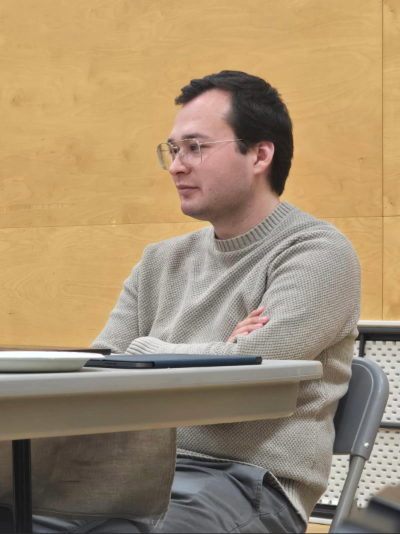
Career paths rarely follow a straight line; they are shaped by a complex web of unexpected turns that only make sense in hindsight. For Gavin Cazon-Wilkes, ’18 BA, ’23 JD, however, one constant thread runs through it all: community.
Gavin grew up between Peace River in Alberta and Fort Simpson in the Northwest Territories, where he and his mother are members of the Liidlii Kue First Nation. It was as a high school student in Peace River that he encountered a student recruiter from Augustana who pitched the advantages of small classes. Having grown up in smaller classrooms, the intimate learning environment felt like a natural fit, but he would decide to move back north and work in construction.
“We have pulp mills and oil refinery facilities in the Peace River area, but things like engineering didn’t entice me, so I thought, ‘I guess I can’t go to university,’” Cazon-Wilkes says.
A year later, thinking about possible alternatives for his future, he found the pamphlet the recruiter had left with him and decided to apply.
A lover of theatre and drama in high school, Cazon-Wilkes began his studies at Augustana majoring in drama, later deciding on a minor in philosophy. This combination would eventually become the ideal educational training for Cazon-Wilkes’s successful career as a lawyer, focusing on Indigenous legal advocacy and self-government negotiations.
“The obvious tie-in is on a very fundamental level — law and justice, to a certain extent for me, stem from Greek Athenian and Hellenistic philosophy,” he explains. “Not so obviously, theatre is a great medium for social justice and advocacy. It was a place where I could write one-act plays tied to my Indigenous identity and how I've kind of grappled with it at times. As a theatre undergrad, we'd have to learn dozens, if not up to a couple 100 pages of script for a play, just like how lawyers have to memorize dozens, if not hundreds, of pages of legislation in their jobs. And, when you enter the courtroom, it is your stage; that's where you act and perform, and your suit is your costume.”
Just as crucial, Cazon-Wilkes notes, was Augustana’s supportive, small-campus atmosphere that offered solid social grounding for his skills to flourish while strengthening his passion for community building.
“The conversations with these amazing professors and classmates expanded my worldview every bit as much as what I learned from the course material,” he says.
Now a lawyer following his studies at the U of A’s Faculty of Law, Cazon-Wilkes is the sole practitioner in Fort Simpson, NWT. He began his regional practice working with the Dehcho First Nations (DFN) — a tribal council representing the Dene and Métis people of the Dehcho Region of the Northwest Territories. The DFN is working towards a modern treaty to build upon Treaty 11, so the majority of his work is assisting the negotiating team on a self-governance agreement, including drafting policy and contract review.
“I'm the only lawyer in about a 48,000 square kilometre radius,” he laughs, adding that his wife and young child for a period of time will soon reside nearer to family in Saint Isidore. “They gave me the option of working remotely but I said, no, I want to be back home. It’s really important to be in the community and for people to be able to see you amongst them. And I'm one of them. I'm also a Liidlii Kue band member and a Dene from the Dehcho, so to be able to return home was a huge honour and privilege and I'm happy to be back here.”
Prior to his current role, Gavin articled with the Wahkohtowin Law and Governance Lodge (WLGL), under fellow Augustana grad Koren Lightning KC, ’04 BA, and Hadley Friedland. “Their mentorship in Indigenous legal advocacy, public education and Bill C-92 child well-services provided the perfect foundation for my current career with the Dene and Dehcho.”
In 2025, Cazon-Wilkes was awarded the King Charles III Coronation Medal for his commitment to Indigenous justice work in the North.
Now the first recipient of Augustana’s Gold Achievement Award that recognizes outstanding professional achievements and/or contributions to the community of recent graduates, Cazon-Wilkes is quick to redirect the spotlight.
“Who I am today is not just through my own efforts, but also because of the people who have been behind me, who've come before me, who have stood alongside me in every chapter of my life,” he says. “When we say it takes a community, it really does. Being recognized with this honour and any other honour that has happened in my life is just as much a recognition of everybody who has uplifted me along the way, and I am deeply grateful.”
The Gold Achievement Award recognizes the outstanding professional achievements and/or contributions to the community of recent graduates. Nominees must be 40 years of age or younger in the year of presentation (based on the year of the Faculty Alumni Awards ceremony).