Spring/Summer Courses
Spring term: May 5- Jun 11
- BIOL 201 - Eukaryotic Cellular Biology
- GENET 270 - Foundations of Molecular Genetics
BIOL 201 - Eukaryotic Cellular Biology - Spring term
If BIOL 107 is about what cells are, the goal of this course is to teach students how cells work and how they are studied. We will be covering:
- Techniques such as microscopy and western blotting
- How cells move, communicate, and reproduce
- Comprehensive topics include neurons, apoptosis, cancer cells, and stem cells.
Instructor: Dr. Michael Harrington
GENET 270 - Foundations of Molecular Genetics - Spring term ( Online)
This course will introduce you to basic concepts about the organization, plasticity and regulation of genetic material from bacteria and bacteriophages. The seminars are integrated to provide an overview of microbial genetics by examining historical and current genetic techniques and experiments in research papers. We will be covering:
- Principles and key elements of molecular genetics
- Principles of the genetics central dogma and demonstrate functional competency in gene expression
- The role of horizontal gene transfer in the movement of genes between bacterial cells
- Demonstrate competency in processes relating to bacterial genetics that inform and improve our understanding of the genetics of all living organisms on our planet
Instructor: Torah Kachur
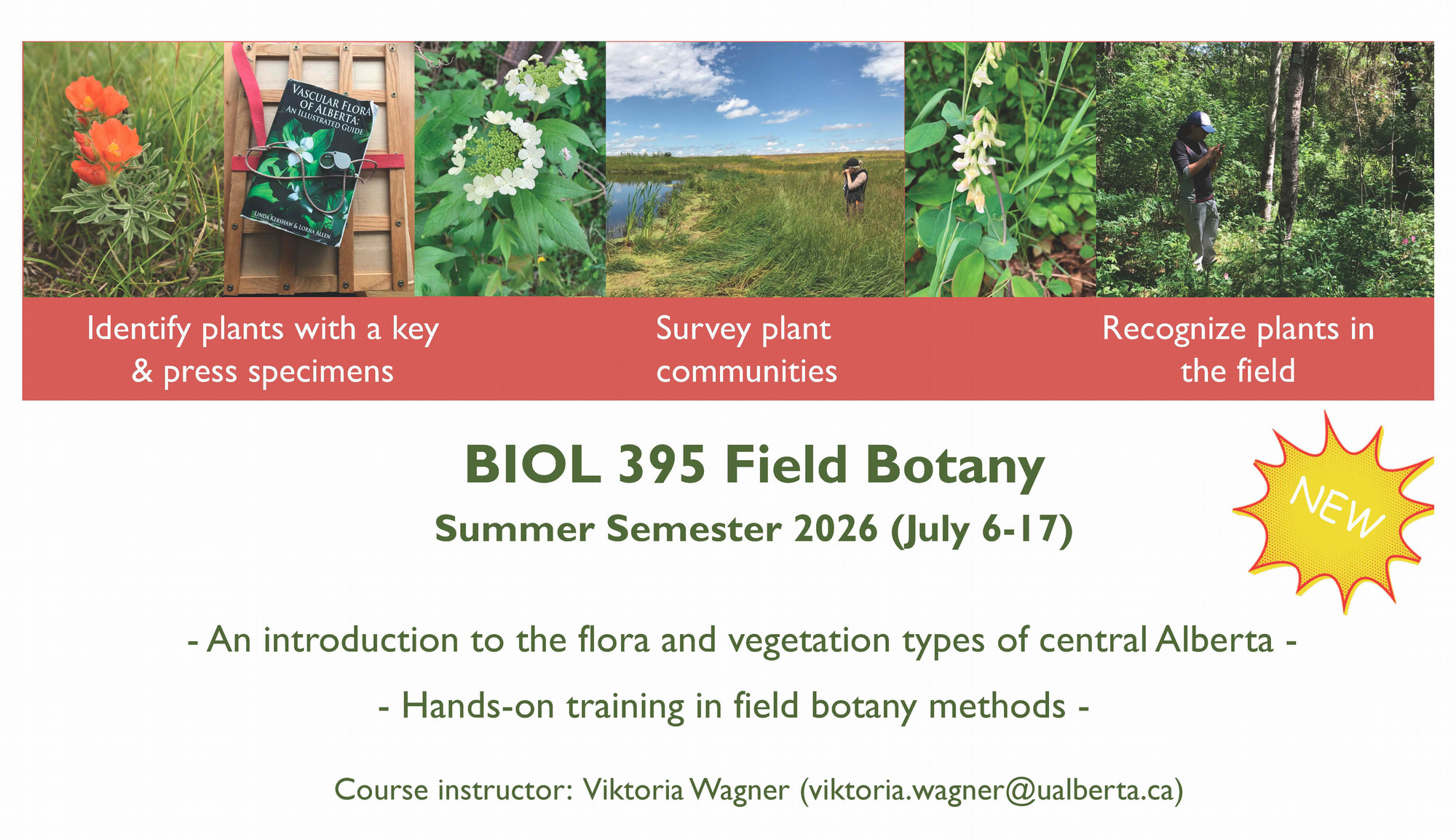
BIOL 395 Field Botany-Summer Term
July 6 - July 17
Lec MTWRF 0800-1200
Lab MTWRF 1300-1700
Course description:
- An introduction to the flora and vegetation types of central Alberta
- Hands-on training in field botany methods
Instructor Viktoria Wagner
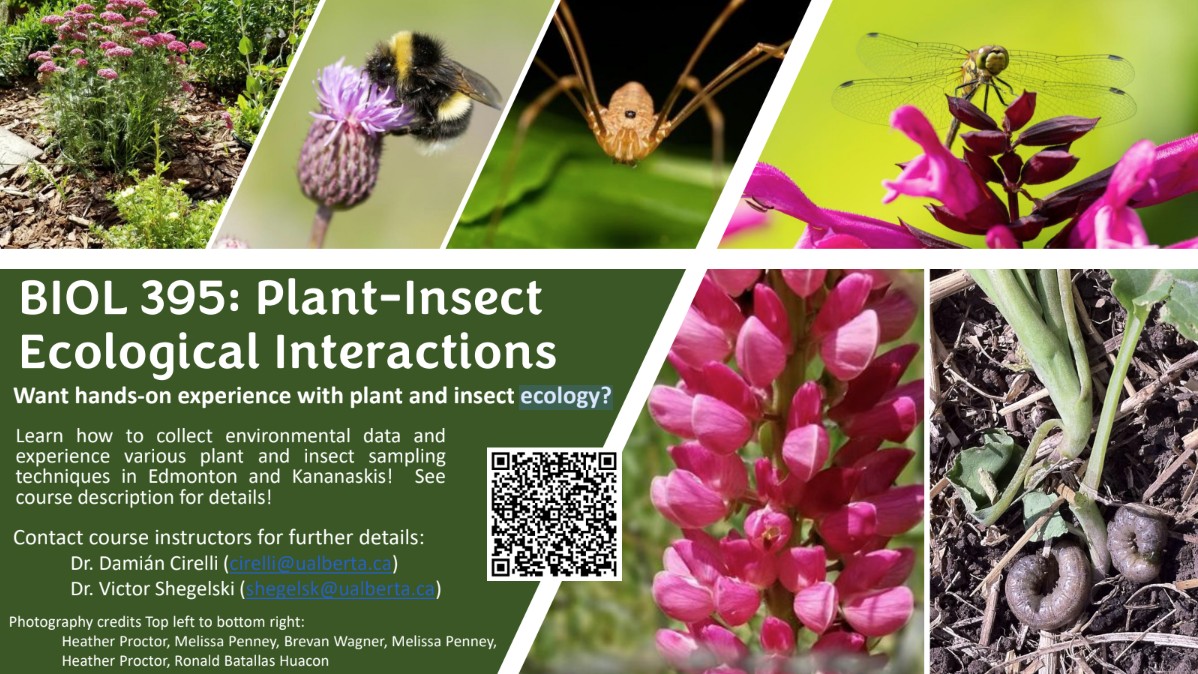
BIOL 395 Plant-Insect Ecological Interactions -Summer Term
July 20 - July 24 and August 3-5 ( In Edmonton) : Lecture M/T/W/R/F 1000-1400
July 27- July 31 ( In Kananaskis): Lab M/T/W/R/F 0830-1630
Course description:
Plants and insects have a long evolutionary history that has resulted in many impressive ecological adaptations and relationships. In this course, students will collect environmental data and take part in various plant and arthropod sampling, preservation and curation techniques. The first week of the course will take place in Edmonton, primarily on campus, and will cover the majority of the lecture material, as well as some practical techniques in sampling. The second week of the course will take place at the Barrier Lake Field Research Station in Kananaskis, where students will travel to various research sites. Prerequisites: any ENT or BOT course