Belarus and the Russo-Ukrainian War: Intervention or Neutrality?
8 July 2026
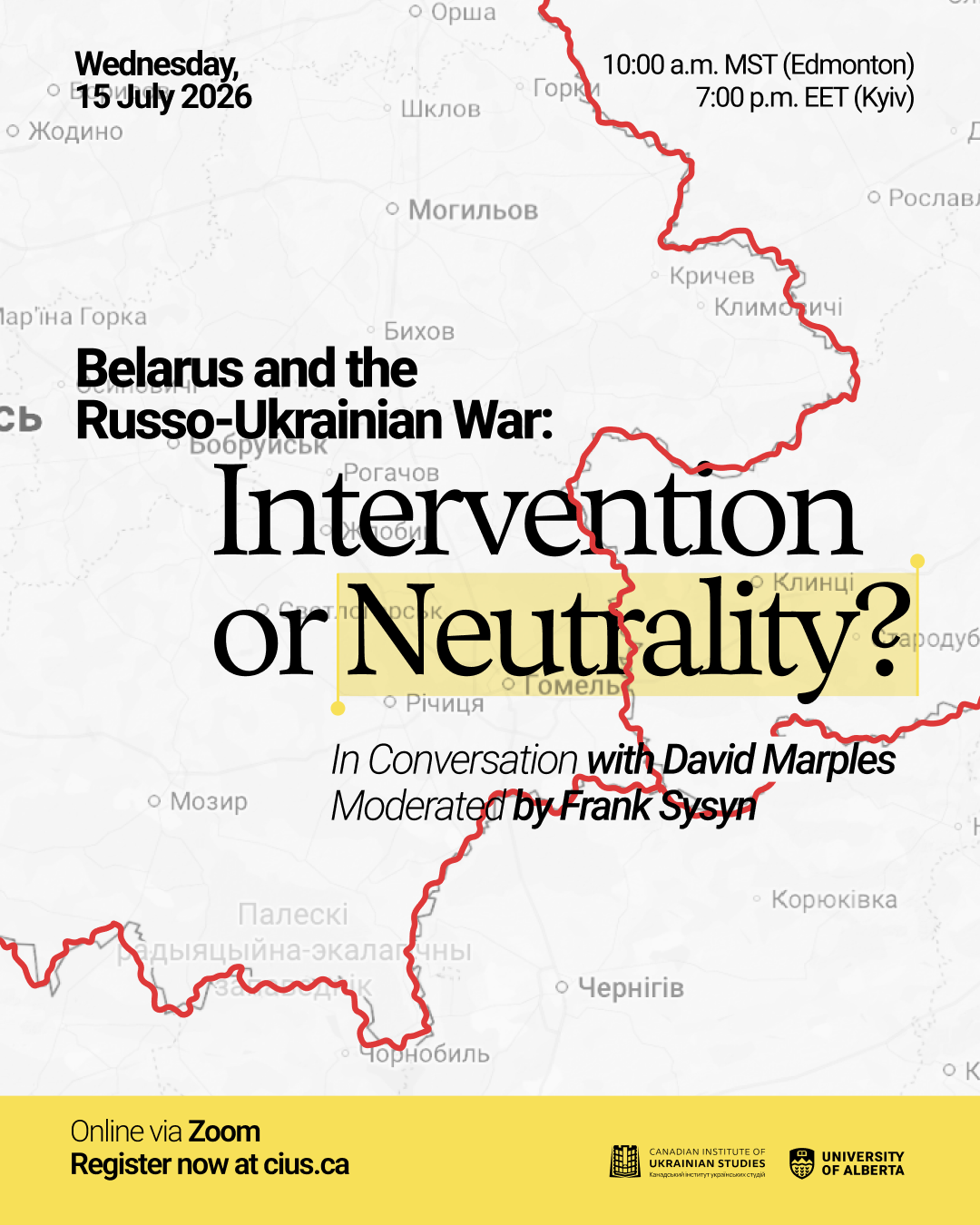
In Conversation with David Marples
Wednesday, 15 July 2026
10 a.m. MST (Edmonton) / 12 p.m. EST (Toronto) / 7 p.m. EET (Kyiv)
Online via Zoom | Moderated by Frank Sysyn
Following the 2022 Russian invasion, Ukraine’s attitude toward Belarus remained ambivalent. The Russian army had launched the attack from Belarus with the collusion of Aliaksandr Lukashenka, but Ukraine maintained diplomatic relations and kept its Minsk embassy open.
Early in 2026, however, President Volodymyr Zelensky changed policy, introduced sanctions on Lukashenka and other officials, and contacted the Belarusian opposition. On June 19, Zelensky demanded that Belarus switch off and remove radar stations close to the Ukrainian border that were directing Russian drones to targets in Ukraine. Belarus was given one week to comply. Lukashenka made no official response but switched off the radar.
These developments highlighted Belarus' dilemma. The discussion will explore the options facing official Minsk. It faces immense pressure from Russia to send its army into Ukraine. Further, Ukraine's drone attacks on Russian oil refineries have led to Putin's increased dependence on petroleum products refined in Belarus to sustain Russia's military campaign.
In turn, Donald Trump has sent envoys into Belarus since early 2025, resulting in the release of over 500 political prisoners and the easing of US sanctions on potash exports and the Belavia airline. Trump has added Lukashenka to his “Peace Council” and promised him a “big deal” soon.
Can Belarus maintain its sovereignty with US help and adopt a neutral position on the war? Could it reopen relations with the EU to relieve its heavy dependence on trade with Russia? To what extent have relations with China eased Lukashenka’s choices? Can Lukashenka continue in power after more than three decades in such a conflicting situation? And how have these recent developments affected the relationship between Belarus and Ukraine, which has deteriorated considerably since the start of the year?

David R. Marples is a University of Alberta Distinguished Professor and teaches Russian and East European history. He holds a PhD in Economic and Social History from the University of Sheffield, UK. He is the author of seventeen single-authored books and five edited books on topics ranging from twentieth-century Russia, Stalinism, contemporary Belarus, contemporary Ukraine, and the Chornobyl disaster. From 2010 to 2015, he was President of the North American Association for Belarusian Studies. His recent books include Belarus: What Everyone Needs to Know (co-authored with Veronica Laputska; Oxford University Press, February 2026), Stalin (co-authored with Alla Hurska, 2022), The War in Ukraine's Donbas (edited, 2022), Understanding Ukraine and Belarus (2020), Ukraine in Conflict (2017), ‘Our Glorious Past’: Lukashenka's Belarus and the Great Patriotic War (Stuttgart, Germany: Ibidem Verlag, 2014), and Heroes and Villains: Creating National History in Contemporary Ukraine (2008).