KGB and the Ukrainian Diaspora Lab
“On Layers of Bias” — the “KGB and the Ukrainian Diaspora” lab
The Canadian Institute of Ukrainian Studies at the University of Alberta, in collaboration with the Sectoral State Archive of the Security Service of Ukraine, announces the launch of the research lab "The KGB and the Ukrainian Diaspora," a public interactive archive that for the first time opens access to declassified KGB documents recording decades of surveillance and operations by the Soviet state security organs against the Ukrainian diaspora in North America. The lab is the first outcome of the joint research initiative of the Adalet project, which combines critical discourse analysis with artificial intelligence to expose the ideological mechanisms of KGB language, and it invites researchers, students, and the wider public to examine these materials for themselves.
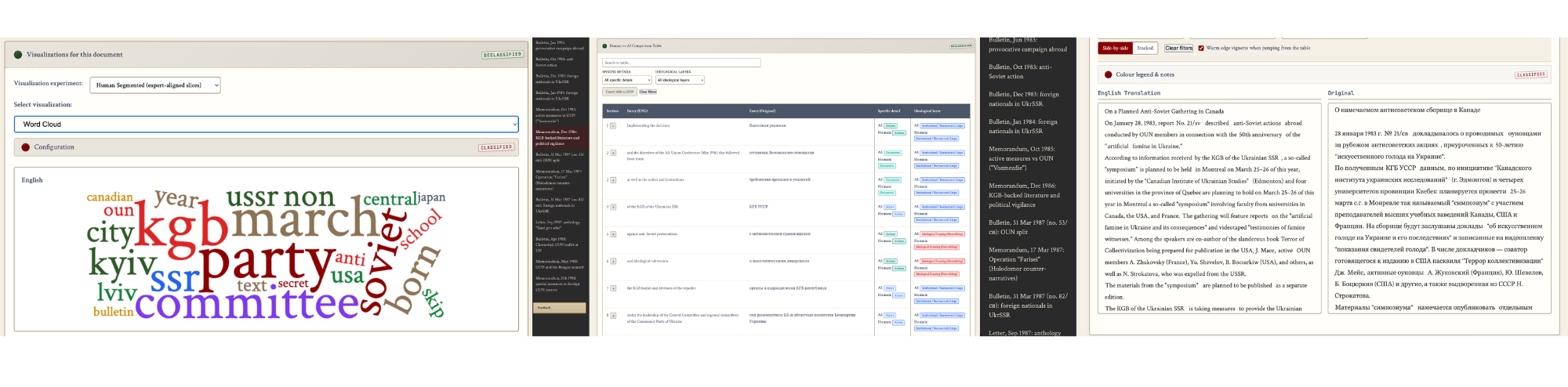
The website "The KGB and the Ukrainian Diaspora" ( https://cius-kgb.com ) is a public interactive archive providing open access to sixteen declassified KGB documents in a bilingual format: the original Russian texts alongside English translations, a parallel reading tool with highlighting by ideological category, and tables comparing human and machine classification. In addition to the Reading Room, the site houses a Research Lab with corpus visualizations, geographic maps of mentions, a glossary of terms, and search tools. Together these make it not a static resource but an environment for active analytical inquiry into the language of Soviet repression.
In an accompanying article prepared for publication, the site's authors Natalia Khanenko-Friesen, Larysa Bilous, Sean Lis, and Andriy Kohut explain their approach to working with the archives and analyze sixteen declassified KGB documents from Fond 16, Opys 1 of the Sectoral State Archive of the SBU. The documents concern a special operation code-named "Vozmezdie," directed against the Ukrainian diaspora and its institutions, among them the Canadian Institute of Ukrainian Studies.
The corpus consists of internal memoranda and information reports, prepared for the most part in the 1980s for the leadership of the Communist Party of Ukraine. It documents coordinated KGB campaigns to discredit the OUN, to counter Western narratives about the Holodomor, and to influence academic and media discourse in North America.
The authors argue that the language of the KGB files contains several overlapping layers of bias, which a researcher must recognize and analytically disentangle before using these documents as historical sources.
The first layer is institutional. The Soviet security apparatus developed a specialized language of its own, with a settled thesaurus, semantic conventions, and rhetorical strategies that programmed a particular interpretive stance toward the facts before any individual officer picked up a pen. This is traceable throughout the KGB documents.
The second layer is personal. As Vieda Skultans has shown in Latvia, and Timothy Garton Ash and Anna Funder in their work on the Stasi archives, individual officers, agents, and informants brought their own prejudices, conjectures, and outright fabrications into the documents, reflecting not what was actually happening but how the regime imagined its enemies.
The third layer is the researcher's own. Sustained work with large bodies of ideologically saturated language risks producing confirmation bias, habituation, and moral numbing: the gradual internalization of the very interpretive frames the researcher sets out to question.
The fourth layer, specific to this project, is algorithmic. Bringing artificial intelligence to bear on archival texts introduces additional structures that can further distort interpretation.
For this reason the authors insist that none of these layers can be "objectively" removed. Any attempt to dismantle an ideological frame inevitably adds a further layer of interpretation, whether human or algorithmic.
«Про шари упередженості» — лабораторія «КДБ і українська діаспора»
Канадський інститут українських студій Університету Альберти у співпраці з Галузевим державним архівом Служби безпеки України оголошує про відкриття дослідницької лабораторії «КДБ і українська діаспора» — публічного інтерактивного архіву, що вперше надає відкритий доступ до розсекречених документів КДБ, які фіксують десятиліття стеження та операцій радянських органів державної безпеки проти української діаспори в Північній Америці. Лабораторія є першим результатом спільної дослідницької ініціативи проєкту «Адалет», що поєднує методи критичного дискурс-аналізу зі штучним інтелектом задля розкриття ідеологічних механізмів мови КДБ і запрошує дослідників, студентів та широку громадськість до самостійного вивчення цих матеріалів.
Вебсайт «КДБ і українська діаспора» ( https://cius-kgb.com ) є публічним інтерактивним архівом, що надає відкритий доступ до шістнадцяти розсекречених документів КДБ у двомовному форматі: з оригінальними російськими текстами та англійськими перекладами, інструментом паралельного читання з підсвічуванням за ідеологічними категоріями, а також таблицями порівняння людської й машинної класифікації. Окрім «Читальної зали», сайт містить «Дослідницьку лабораторію» з корпусними візуалізаціями, географічними картами згадок, глосарієм термінів і пошуковими інструментами. Все це перетворює його не на статичний ресурс, а на середовище для активного аналітичного дослідження мови радянських репресій.
У супровідній статті, яку автори сайту Наталія Ханенко-Фрізен, Лариса Білоус, Шон Ліс і Андрій Когут підготували до публікації, партнери пояснюють свій підхід до роботи з архівами та аналізують шістнадцять розсекречених документів КДБ із Фонду 16, Опис 1 Галузевого державного архіву СБУ, що стосуються спеціальної операції під назвою «Возмєздіє», спрямованої проти української діаспори та її інституцій, зокрема Канадського інституту українських студій.
Корпус документів охоплює внутрішні доповідні записки та інформаційні повідомлення, підготовлені переважно у 1980-х роках для керівництва Компартії України, і документує скоординовані кампанії КДБ із дискредитації ОУН, протидії західним наративам про Голодомор та впливу на академічний і медійний дискурс у Північній Америці.
Автори стверджують, що мова файлів КДБ містить кілька взаємоперекриваючих шарів упередженості, які дослідник мусить розпізнати та аналітично розплутати ще до того, як використовувати ці документи як історичні джерела.
Перший шар — інституційний. Радянський апарат безпеки виробив власну спеціалізовану мову з усталеним тезаурусом, семантичними конвенціями та риторичними стратегіями, що «програмували» певне інтерпретаційне ставлення до фактів ще до того, як конкретний офіцер брав перо до рук, — і це простежується в документах КДБ.
Другий шар — особистісний. Як показали Віеда Скултан у Латвії, Гартон Еш і Анна Фундер у дослідженнях архівів «Штазі», окремі офіцери, агенти й інформатори привносили до документів власні упередження, домисли та відверті фальсифікації, відображаючи не те, що відбувалося насправді, а те, якими режим уявляв своїх ворогів.
Третій шар — дослідницький. Тривала робота з великими масивами ідеологічно насиченої мови ризикує спричинити в самих дослідників підтвердження упередження, звикання та моральне розчулення, тобто поступову інтеріоризацію тих самих інтерпретаційних рамок, які вони прагнуть критично осмислити.
Четвертий шар, специфічний для цього проєкту, — алгоритмічний. Йдеться про залучення штучного інтелекту до аналізу архівних текстів привносить додаткові структури, що можуть далі деформувати інтерпретацію.
Саме тому авторки й автори наполягають, що жоден із цих шарів не може бути «об'єктивно» знятий, адже будь-яка спроба демонтувати ідеологічні рамки неминуче додає новий шар інтерпретації, людської чи алгоритмічної.

CORE AUTHORS
Natalia Khanenko-Friesen
Natalia Khanenko-Friesen is the Director of the Canadian Institute of Ukrainian Studies, Professor and Huculak Chair in Ukrainian Culture and Ethnography at the University of Alberta. As a cultural anthropologist and an expert in oral history, witnessing studies, diaspora studies, her current work focuses on contemporary Ukraine, Ukrainian diaspora, Crimean Tatar studies, archives of Soviet repression and digital humanities.
Andriy KohutAndriy Kohut is the director of the Sectoral State Archive of the Security Service of Ukraine and the Stuart Ramsey Tompkins Visiting Professor in the Department of Modern Languages and Cultural Studies (2025/26), University of Alberta. Kohut has published numerous scholarly and popular articles and edited several collections of documents from declassified KGB archives. His research interests include Soviet deportations, the Holodomor, history of the Communist regime's secret services, memory politics, and cultural diplomacy.
Larysa Bilous is a historian and research associate at CIUS, University of Alberta. Her research focuses on twentieth-century Ukrainian social and Jewish history, peasant revolts, and Soviet archival studies. She collaborates on interdisciplinary projects in digital humanities and archival ethics.
Sean Lis is a PhD student in the Department of Modern Languages and Cultural Studies. With the skills developed through previous Digital Humanities publications, he utilizes a variety of digital methods to interrogate details out of data that lie below the surface. Focusing on applied AI in the humanities, Sean prides himself in using the tools of today to answer the mysteries of yesterday. Sean is currently studying the Great Northern War, as well as declassified former KGB archival documents.