An Emerging Field: LGBTQI+ Ukrainian Experiences in Canada
12 June 2026
Mariia Burtseva (she/her) is a PhD candidate in the Department of Modern Languages and Cultural Studies and a research assistant in the Canadian Institute of Ukrainian Studies, University of Alberta. Her PhD research project is focused on Ukrainian LGBTQI+ migration in Canada.
Canada has a long history of immigration and a well-established tradition of queer studies, queer archives, and queer public memory. At the same time, not all queer experiences become equally visible within these narratives. Some stories are more easily documented, remembered, and included in public discussions, while others remain fragmented, underrepresented, or difficult to find in archives and scholarship.
The experiences of LGBTQI+¹ Ukrainians in Canada are one example of this challenge. Since the Russo-Ukrainian war began in 2014, and especially since Russia’s full-scale invasion in 2022, many Ukrainians have arrived in Canada through new migration and displacement pathways. Among them are LGBTQI+ Ukrainians, whose experiences are shaped not only by war and migration but also by sexuality, gender identity, and questions of belonging.
These experiences matter, because they remind us that migration is never lived in exactly the same way by everyone. Social position, gender, sexuality, and previous life experience all influence how people leave their homes, where they go, and how they adapt to new environments. Paying attention to LGBTQI+ Ukrainians does not separate them from broader Ukrainian migration. Rather, it helps us better understand the diversity of Ukrainian experiences and the different ways vulnerability, resilience, safety, and belonging are negotiated.
At the same time, LGBTQI+ Ukrainians remain an emerging field of study. Their stories are often absent from traditional archives and public memory. They may exist in private conversations, friendships, online communities, activist networks, informal support groups, and personal narratives that are not always documented. As a result, many experiences remain only partially visible, despite being fully a part of contemporary Ukrainian and Canadian life.
¹Throughout this text, the acronym LGBTQI+ and the term queer are used as umbrella terms to refer to individuals with diverse sexual orientations, gender identities, and gender expressions. Acknowledging the broader acronym 2SLGBTQQIA+, commonly used in the Canadian context, the term queer is employed here because of its inclusivity and flexibility, allowing for the recognition of a wide range of experiences without limiting them to fixed identity categories.
Ukrainians have been present in Canada as an immigrant community since the late nineteenth century and have become an important part of the country’s social and cultural landscape. In 2016, approximately 1.36 million people, about 4% of Canada’s population, stated that at least one of their ethnic origins was Ukrainian. The arrival of new Ukrainian migrants in recent years has further expanded this community.
Among the recent arrivals are LGBTQI+ Ukrainians who migrated to Canada following the war in the Donbas and the annexation of Crimea in 2014, and after the beginning of Russia’s full-scale invasion of Ukraine in 2022.
Russia’s full-scale invasion of Ukraine brought immigration issues to the forefront, leading to the introduction of the Canada-Ukraine Authorization for Emergency Travel (CUAET) program in March 2022 – the response to the challenges following the Russian invasion. As a result of Canada’s CUAET program, which existed for two years until March 2024, many Ukrainians, including LGBTQI+ individuals, were seeking refuge in Canada (298,128 Ukrainians arrived to Canada between 17 March 2022 and 1 April 2024). The new wave of newcomers has shifted the landscape of the Ukrainian Canadian community and increased the visibility of the diversity within Ukrainian communities across the country.
For many Ukrainians, forced migration was not only a response to military violence but also a deeply personal rupture that reshaped everyday life, identity, and belonging. While queer Ukrainians shared experiences common to many other Ukrainian citizens, such as war-related trauma, displacement, and the challenges of migration and integration, they also faced additional fears due to the extremely homophobic and intolerant policies of the aggressor state.
Queer Ukrainians fled their homeland also because of higher risks of persecution. For LGBTQI+ Ukrainians, displacement often carried a double layer of vulnerability. Beyond the shared difficulties of migration, queer refugees have frequently encountered unique barriers in host countries, including exclusion, discrimination, and legal or cultural hostility.
In territories under Russian occupation, these risks were intensified by state-sponsored homophobia and violent practices, making displacement not only a matter of survival from war but also of escaping targeted oppression. This has been happening since 2014 for LGBTQI+ people in Crimea and eastern regions of Ukraine, which have been under Russian occupation for more than ten years. Existing accounts illustrate the challenges faced by queer people living in occupied Ukrainian territories.
Many LGBTQI+ Ukrainians are also serving in the Ukrainian military and participating in the defence of Ukraine alongside their fellow soldiers. Their experiences challenge assumptions that sexual and gender diversity exists outside of Ukrainian society and demonstrate that queer Ukrainians are an integral part of Ukraine’s ongoing struggle for sovereignty and freedom. At the same time, visibility does not automatically translate into full social or institutional recognition. Despite increasing public visibility, debates surrounding LGBTQI+ rights and equality remain ongoing in Ukraine.
Yet many of these experiences remain insufficiently documented. Recognizing these narratives is not simply a matter of visibility but also of ensuring that the diversity of Ukrainian experiences is reflected in community memory, scholarship, and public discourse.
For queer Ukrainians, belonging is often complex and negotiated. Ukrainian spaces may feel familiar because of shared language, culture, memory, humour, and emotional connections to Ukraine. At the same time, some people may feel that aspects of their identity remain unseen or difficult to discuss openly. Experiences of belonging can therefore be partial rather than complete, shaped by different social environments and relationships.
For this reason, LGBTQI+ Ukrainian experiences should not be understood as separate from either Ukrainian Canadian history or Canadian queer history. They are a part of both. They reveal how questions of migration, displacement, war, gender, sexuality, nationality, and belonging intersect in contemporary Canada. They also challenge us to think more carefully about who is included in our narratives and whose stories remain overlooked.
As Pride Month invites reflection on visibility, inclusion, and community, it also provides an opportunity to pay attention to stories that have often remained at the margins. Queer Ukrainians have always been a part of Ukrainian communities, both in Ukraine and in the diaspora. Today, their experiences are becoming increasingly visible through community initiatives, activism, research, and personal storytelling.
As an emerging area of inquiry, Ukrainian queer studies have the potential to contribute to broader discussions of migration, diaspora, identity, community, memory, culture, and social change. At the same time, they encourage greater attention to experiences that have often remained overlooked within both Ukrainian studies and public conversations about Ukrainian communities.
The field of Ukrainian queer studies in Canada is still emerging. Yet the experiences of LGBTQI+ Ukrainians demonstrate why this work matters. These narratives help us understand not only queer lives but also contemporary migration, diaspora communities, and the ongoing consequences of war and displacement. These narratives suggest that inclusion is not only a matter of legal rights or public visibility. It is also about memory, community, emotional safety, and the ability to tell one’s own story.
As new generations of scholars, community members, and activists continue this work, LGBTQI+ Ukrainian experiences have the potential to become an important part of both Ukrainian Canadian scholarship and Canadian queer history. Not as marginal additions, but as stories that help us better understand the diversity of Ukrainian life in Canada today.
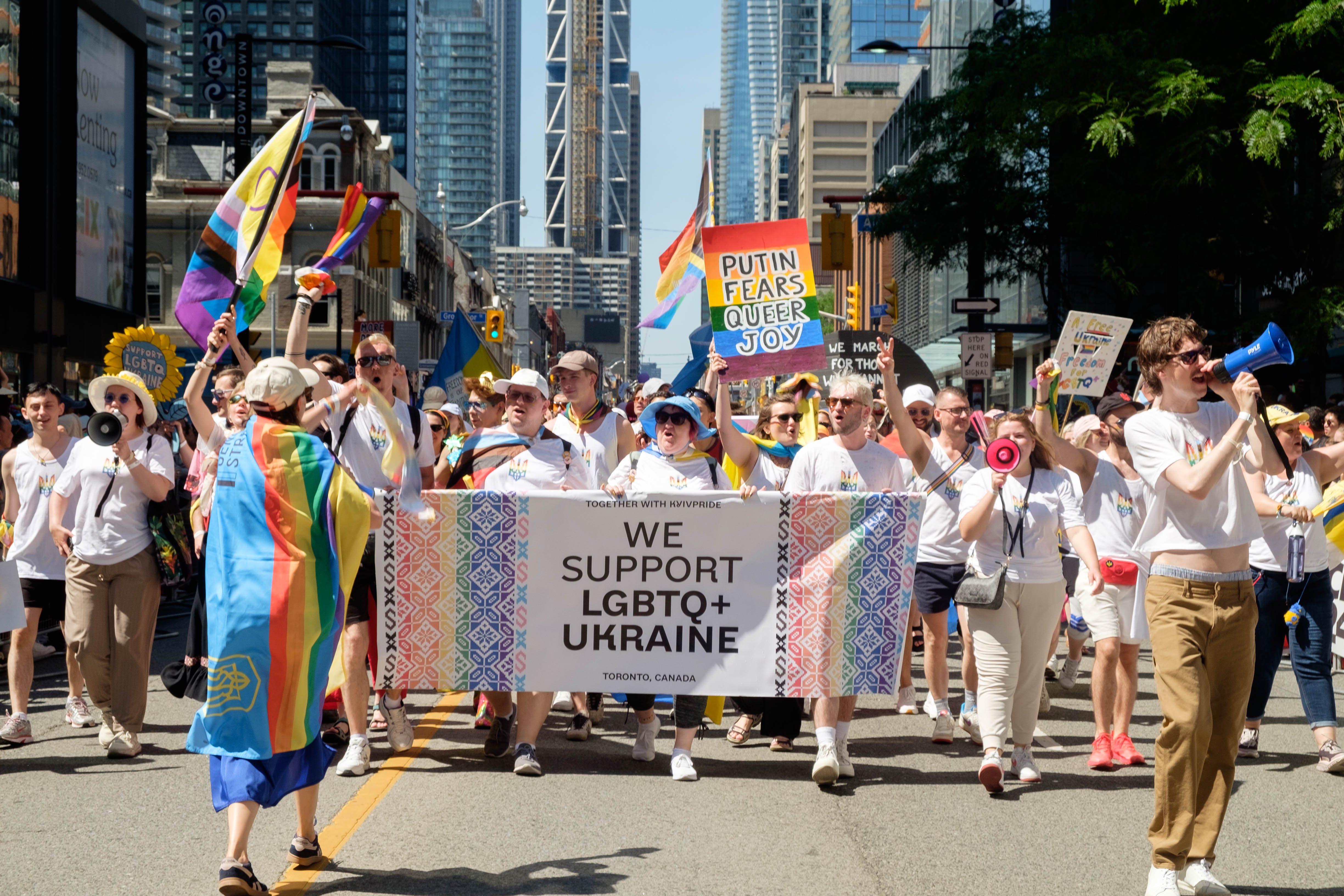
Photo: The Ukrainian community marching in the 2025 Toronto Pride Parade.
Credit: Landon Nesbitt