ULEC Webinar: Addressing Challenges to Teaching the Holodomor
1 February 2026
On January 21, the Ukrainian Language Education Centre (ULEC) hosted a webinar titled Addressing Challenges to Teaching the Holodomor. The session was led by Marta Baziuk, Executive Director of the Holodomor Research and Education Consortium (HREC), a project of the Canadian Institute of Ukrainian Studies at the University of Alberta.
The webinar focused on one of the most difficult and sensitive topics in Ukrainian history - the Holodomor of 1932-1933 - and explored how educators can approach its teaching in meaningful, age-appropriate, and responsible ways.
The speaker began by addressing a fundamental question: why so few people, both in and outside Ukraine, are aware of or openly discuss the Holodomor. She emphasized that teaching this topic requires careful historical context, as the famine cannot be separated from broader processes of cultural repression, political control, and the deliberate silencing imposed by the Soviet regime.
A key challenge discussed during the webinar was the long-standing denial of the Holodomor by Soviet authorities. For decades, archives remained closed, survivor voices were suppressed, and access to reliable information was severely limited. This historical silence continues to affect how the Holodomor is taught today.
The speaker highlighted the importance of moving beyond statistics when working with students. While numbers provide scale, it is personal stories, testimonies, and visual evidence that help learners truly understand the human impact of the tragedy. She stressed that emotional connection - when handled with care - plays a crucial role in meaningful historical learning.
A significant portion of the webinar focused on visual documentation. The speaker presented official Soviet photographs depicting the confiscation of grain from Ukrainian farmers, offering insight into the mechanisms that enforced famine conditions. She also discussed the scarcity of authentic images, caused by strict limitations on foreign journalists at the time. The work of photographers such as Alexander Wienerberger and Nikolai Bokhan was highlighted as rare and powerful visual testimony of human suffering during the Holodomor.
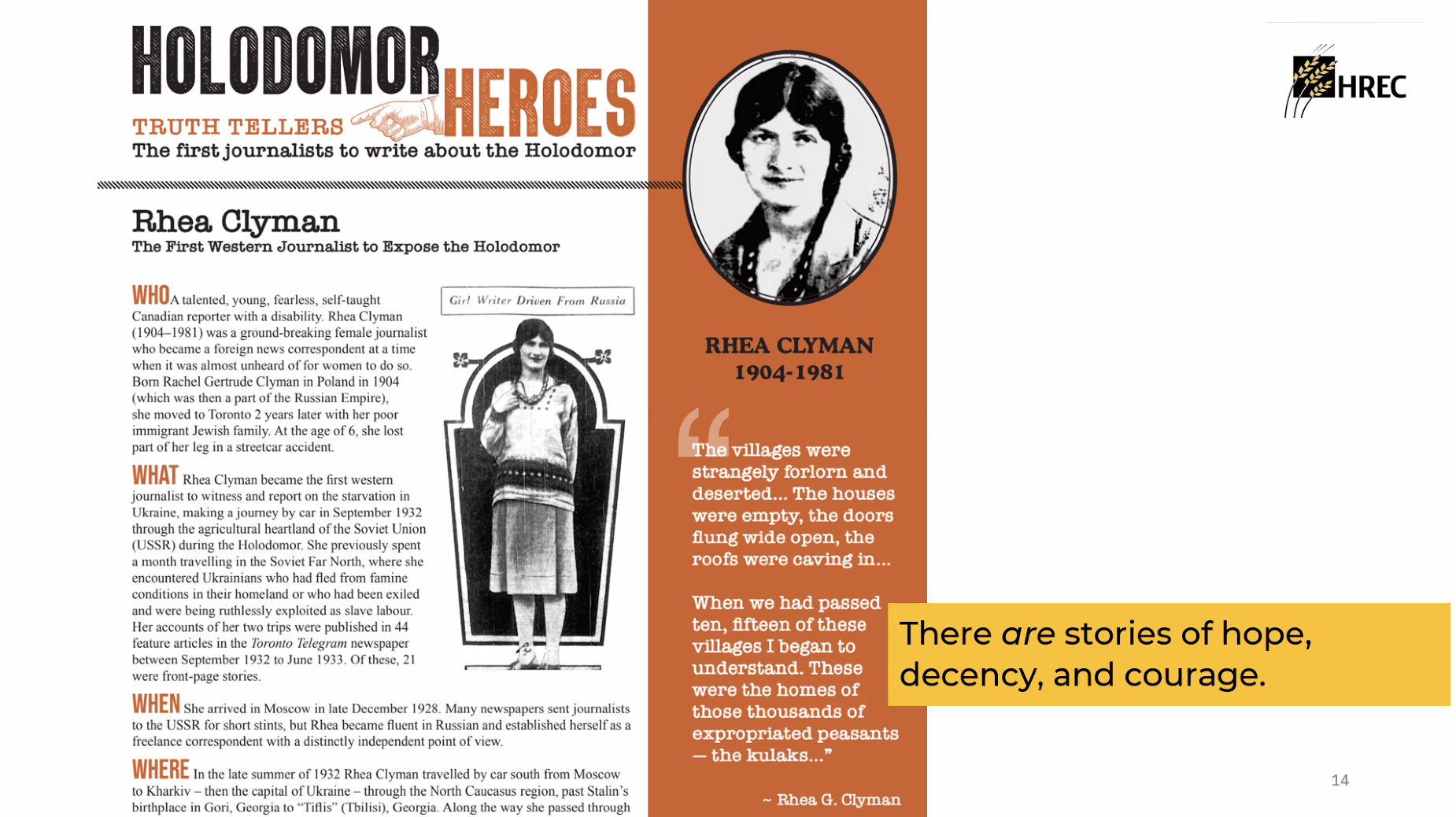
The webinar also explored the role of journalism in preserving historical truth. The speaker shared the story of Rhea Clyman, a journalist whose reporting on the famine was largely forgotten for decades before being rediscovered through modern research. These recovered narratives, she explained, are particularly valuable for engaging younger audiences and helping them understand the lived experiences behind historical events.
Another important theme was survivor testimony. The speaker discussed interviews with individuals whose stories were previously unknown, including testimonies now featured in exhibits at the Canadian Museum for Human Rights in Winnipeg. These personal accounts demonstrate the lasting emotional weight of the Holodomor and highlight the importance of preserving memory across generations.
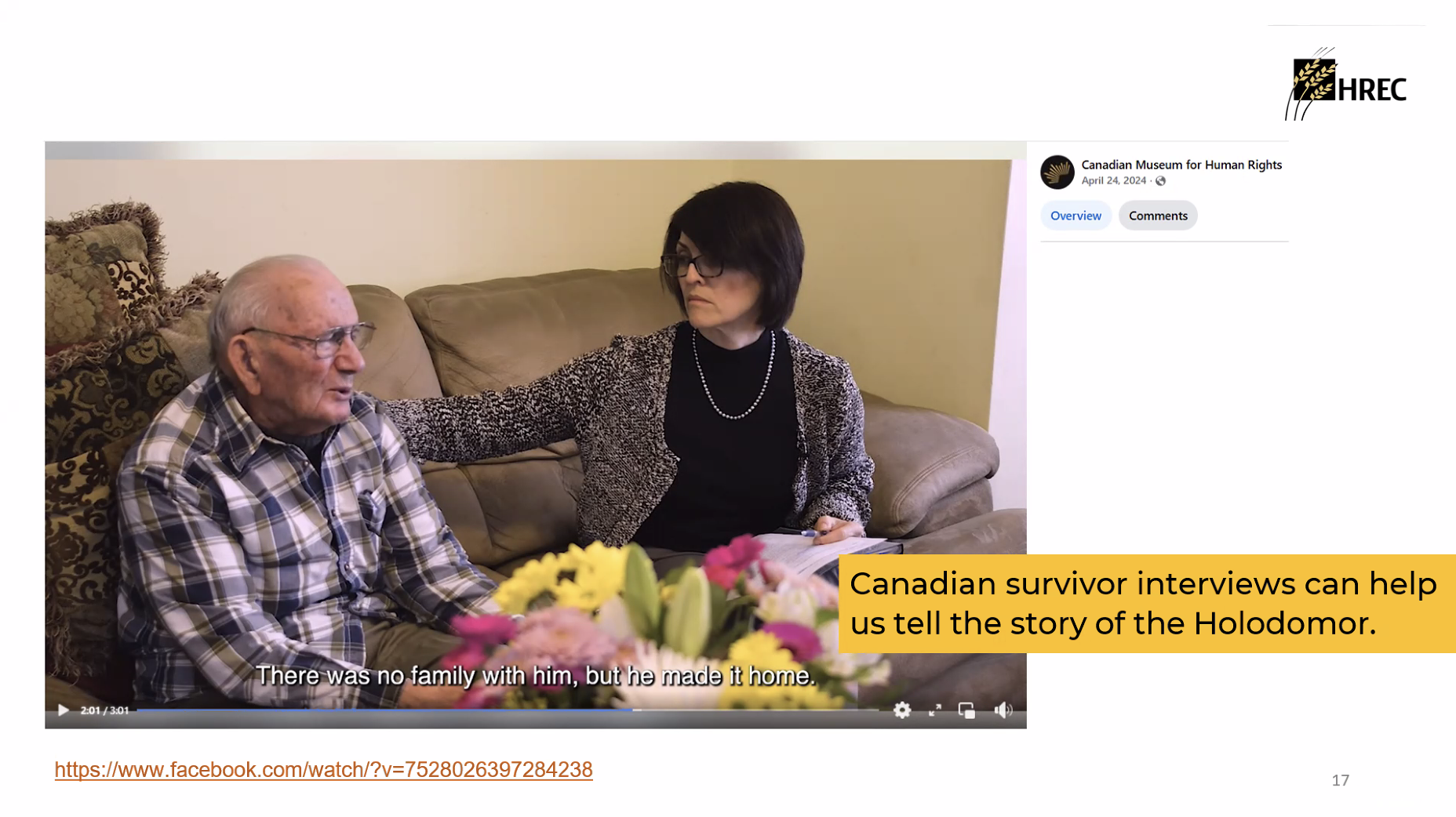
Participants were introduced to a range of educational resources available through holodomor.ca, including the HREC Special Collections. These collections contain authenticated photographs and materials verified by librarian Lana Babi, whose work helps counter misinformation and ensures historical accuracy. The speaker also presented the Mycak collection, which includes video interviews and testimonies of Canadian Holodomor survivors, offering educators valuable tools for classroom use.
Building on these themes, the webinar also pointed to ongoing and future educational initiatives. Those interested in deepening their understanding of famine as a historical and global phenomenon are invited to register their interest in the soon-to-be-launched course Famine as Genocide in the 20th Century.
The discussion extended beyond Ukraine, noting the limited presence of the Holodomor in educational materials in neighboring countries such as Moldova and Romania. The need for broader international educational initiatives was emphasized, along with openness to comparative research, including discussions of the Kazakh famine, while acknowledging the different historical causes and research challenges involved.
Throughout the webinar, the speaker returned to a central idea: teaching the Holodomor is not only about history, but about understanding human behavior under extreme conditions - fear, power, responsibility, moral choice, and resilience. These lessons remain deeply relevant for students today.
For those who were unable to attend the webinar live, the full recording is available on the ULEC YouTube channel.
We encourage you to share the webinar recording with teachers, educators, colleagues, and anyone who may be interested in learning more about the Holodomor and effective ways to teach this important and challenging topic.