Time to Translate: Reflections from the Inaugural Translating Ukraine Residency
2 October 2026
What can happen when translators are given something increasingly rare: uninterrupted time to work?
In summer 2026, the inaugural Translating Ukraine Residency brought four seasoned Ukrainian-to-English translators—Yuri Tkacz, Ksenia Maryniak, Viktoriia Spalek, and Richard Pettifer—to Wojnowice Castle near Wrocław, Poland, for stays of three weeks.
Conceived as both a working retreat and a collaborative space, the residency offered participants time, focus, and intellectual environment that allowed them to advance literary translation projects while also contributing to a broad international community of translators.
Building upon the Translating Ukraine Summer Institute, which was founded in 2024 and underwent its third annual sessions in July, the residency reflects Translating Ukraine’s profound commitment to strengthening Ukrainian literary translation not only by supporting individual works but also by creating opportunities for established translators to exchange ideas, experience, and approaches to their craft.
For the inaugural cohort of TUResidents, the uniquely valuable combination of concentration and community ranged from completing translations and refining book manuscripts to conversations with fellow translators, authors, editors, and writers.
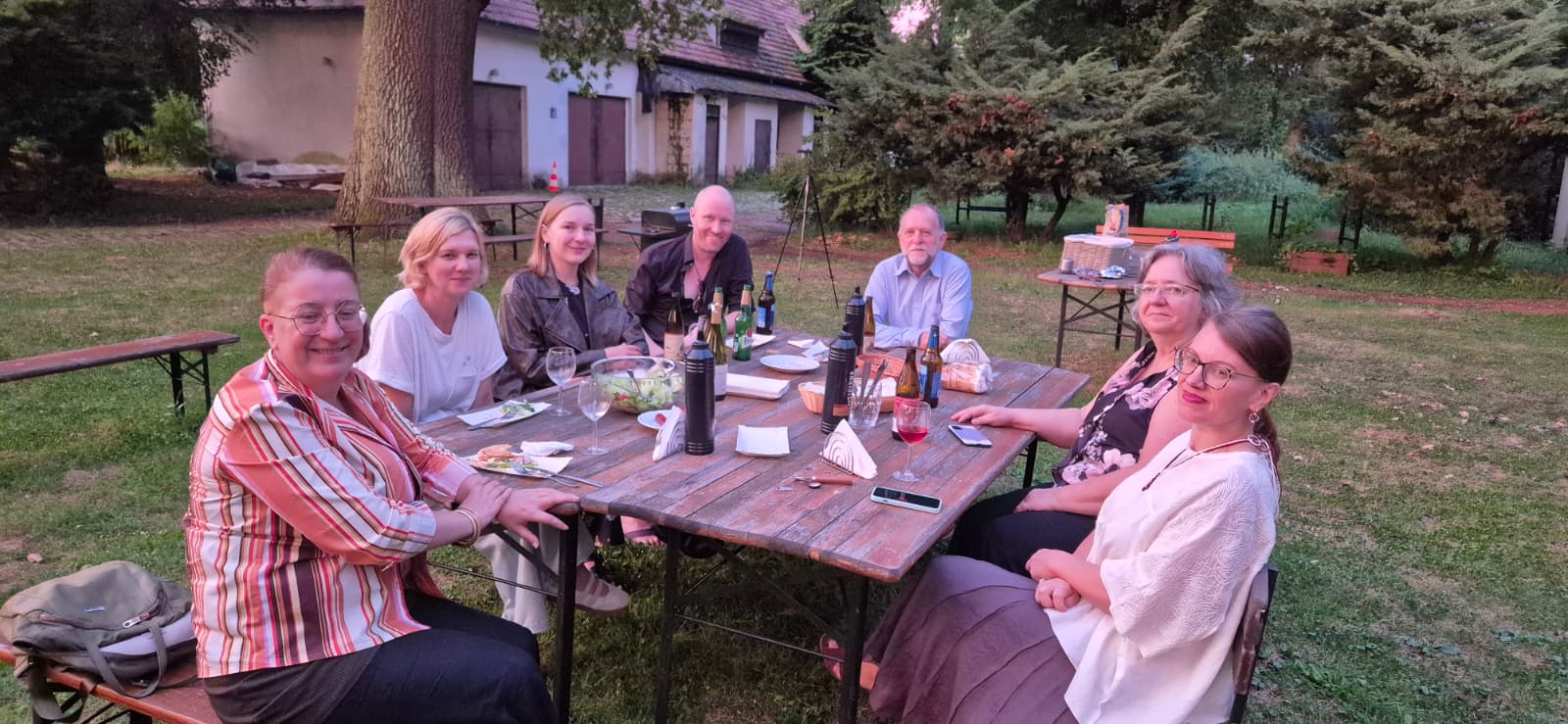
TUR residents meet with local Ukrainian literary activists.
~ ~ ~
Lifeboat for a Literary and Artistic Publishing Project
For Viktoriia Spalek and her colleague Richard Pettifer, the Translating Ukraine Residency created time to focus that can be particularly difficult to find amid the high-octane pace of everyday life in Berlin. As co-editors, they used the three weeks at Wojnowice to work on the second issue of DACH Magazine, an English-language publication, based in Berlin, featuring Ukrainian prose, poetry, art, and photography.
Spalek reflects:
Berlin is a huge city, constantly buzzing with events, with an endless noise hanging in the air. It is a wonderful city, but it constantly distracts you from work and can easily knock any idea out of your head in the middle of small talk.
The residency in Wojnowice became a lifeboat for our project. We had already announced the open call and selected the participants, but we simply could not find enough time that worked for both me and my colleague Richard in a city where there is always something else to do.
During three weeks of living in the castle, with the KEW team taking care of everyday life and leaving us free to focus entirely on our work, we translated the works of six writers and seven poets.
As a publication based in Germany, it was very important for us to be warmly welcomed in Poland, where we also had the opportunity to present the magazine in Wrocław.
We are incredibly grateful for this wonderful and productive experience.
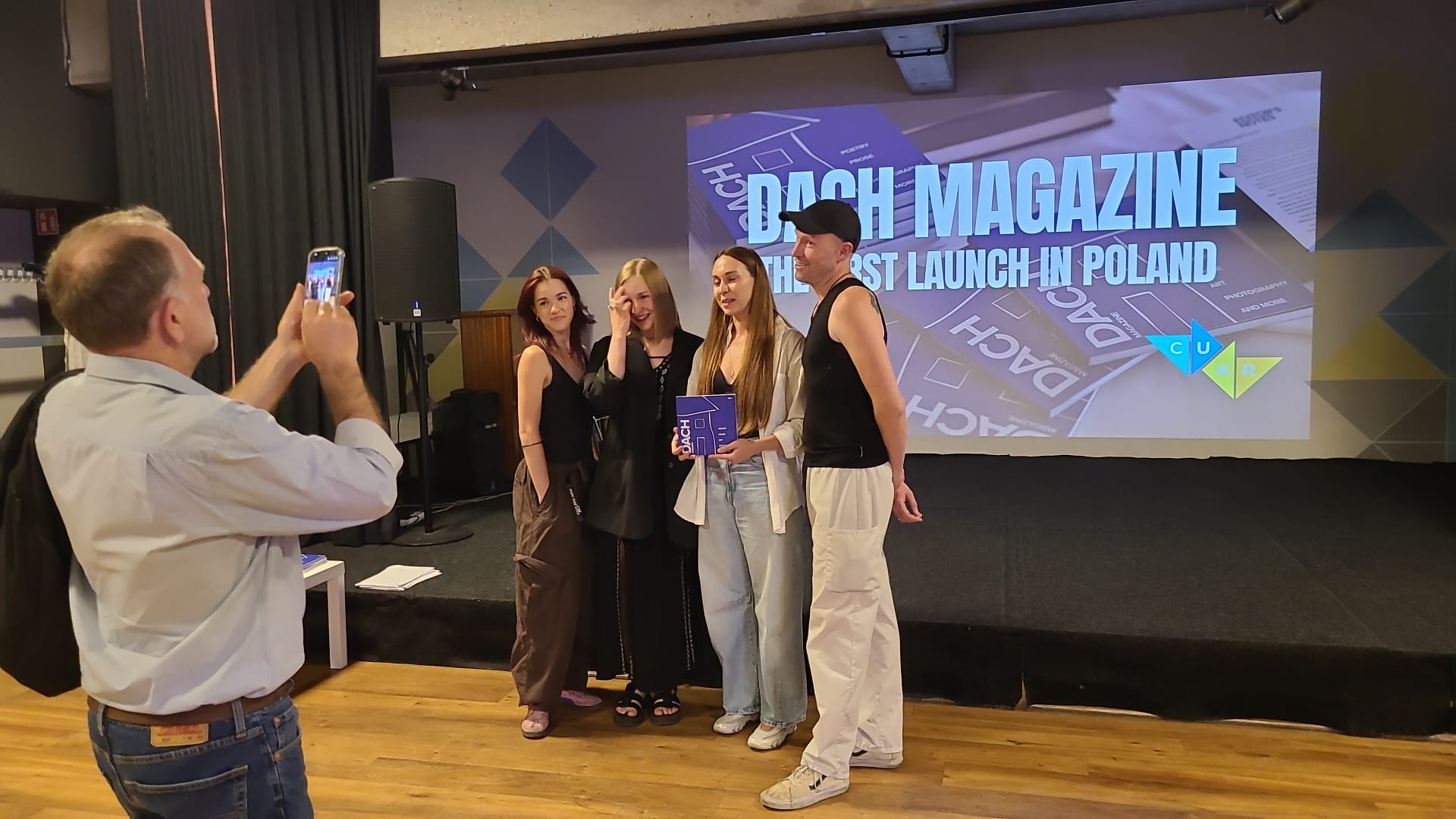
DACH Magazine co-editors with hosts at the CUKR Ukrainian Cultural Centre in Wroclaw.
~ ~ ~
A Superlative Professional Development Experience
For Ksenia Maryniak, the residency offered a rare opportunity to step away from the competing demands of work and everyday life and give sustained attention to literary translation. Ksenia’s principal project at Wojnowice was refining her English translation of the epic Ukrainian novel Doroha na Asmaru, forthcoming as The Road to Asmara in the Harvard Library of Ukrainian Literature. The residency was also a rewarding time of exchanging ideas with fellow translators and working in person with the novel’s author, Serhii Synhaivsky.
Maryniak writes:
For a specialist in our field, one would think it unusual to employ the expression "words cannot adequately describe..." Yet, following my Translating Ukraine Residency at the magical moated Wojnowice Castle, searching my feelings about it produces first of all a silent reverie of delight and gratitude. The location and conditions of our accommodation were simply ideal. Many thanks for the thoughtful, kind, comfortable, and frankly delicious service provided to the four of us at the Zamek-na-wodzie near Wrocław, Poland, sponsored by a broad institutional alliance and hosted by the wonderful Kolegium Europy Wschodniej under the scope of the EU-funded "Archipelagos" project.
Being able to dedicate my time to the creative challenges of literary translation—away from the obligations of home and day job—was blissful and very productive. I also greatly enjoyed the many dialogues, consultations, and conversations with fellow TUResidents, which were a rare and valuable benefit, given my prevailing non-literary occupations back in Edmonton and the University of Alberta. I can only hope that my input and perspective were in some measure as helpful to them as theirs were, fully, to me.
I am thankful furthermore for the absolutely unique chance to collaborate in person with "my" author, Serhii Synhaivsky, during the final few days of my residency. Last but not least, the TUResidency support allowed me to stop in Montreal on my way home at the invitation of the “Montréal littéraire” Ukrainian literary studio, in order to moderate a panel during the inaugural Montreal Literary Encounter, sponsored in part by the Literary Translators Association of Canada.
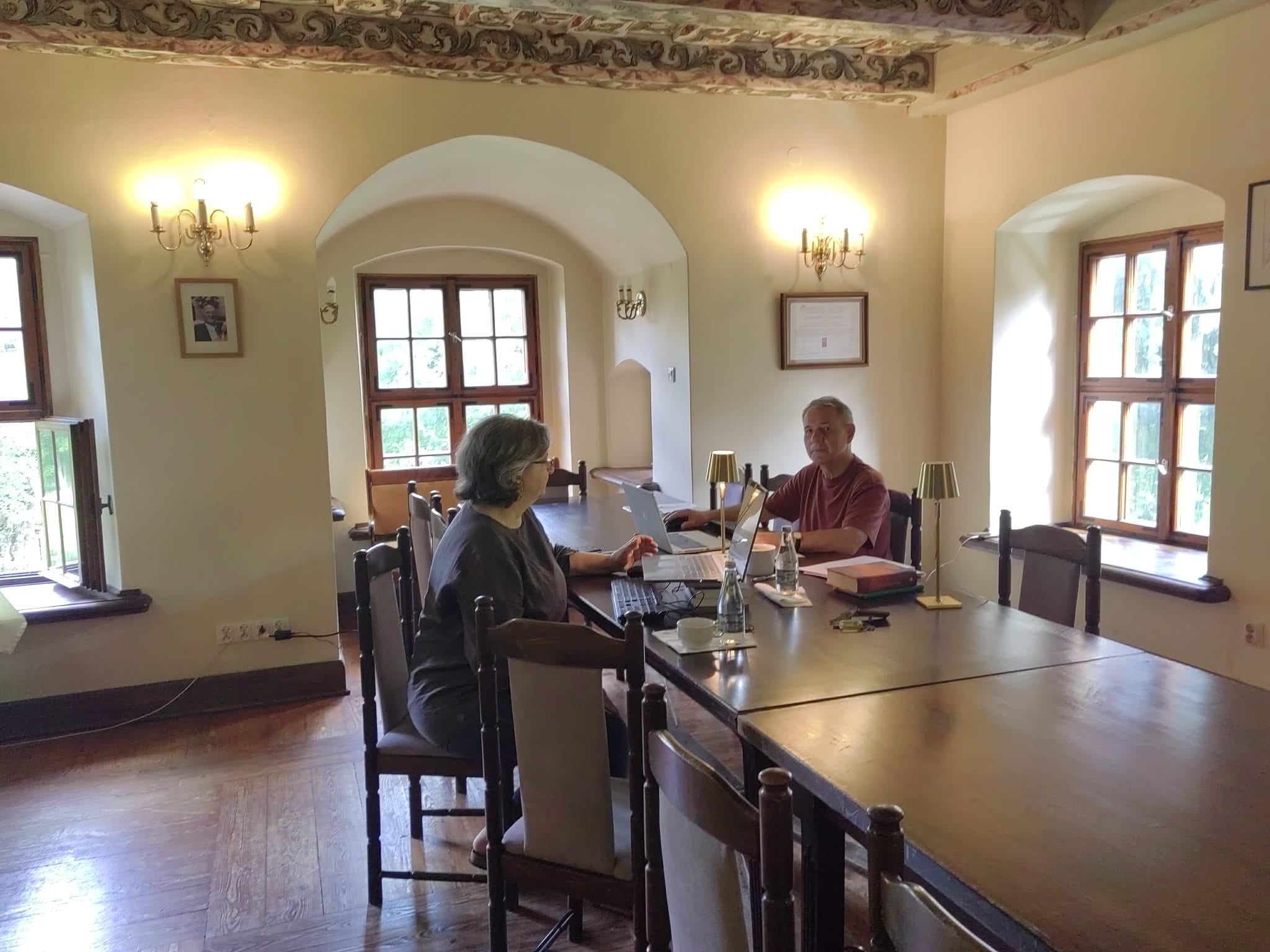
With Serhii Synhaivsky in the Wojnowice Castle’s Czapski Room.
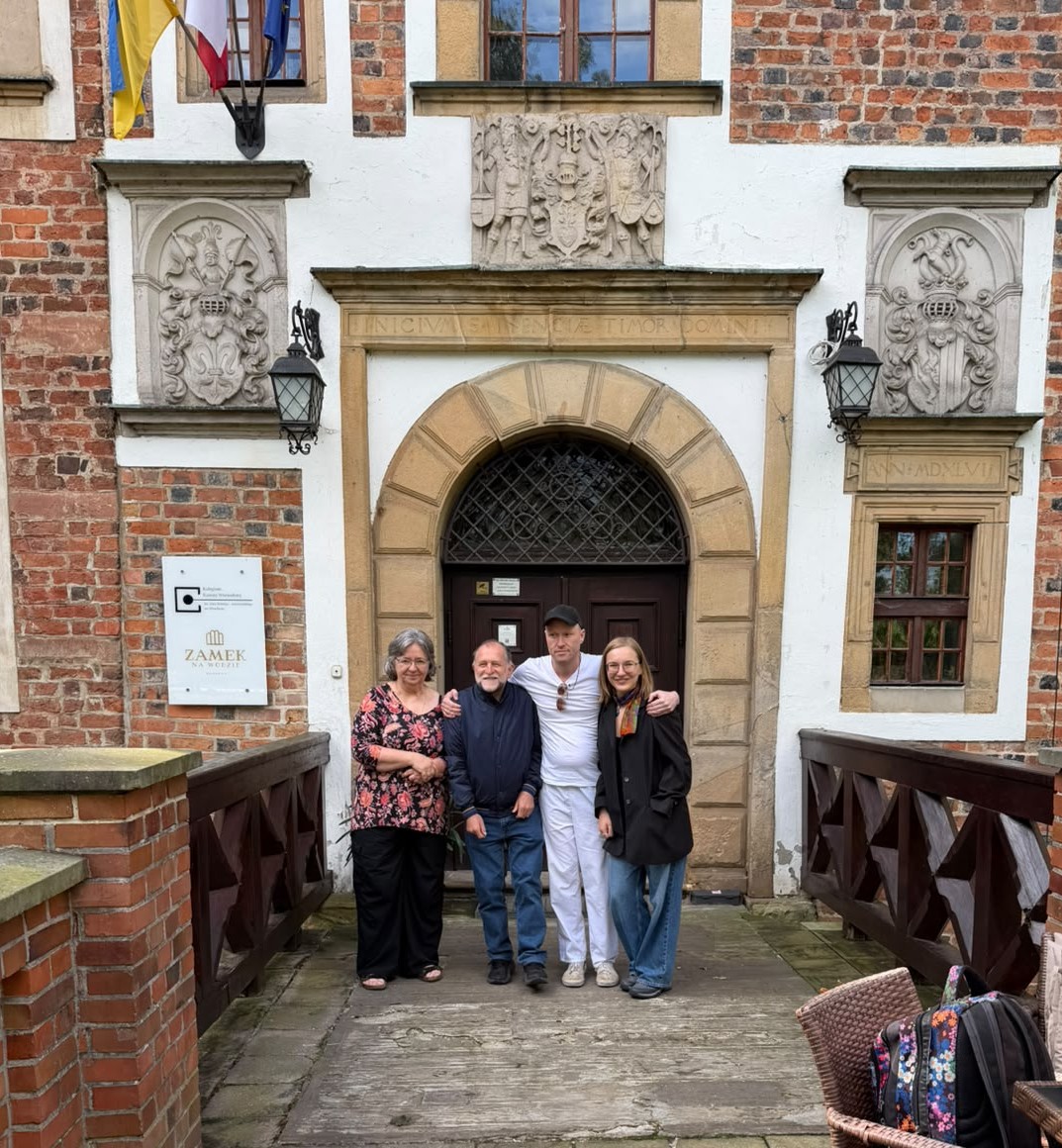
TUR residents at entrance to the Wojnowice Castle.
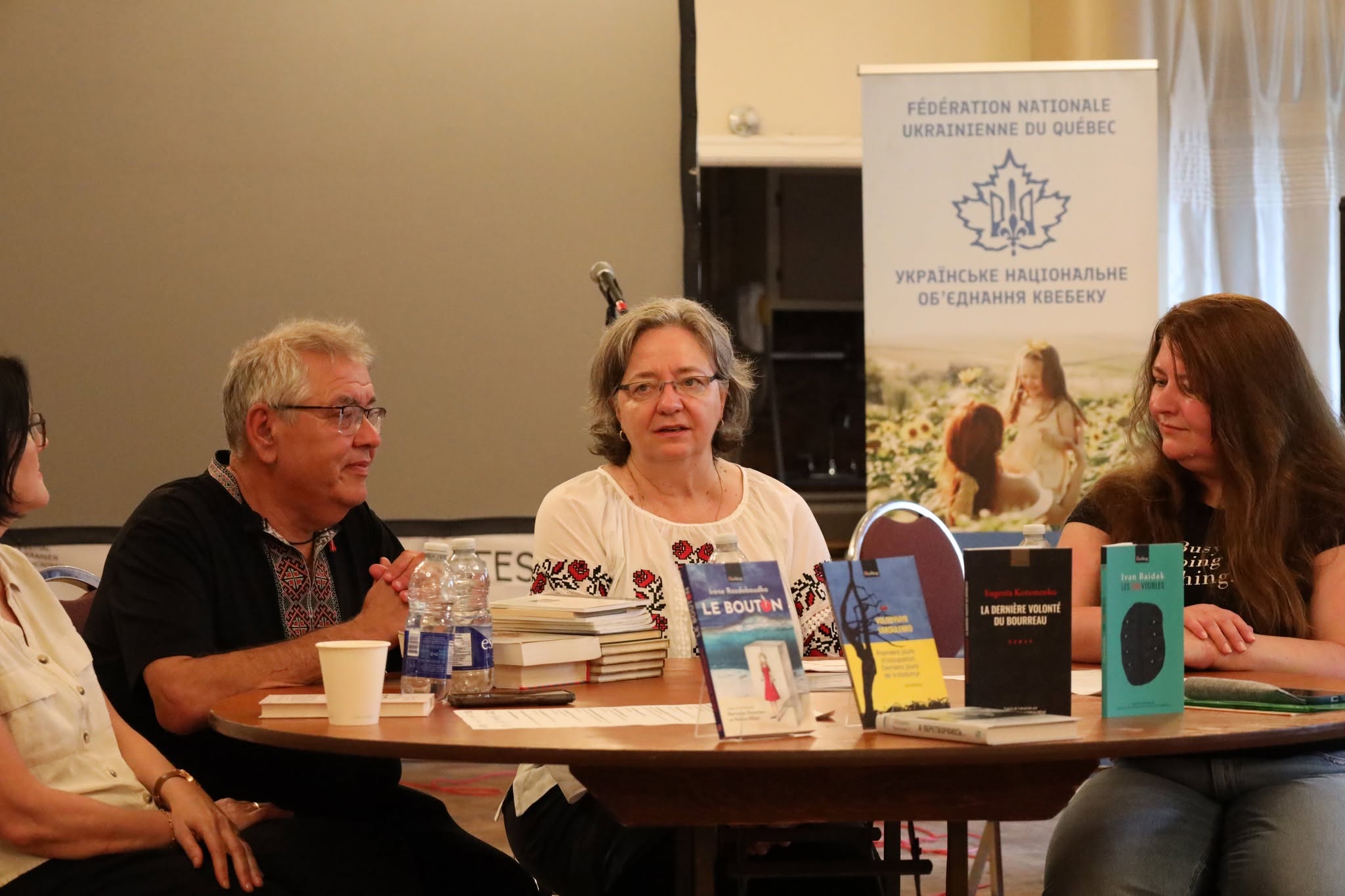
Describing the TUR experience at the Montreal Literary Encounter.
~ ~ ~
Life—and Work—in a Castle
For Yuri Tkacz, the residency experience combined focused work on his manuscript with the particular rhythms of life at the Wojnowice Castle: conversations with fellow translators, encounters with the local literary community, long walks through the surrounding forest—and one memorable encounter with the local fire brigade.
Tkacz writes:
Life in a castle takes some getting used to. There are rules, and the place has a rhythm of its own. The seclusion promotes working on a project, as well as healthy exercise—it’s a brisk half-hour walk to the local supermarkets to buy the little extras civilization accustoms you to. And a wander through the forest always clears the head.
The coffee here is excellent, much better than in most cafes. And the cooks are friendly and always trying to please. I am grateful to those back home in Australia who encouraged me to come here, and to those here who accepted me so warmly.
It was an interesting journey getting to know the others at this residency, learning from their experience and their approach to the translation craft. Also it was great to be able to meet local editors and writers, to hear from them about the Wroclaw experience and to participate in the local launch of Dach magazine. I guess everyone will remember us setting off the fire alarm after frying too many sausages too quickly, causing three fire brigade units to turn up.
As I am also a keen nature lover, I loved taking daily hikes throughout the forest and identifying the multitude of different fruiting plants and partaking of their fruits. Blackberries, dewberries, black raspberries, red currants, hazelnuts, sloe, prunes, cherries, cherry plums, guelder rose and bird cherry abound in the forest.
Looking forward to presenting the MS of “Children of the Prairies” to Jars Balan to write an introduction and bring the book to print in 2027.
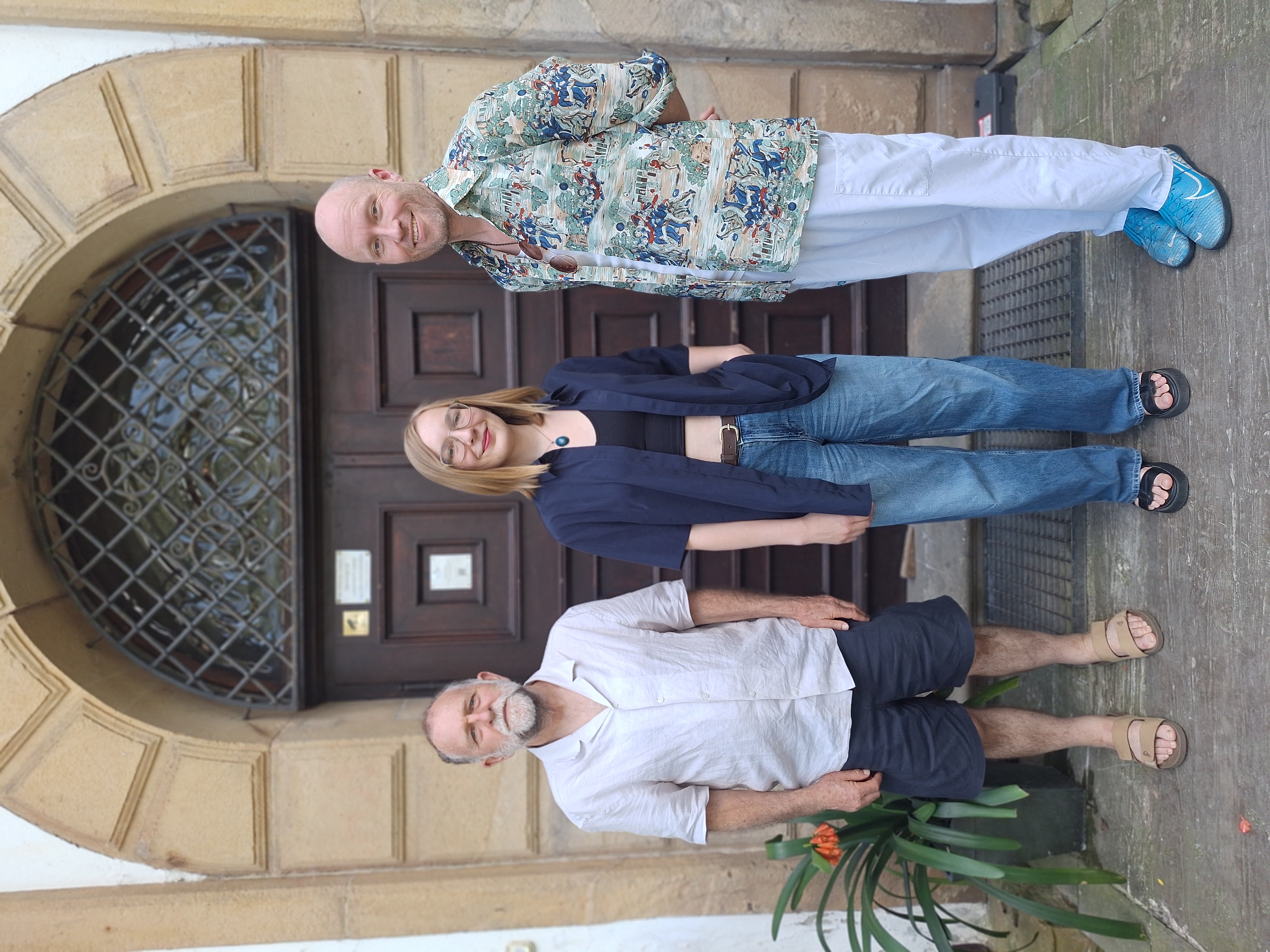
Yuri Tkacz, Viktoriia Spalek, and Richard Pettifer.
~ ~ ~
Supporting Ukrainian Translation
The Translating Ukraine Residency offered translators dedicated time and space to advance their projects while exchanging ideas and experiences with colleagues from around the world. Hosted at Wojnowice Castle, the residency reflects a shared commitment to strengthening Ukrainian-to-English translation and the community behind it.
The Translating Ukraine Summer Institute and Residency are jointly organized by an alliance that includes the Ukrainian Research Institute at Harvard University; the Canadian Institute of Ukrainian Studies (CIUS), Kule Institute for Advanced Study (KIAS), and Disrupted Ukrainian Scholars and Students initiative (DUSS) at the University of Alberta; the Harriman Institute at Columbia University; the Yale Ukrainian Program at Yale University; the Ukrainian Studies Program at the University of Cambridge; Kolegium Europy Wschodniej; the National Ossolinski Institute; New Eastern Europe; NGO Translatorium; and the Shevchenko Scientific Society in the US.
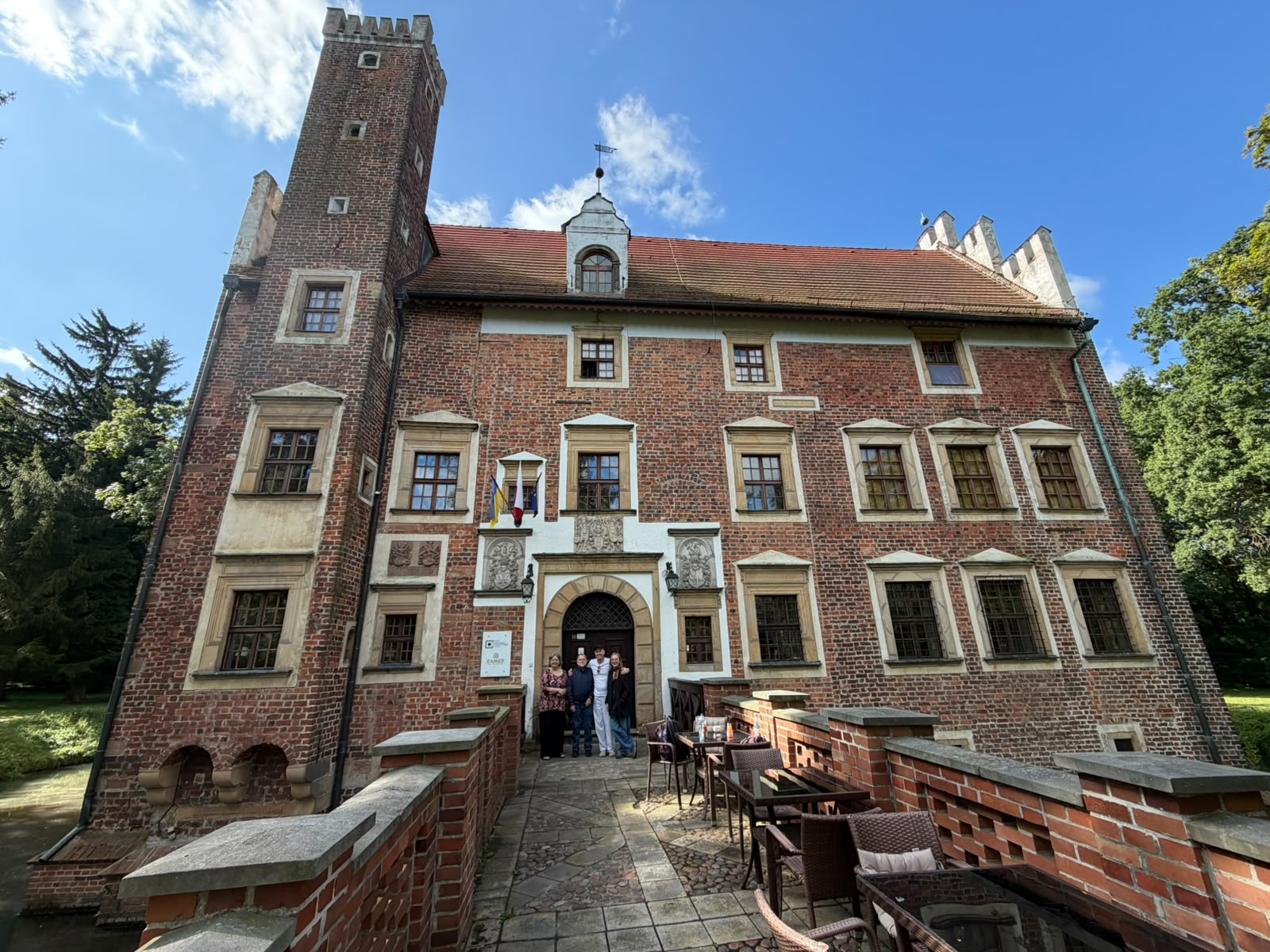
TUR was hosted by the Kolegium Europy Wschodniej at the Zamek-na-wodzie Castle at Wojnowice near Wroclaw.
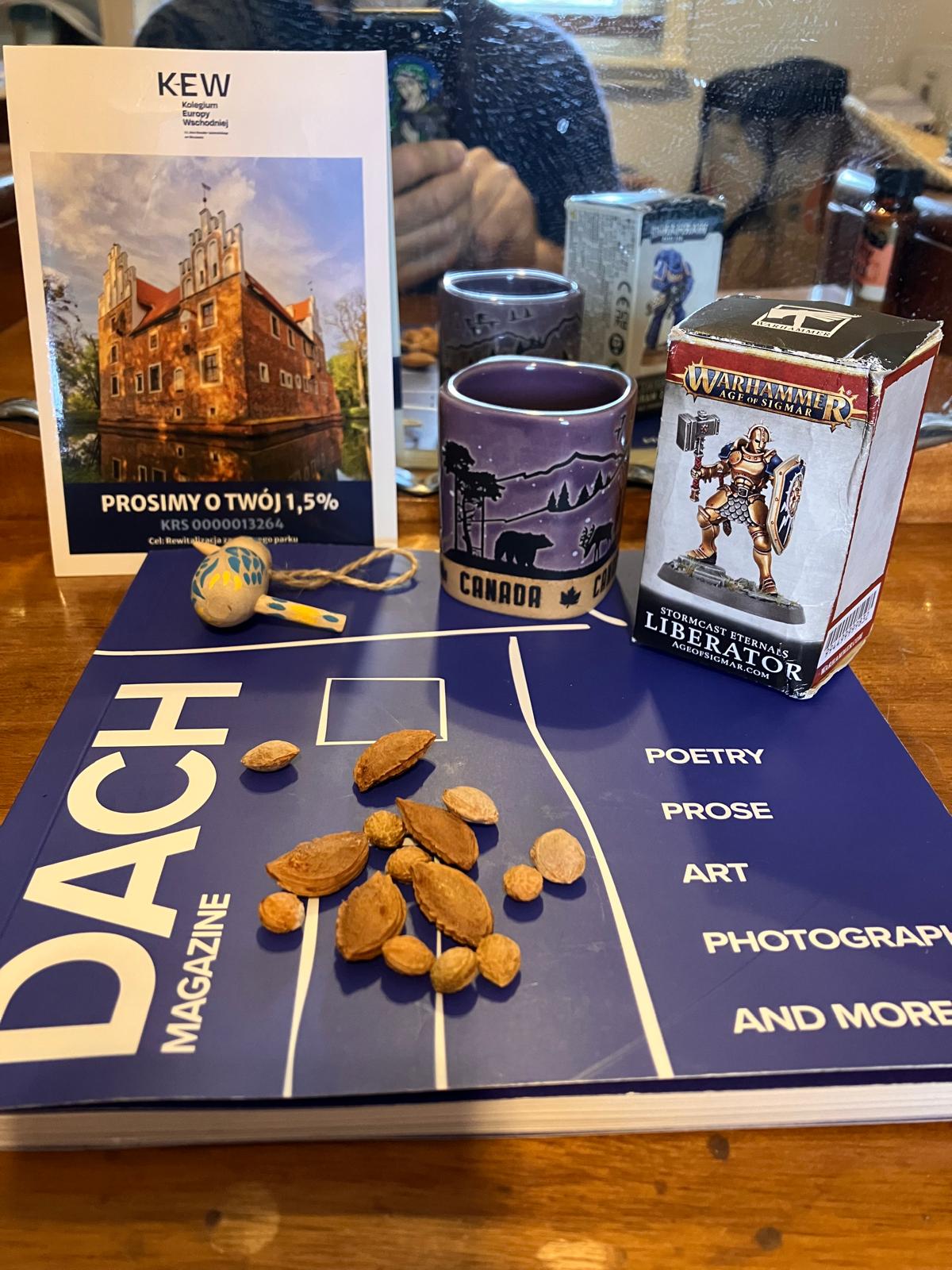
Souvenirs and unforgettable memories.