Convocation - Spring 2026
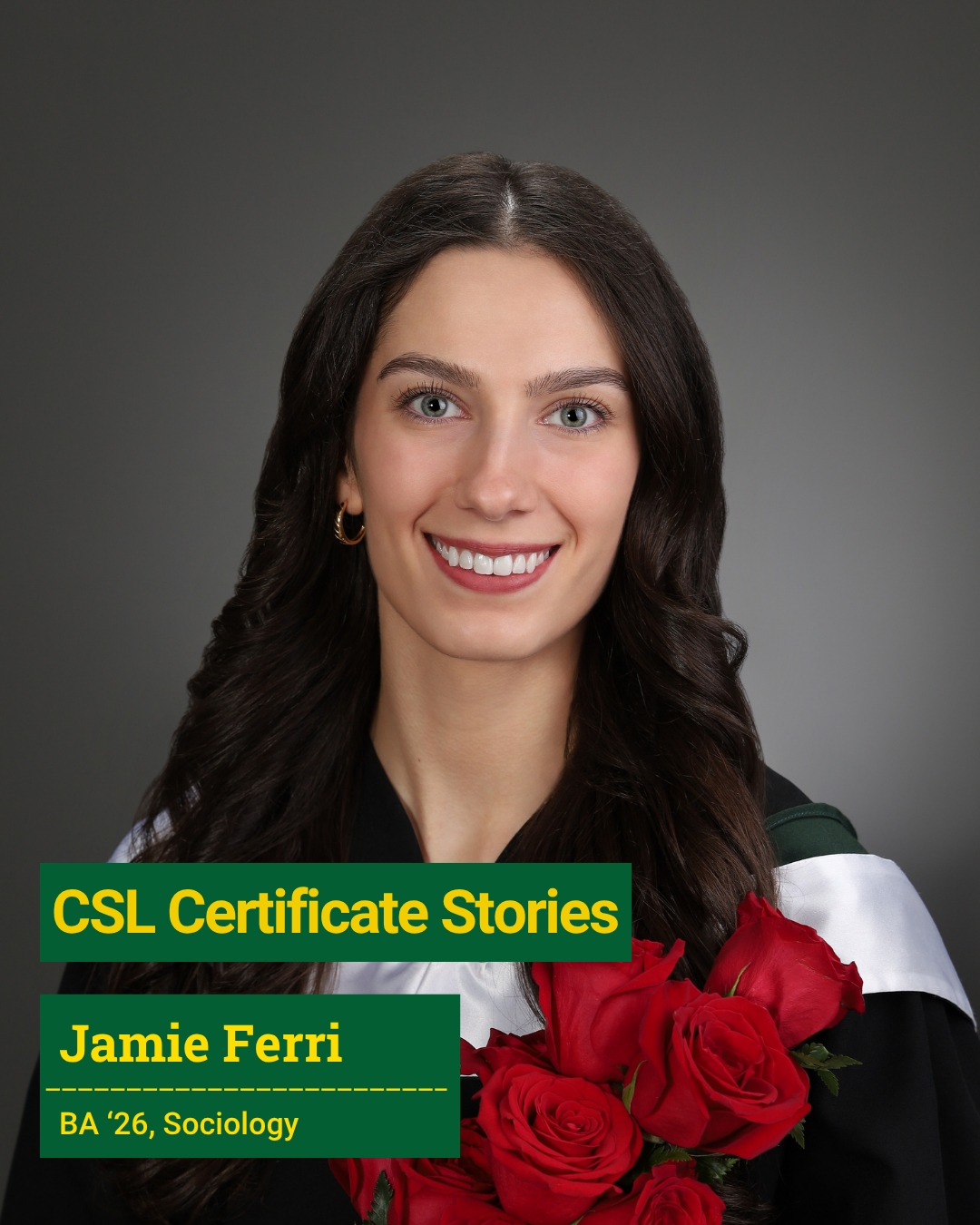
Jamie Ferri | Bachelor of Arts Sociology, minor in Psychology
Why did you decide to pursue the CSL certificate?
I decided to pursue the Community Service-Learning certificate because I wanted opportunities to learn beyond the classroom and become more involved in the community. The certificate offered a unique way to connect academic learning with meaningful participation while gaining experience with local organizations. I was also interested in developing practical skills such as communication, teamwork, and leadership. Most importantly, I wanted to better understand the diverse experiences and needs of people within my community.
How did you integrate CSL into your degree?
I integrated CSL into my degree by completing CSL courses that complimented my academic interests in health, community development, and social inclusion. Through courses such as CSL 100, 200, 350, and other designated CSL courses (i.e. REN R 465 & EDU 100), I connected sociological and psychological concepts to the experiences of individuals and organizations in the community. The reflective assignments encouraged me to critically examine my assumptions, values, and role within community partnerships. These experiences helped bridge the gap between academic learning and practical application.
What was your favourite CSL placement or experience?
My favourite CSL experience was my placement at The Steadward Centre for Personal & Physical Achievement (TSC). Working alongside individuals with disabilities in adaptive physical activity (APA) programs allowed me to build meaningful relationships with participants and witness the impact of accessible programming. I particularly enjoyed seeing participants gain confidence and achieve personal goals through physical activity. The sense of community within the program made this experience especially memorable.
What impact did CSL have on your academic and career goals?
CSL had a significant impact on both my academic and career goals by helping me discover my passion for rehabilitation and person-centered care. My experiences, particularly at TSC, reinforced my interest in supporting individuals' participation in meaningful activities and ultimately inspired me to pursue a master's in occupational therapy. Academically, CSL encouraged me to think more critically about the relationship between social systems, health, and community well-being. Through these experiences, I gained a deeper understanding of the type of work I hope to pursue and the impact I want to have in the future.
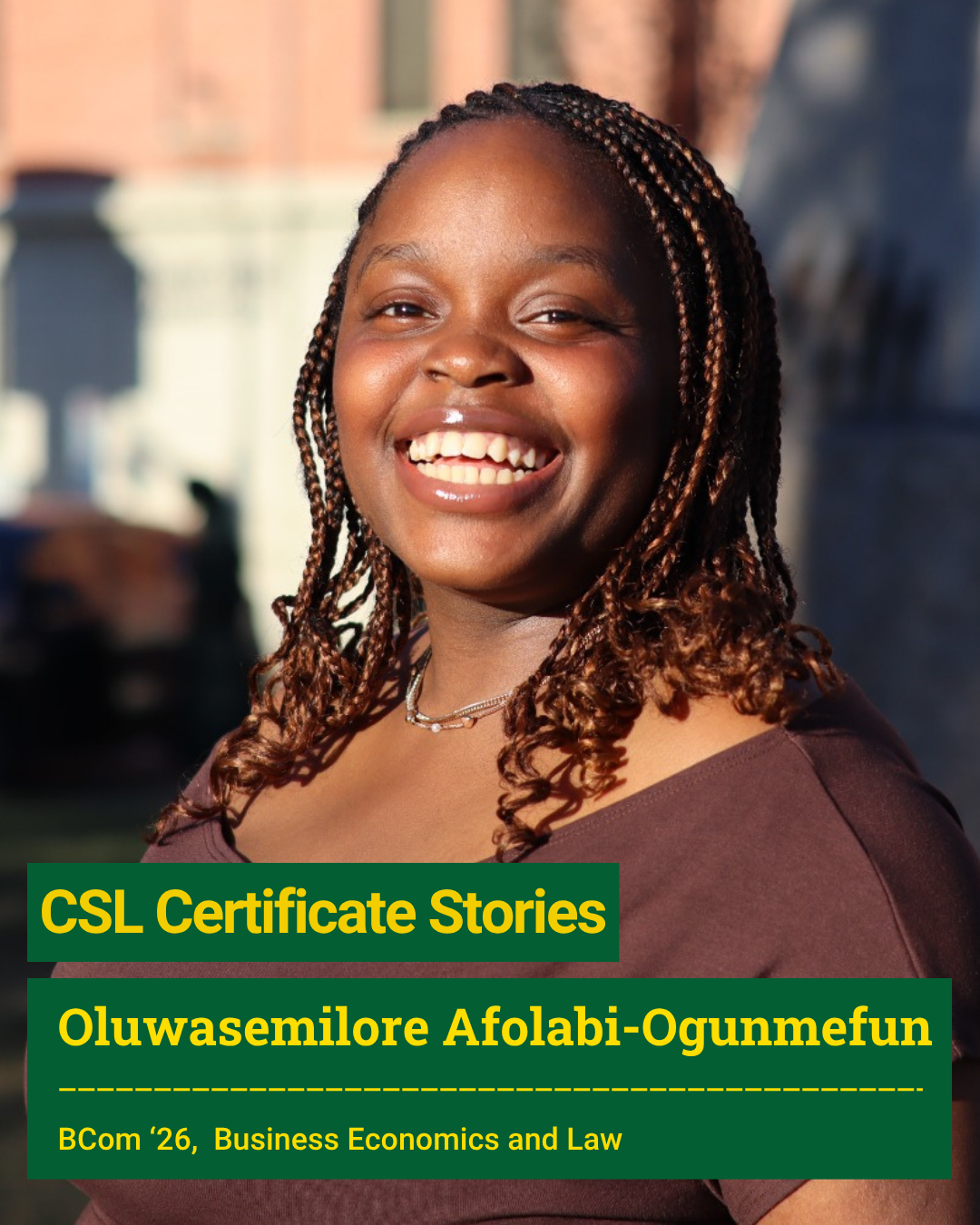
Oluwasemilore Afolabi-Ogunmefun | Bachelor of Commerce Business Economics and Law
Why did you decide to pursue the CSL certificate?
I decided to pursue the CSL certificate to apply what I was learning in the classroom to real community challenges. I was especially interested in developing professional skills and building relationships with community partners. I also wanted to understand how academic concepts can create a positive social impact.
How did you integrate CSL into your degree?
I integrated CSL into my business degree by selecting courses and placements that matched my interests in sustainability, corporate social responsibility, and strategic management. These experiences allowed me to apply business concepts to real-world community challenges. They also showed me how theories from class can be adapted to meet the needs of organizations and communities. As a Business student, I initially expected to focus mainly on organizational performance, strategy, and profitability. However, CSL taught me that business concepts can also support community-focused goals. Instead of seeing business and community engagement as separate, I learned they can work together to create meaningful and sustainable outcomes.
What was your favourite CSL placement or experience?
My experience with Waste Free Edmonton stands out because it allowed me to work on a current public policy issue with tangible environmental and community impacts. I enjoyed collaborating with the organisation to better understand its goals, identify target audiences, and develop strategies to encourage behaviour change. The experience demonstrated how marketing principles can be applied beyond traditional business objectives to support sustainability initiatives and community education.
What impact did CSL have on your academic and career goals?
CSL helped me see the practical value of the concepts I study and strengthened my interest in applying those skills outside the classroom. Working directly with community organizations improved my communication, project management, research, and stakeholder engagement skills. It also gave me greater confidence in my ability to contribute to projects with real social impact, influencing how I think about my future career and the kinds of organizations and initiatives I would like to support.
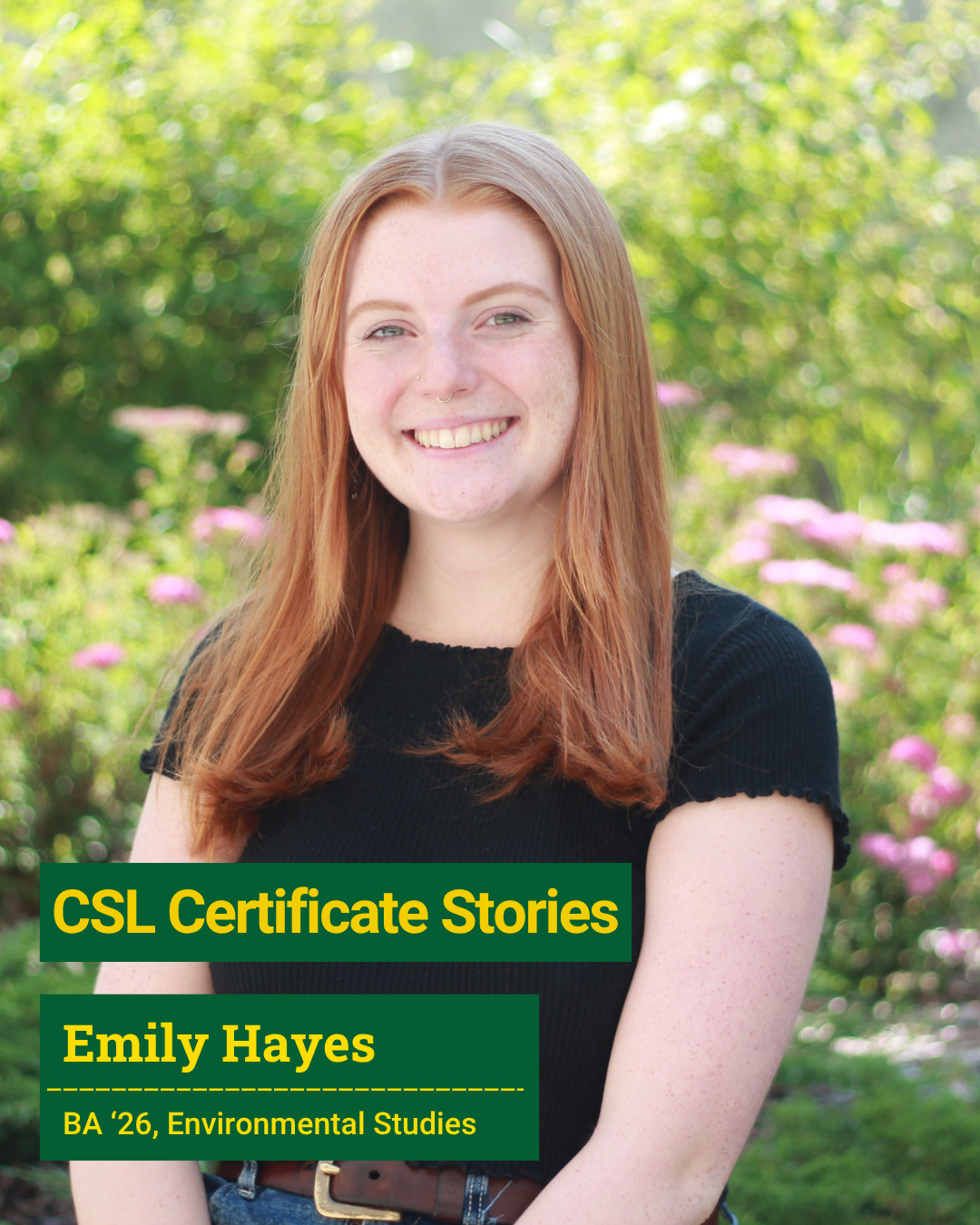
Emily Hayes | Bachelor of Arts Environmental Studies concentrating in Politics, Society and the Global Environment
Why did you decide to pursue the CSL certificate?
I was initially introduced to the certificate while taking a required course in first year (AREC 173) which had a CSL component. I liked the idea not only because it would allow me to explore my classroom learning in a new context but also because I could get more experience in the nonprofit sector. I have always loved volunteering and learning about new causes. In this regard, the CSL certificate seemed like the perfect fit!
How did you integrate CSL into your degree?
I started my degree during the height of COVID-19 in 2020 which gave me a lot of time to research opportunities like certificates. I had heard that at least one or two more of my courses would also have this component so I looked into the requirements. Luckily, I was in a very flexible degree program and the goals of CSL aligned very much with the hands-on component I already set out to accomplish in my studies. It was all worth it!
What was your favourite CSL placement or experience?
For SOC 291 Environmental Sociology, I was placed with Council of Canadians. I worked with them and other local climate activists to make a theatrical demonstration on why we should be pursuing a just climate transition. We went and performed it outside of the MPs office in Edmonton-Riverbend. I loved this placement because I was truly treated as an equal and my opinions were not just heard but encouraged in the campaign planning. It felt very collaborative and encouraged me to get more involved in the climate action space. I am still in contact with a few connections I made during this placement which has been wonderful!
What impact did CSL have on your academic and career goals?
Overall, I think CSL really just solidified that the non-profit space was for me. I have always had an interest in grassroots initiatives and was very encouraged by what I saw in my placements. I was also incredibly lucky to get to work for the CSL office in my last semester as the CSL intern. I got to develop professional skills while learning a lot about the nonprofit sector from a more professional lens. The CSL team is also just incredible and was a great influence in knowing the type of workplace environment I want to work for in the future!
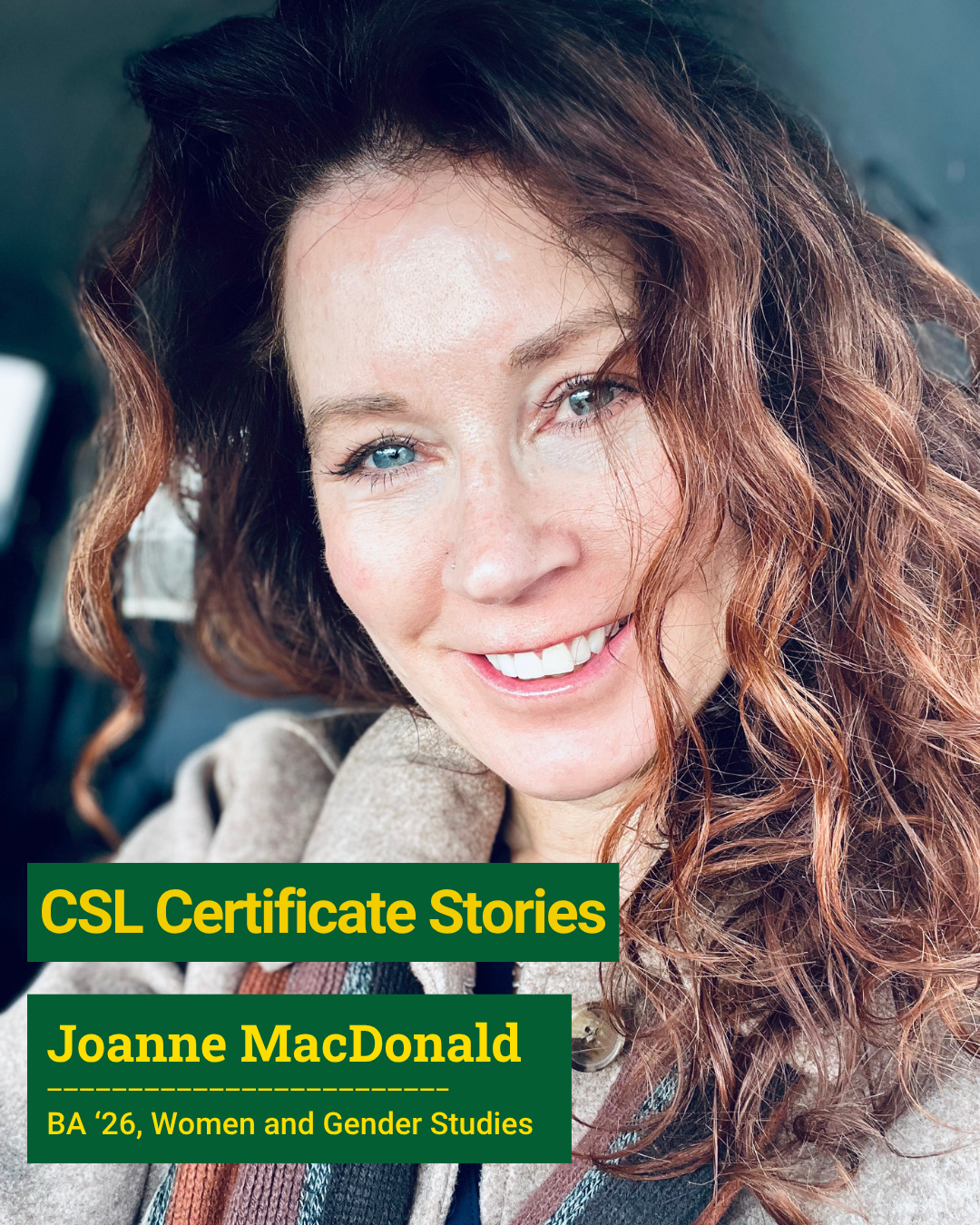
Joanne MacDonald | Bachelor of Arts Women and Gender Studies, minor in Art and Design
Why did you decide to pursue the CSL certificate?
I discovered CSL almost accidentally in my first year, while I was exploring the Faculty of Arts online. However, it was not until my second year that I was able to fit a CSL class into my schedule, and then I was hooked! I felt that CSL aligned really well with my academic and career goals of wanting to work with the community and non-profit sector, and I was especially excited by the volunteer aspect. I felt that pursuing the CSL certificate was a great way to add another credential to my degree, as well as providing me with real-world experiences and connections in the community.
How did you integrate CSL into your degree?
As an Arts student, I found it quite easy to integrate CSL into my degree, as there are many courses that fall under that umbrella. My first CSL course was CSL 100 with Dr. Nixon, and I was initially concerned about how I would manage the requisite 20 hours of volunteerism. However, I soon realized that the work could easily align with my other courses and personal commitments because there were many placement choices and lots of scheduling flexibility. Looking back, I am so glad I chose to earn the CSL certificate, as it was definitely one of the most meaningful parts of my degree.
What was your favourite CSL placement or experience?
It is actually difficult to pick just one, as each placement and class was unique, and the experiences were unlike any other during my time at the U of A. So I would like to highlight two standout experiences.
I was very fortunate to take CSL 370: Walls to Bridges, with Jay Freisen, a course that took place inside the Edmonton Institute for Women. This course was unique, not just because of the location, but because it combined university students and incarcerated students together as equal participants, learners, and knowledge keepers. This course, and the people I learned with each week, were unforgettable. They made the theory and academic constructs I had been studying come to life in ways that I will carry with me forever.
Another standout experience was my CSL internship with HUM 101, under Lisa Prins. During my internship, I worked with adult learners in two HUM classes: an off-campus Humanities course and an on-campus Science course. The students in HUM come from a wide variety of backgrounds and experiences, and are not what is typically considered your “usual” university student. As a mature student myself, I felt a connection to these amazing and enthusiastic learners, whose lifelong love of learning continues to inspire me. The internship not only provided me with fantastic work experience, but also deepened my commitment to pursue work in the non-profit sector, as many of these students were facing barriers to education and many other essential resources.
What impact did CSL have on your academic and career goals?
CSL is such a unique program. Not only does it offer engaging and thought-provoking coursework that aligns beautifully with academic theory, but it also provides real-world experiences that bring those theories to life. Through my placements and coursework, I was able to move beyond simply studying concepts in the classroom and engage directly with the communities and organizations connected to those issues.
One of the most meaningful aspects of CSL was the opportunity to connect my academic studies with my personal interests. As a Women and Gender Studies student with a minor in Art and Design, I am very interested in the ways that art and community align. My placement with E4C Art Start allowed me to combine community engagement with my passion for art. Through arts-based programming, I worked with elementary school children while developing practical skills in facilitation, communication, and relationship-building. It was an experience that showed me how creativity can be a powerful tool for connection, learning, and community development.
All of my CSL experiences really deepened my understanding of social issues, strengthened my communication and facilitation skills, and helped me develop meaningful relationships within the community. Perhaps most importantly, CSL helped clarify my career direction. Before entering the program, I knew I was interested in community work, but CSL showed me the many ways that education, advocacy, and community engagement intersect. My CSL experiences reinforced my desire to pursue work in the non-profit and community sectors. Pursuing the CSL certificate was the highlight of my undergraduate experience, and I highly recommend it to any student who is looking to create meaningful connections and graduate with an increased understanding of themselves and their relationships to their community.
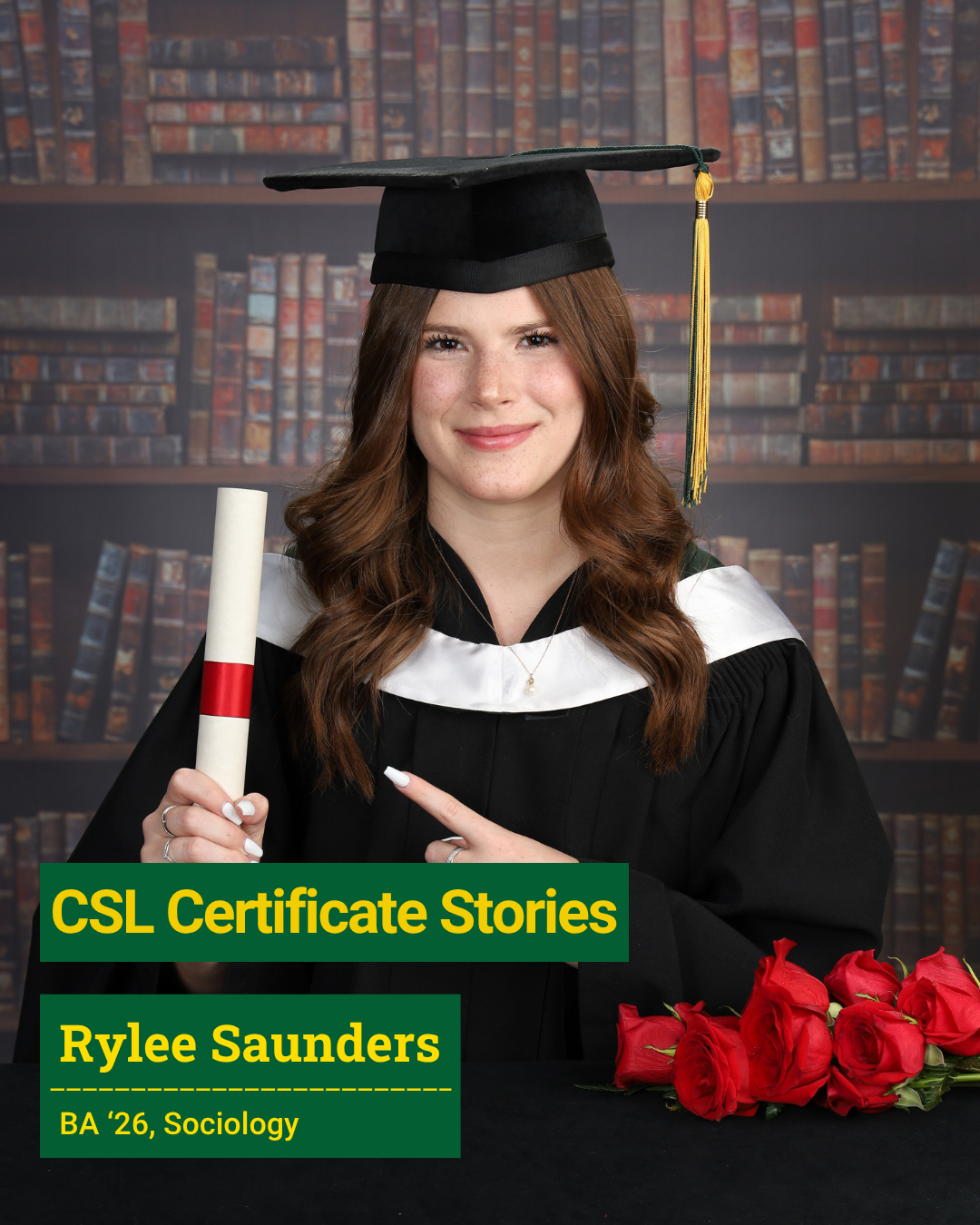
Rylee Saunders | Bachelor of Arts Sociology, minor in History
Why did you decide to pursue the CSL certificate?
I have had a passion for volunteering since a young age. My uncle first got me involved by helping create and distribute food hampers to those in need during the Christmas season. I have also had the pleasure of working at a non-profit organization that directly engages with the public and many amazing people for the past three years. When I heard about the CSL Certificate, I knew it would be a perfect fit for me, allowing me to work with and learn from incredible individuals while becoming more involved in the community here.
How did you integrate CSL into your degree?
The certificate integrated quite well into my degree. Having a sociological perspective and learning about different types and levels of structural inequalities, as well as the importance of cultural relativism, allowed me to become a better volunteer with a more empathetic and holistic understanding of social and cultural issues.
What was your favourite CSL placement or experience?
My favorite placement was right here on campus! I worked with ISVS and helped co-lead their English Conversation Club (ECC), which I really enjoyed. It allowed me to meet people from all over the world and support them on their journey of integrating into Canadian society and culture.
What impact did CSL have on your academic and career goals?
The CSL Certificate truly solidified my passion for working in the public service and community sector. It allowed me to put into practice the concepts I was learning in my classes and helped me become a better person, advocate, and community member as a result.
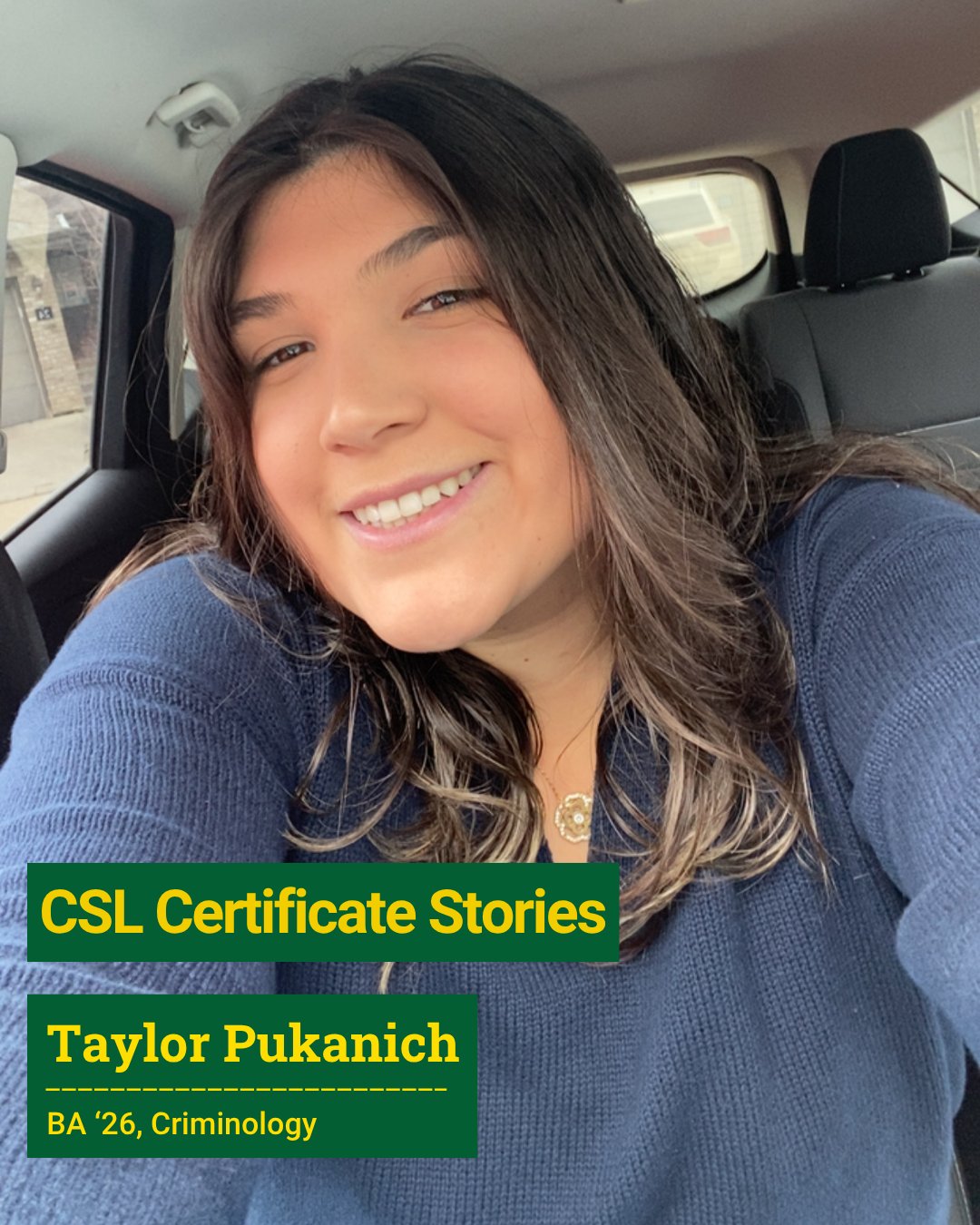
Taylor Pukanich | Bachelor of Arts Criminology
Why did you decide to pursue the CSL certificate?
I decided to pursue the CSL certificate after taking CSL 100, which was recommended to me by a friend. I really enjoyed the course, especially the integrated volunteer component that is core to all CSL classes. Through that experience, I learned about the certificate and liked the idea of how I could complete it alongside my degree without any additional tuition.
How did you integrate CSL into your degree?
I integrated CSL into my degree by prioritizing CSL courses as my free electives, as these classes felt like a breath of fresh air compared to my other university courses. I appreciated the collaborative, hands-on learning environment that CSL offers. Through these courses, I built meaningful connections with organizations related to my field, such as the Youth Restorative Action Project. These experiences were incredibly valuable as a student. Some placements also led to strong professional relationships with supervisors, with a few even providing reference letters for job opportunities and scholarships.
What was your favourite CSL placement or experience?
My favourite CSL placement was with the Alberta Basketball Association. It was a unique experience helping run Alberta Provincials, a large-scale weekend event that required full engagement over three days. I really enjoyed being fully immersed in the event and contributing in various ways through event management. It was awesome to earn academic credit while being involved in something connected to one of my favourite hobbies—basketball.
What impact did CSL have on your academic and career goals?
CSL had a significant impact on my academic and career goals. Through volunteer placements, networking opportunities, and engaging hands-on experiences, I gained valuable skills and connections that will support my future career. I highly recommend completing a CSL certificate to anyone considering it.
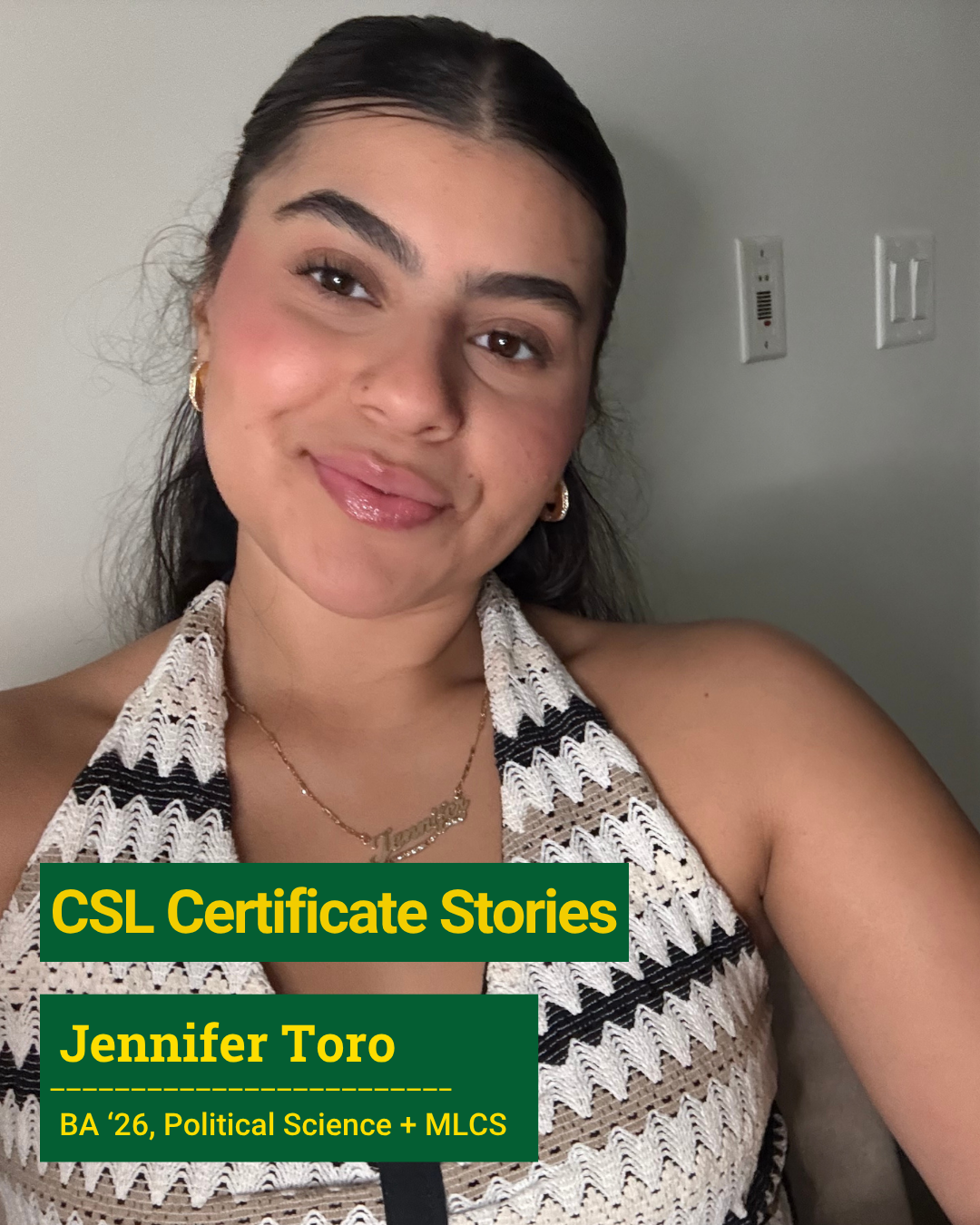
Jennifer Toro | Bachelor of Arts Political Science and Modern Languages and Cultural Studies, minor in Sociology
Why did you decide to pursue the CSL certificate?
Looking back on my undergraduate experience, Community Service-Learning became one of the most meaningful parts of my degree, even though it wasn't something I initially planned for.
I became heavily involved on campus throughout my studies, and many of my MLCS courses included CSL components. Since I was already pursuing several certificates and genuinely enjoyed volunteering, pursuing the CSL Certificate felt like a natural next step. What began as a way to formalize experiences I was already enjoying quickly became one of the most impactful aspects of my university journey.
How did you integrate CSL into your degree?
CSL helped fill a gap I was feeling in my studies. I have always loved theory, research, and academic inquiry, but at times those conversations felt distant from the communities and people I hoped to serve. CSL offered an opportunity to connect classroom learning with real, tangible community impact. It allowed me to see how language, culture, politics, and history shape people's lived experiences while also challenging me to think critically about my own role within the community. As someone whose faith emphasizes service, care, and community, CSL also gave me a meaningful way to put those values into practice.
What was your favourite CSL placement or experience?
One of the things I appreciated most about the certificate was the variety of experiences it offered. Through my MLCS courses, I worked with Sombrilla, translating materials to support educational initiatives in Central America. I volunteered with USchool, where I helped bridge language and cultural understanding through translation and communication support. I also completed both credited and non-credited placements with the Edmonton Down Syndrome Society, supporting their work through administrative and community engagement initiatives.
While my placement with the Edmonton Down Syndrome Society remains one of my favorite experiences, I would also like to highlight a CSL project I completed through the University of Alberta Library. As part of this experience, I transcribed and produced metadata for Obispados y Prebendas de Guatemala, an eighteenth-century collection of digitized colonial Latin American documents. I also had the opportunity to co-create a digital humanities project using ArcGIS StoryMaps focused on the Codex Osuna, a significant colonial Mexican codex.
Through this work, I gained a greater appreciation for the importance of preserving, transcribing, and studying historical documents. My professor, Dr. Ann De Leon, often emphasized that transcription is not simply administrative work; it is a way of preserving memory, increasing accessibility, and ensuring that important histories continue to be studied and understood. Participating in this project strengthened my understanding of identity, history, and power within my coursework while showing me how even small contributions can have a lasting impact on scholarship and community knowledge.
What impact did CSL have on your academic and career goals?
CSL has deeply shaped both my academic and personal life. It has shown me how much classroom learning can be enriched through real-world application and taught me the value of patience, empathy, reflection, and community engagement. It challenged me to rethink what service means, how learning extends beyond textbooks, and how even small contributions can create meaningful change.
As a Political Science student, CSL fundamentally changed the way I understand the polis. It reminded me that politics is not only about institutions, governments, or theories, but also about people, relationships, culture, and community. It strengthened my commitment to connecting academic knowledge with lived experience and taught me the importance of understanding and speaking the language of the communities we hope to serve.
More than anything, CSL reinforced my belief that meaningful learning happens when we step outside the classroom and engage with the world around us. The certificate not only shaped my academic interests and future career goals, but also helped me become a more thoughtful community member, leader, and person.
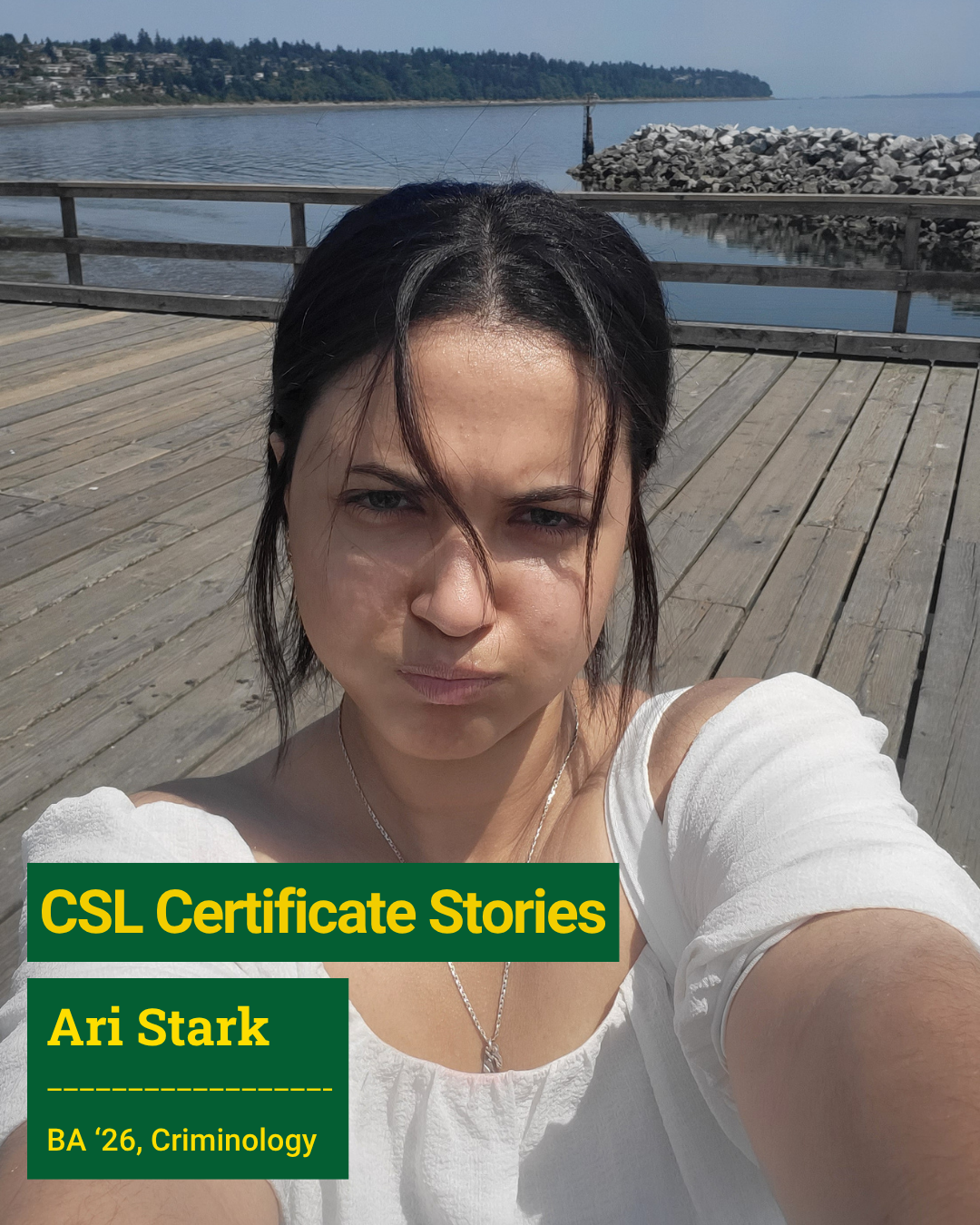
Ari Stark | Bachelor of Arts Criminology
Why did you decide to pursue the CSL certificate?
Honestly, I originally started taking CSL courses because I heard they were relatively easy and fit well into my degree. After my first course, though, I realized I actually really enjoyed it. I liked being out in the community instead of just in a classroom, and I found the experience way more interesting than I expected. What started as a practical choice turned into something I genuinely wanted to keep doing, so I ended up completing the certificate.
How did you integrate CSL into your degree?
I just worked CSL courses into my degree whenever I could. They gave me a nice break from regular coursework while still letting me learn in a more hands-on way. I got to connect what I was learning in class to real community settings and build volunteer experience at the same time. Since I’m interested in medicine, I also liked being able to work with different organizations and practice things like communication, teamwork, and adapting to different environments.
What was your favourite CSL placement or experience?
My favourite CSL placement was my first one with the Jewish Senior Citizens’ Centre. I went in thinking I’d mostly just be learning about community programming, but it ended up being a lot more fun (and memorable) than that. I was helping out in the kitchen, and it quickly became obvious that my vegetable-chopping skills were not exactly up to standard. The ladies had no problem calling me out on it either, which honestly made it funnier and made me feel really welcome at the same time.
What I remember most is how comfortable and friendly everyone was. I got to hear people’s stories, spend time with folks who had very different life experiences from mine, and just be part of a really warm environment. And at the end of it, we actually ate the food we made together, which made it feel even more like a shared experience rather than just volunteering :).
What impact did CSL have on your academic and career goals?
CSL made me realize I really enjoy volunteering and being involved in the community. It also helped me find opportunities I probably wouldn’t have looked for on my own. Since I’m thinking about medical school, it’s been especially valuable for getting more comfortable working with different kinds of people and building skills like communication, empathy, and teamwork. I’m still figuring out my exact path, but CSL definitely pushed me more toward wanting a career that involves helping people and staying connected to the community.
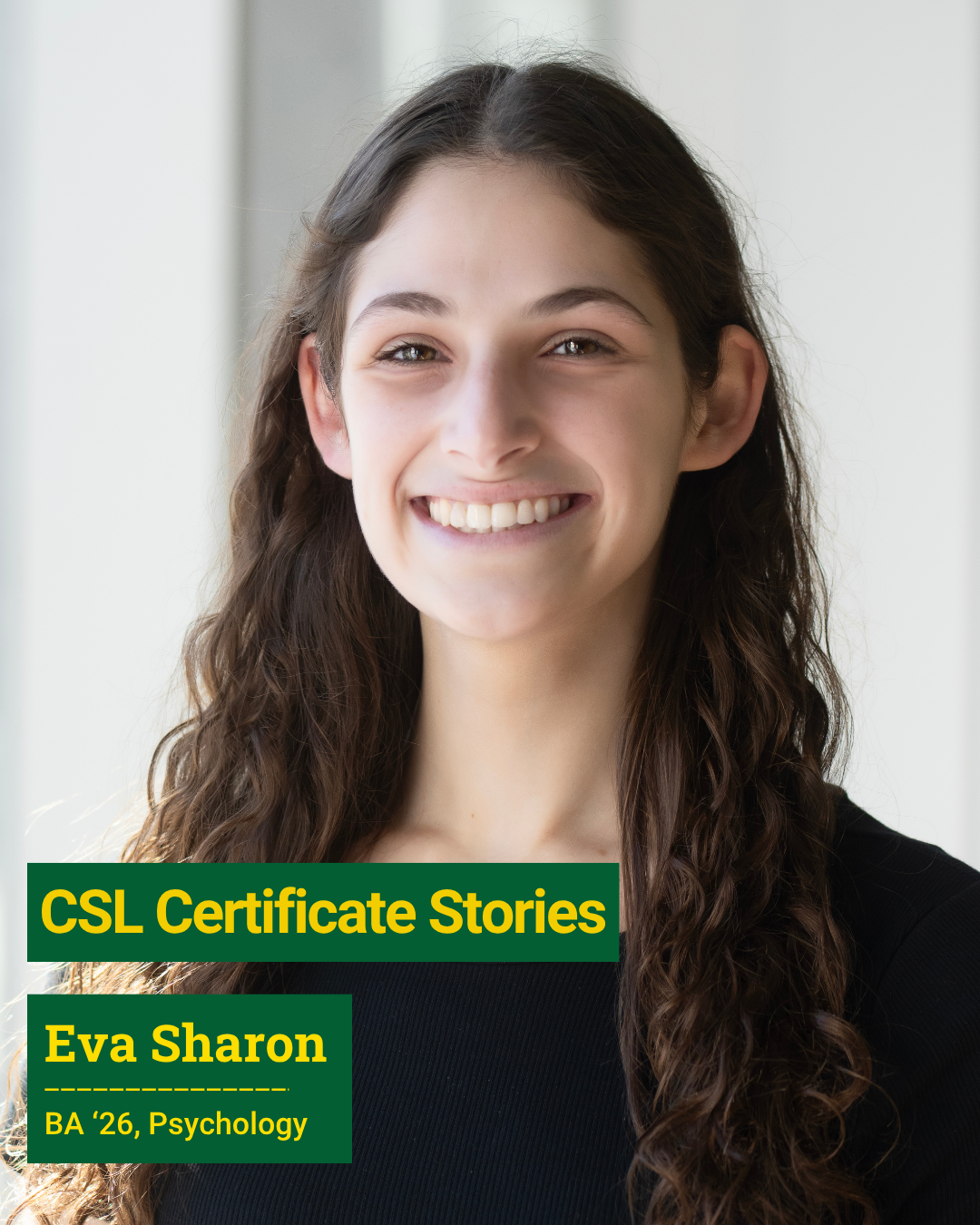
Eva Sharon | Bachelor of Arts Psychology
Why did you decide to pursue the CSL certificate?
I chose to pursue the CSL certificate as it really fit my interests. In third year I was really re-evaluating my degree and program and I was involved with the Non-profit Board Internship at the time. I really enjoyed working with a new community and helping people and the CSL certificate was a great way to connect with new volunteer opportunities and help other communities I may not have found on my own!
How did you integrate CSL into your degree?
As I mentioned before, the number of classes really fit well into my schedule. Additionally, the CSL department offers CSL option courses conjoined with other departments. For example, a senior Psychology course I took on Adult Development and Aging had an option to do a CSL component so I did that one and it fit well with both my Psych major requirements and this certificate's needs. Also as someone in Psychology, it was beneficial to have more of a community engagement component along the way. It really helped me see what I learn about in real life and be able to apply learnings to class from in-person.
What was your favourite CSL placement or experience?
I can't say I necessarily have a favourite CSL experience. I really enjoyed each opportunity I got through this certificate. I loved meeting people within the CSL department, as well as meeting new people outside of the U of A community. I had the chance to do such a wide variety of things like assist people in a large truck, supervise and entertain kids, play bingo with older people, workout with people experiencing disabilities and create a diversity, equity and inclusion policy for a movie theatre and eat free popcorn. There have been so many exciting experiences I have had with the CSL group and I hope I continue to remain involved with these communities after I graduate.
What impact did CSL have on your academic and career goals?
I am so grateful for CSL and the impact it has had on my life, both academically, in my career path, and just for me in terms of my personal growth and journey. Academic-wise, as my goal in the future is to help people, it allowed me to gain practical experience out in the real world helping people of varying ages, demographics, abilities and so-on. I got to meet and help such a variety of people, which was such a great experience overall. In terms of my career goals, the obvious thing would be to say I got many volunteer hours as applying to Master's programs is competitive. However, in all honesty, once again, the chance to actually do hands-on work and helping people is just so relevant to the field I aim to be a part of and it made me feel more confident in my path to want to help people. I truly am grateful and strongly value all the work and opportunities I was given as a CSL certificate student, thank you.