Have you met… Dr. Carol Brown?
14 October 2026
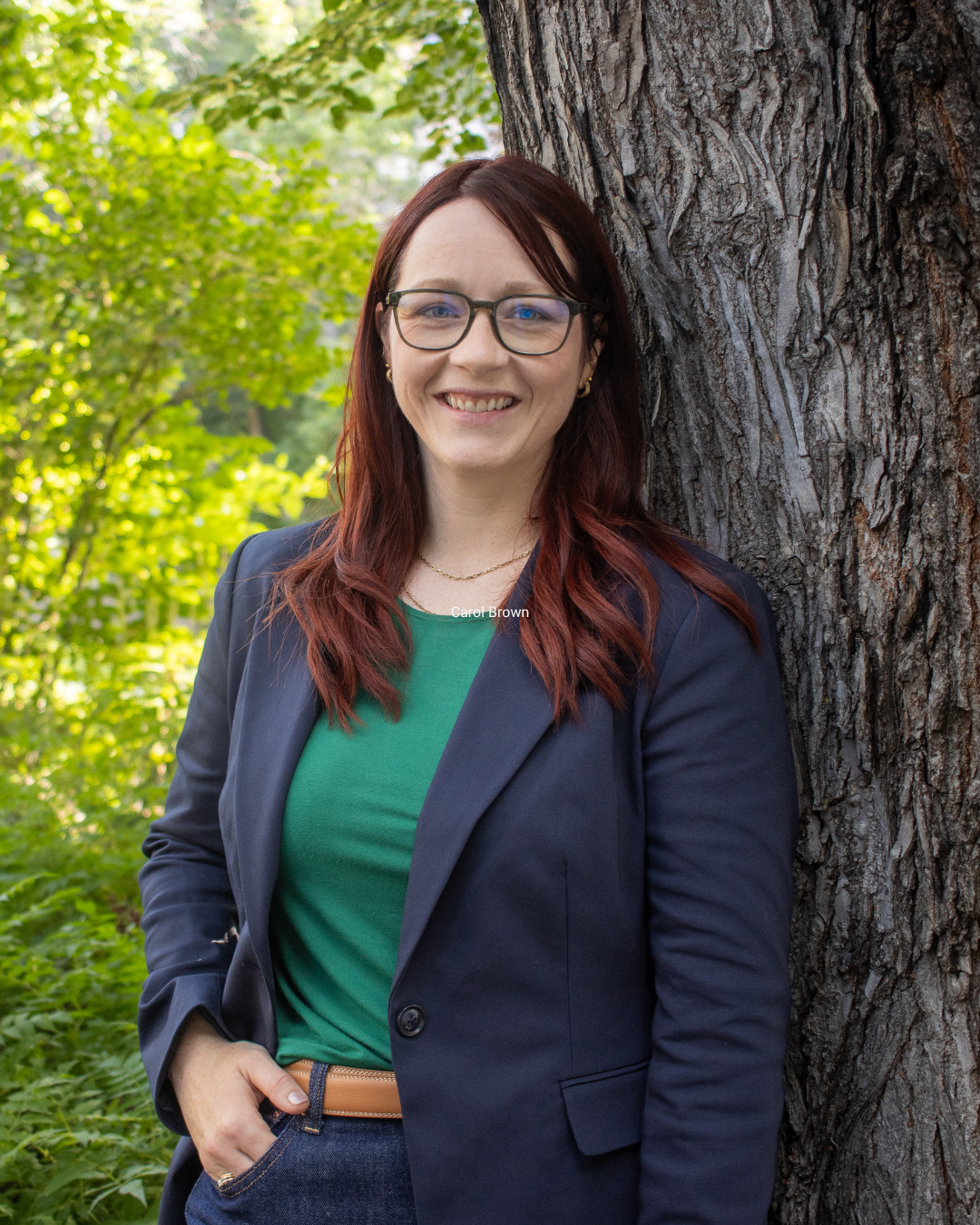 Dr. Carol Brown (she/they) is a science educator whose research interests relate to how science education in both formal settings (K-12 and post-secondary) and informal spaces (libraries and science centres) can effectively respond to science and health misinformation.
Take a few moments to get to know Dr. Brown!
Tell us about yourself!
I’ve just started my new role as an Assistant Professor of Science Education here at the U of A. I grew up on a farm in Treaty 6 territory, so I am grateful to be able to live, work, and raise my family here in Amiskwaciwâskahikan. I love the river valley and spend a lot of my free time there on walks, runs, and bike rides.
What brought you to the U of A Faculty of Education?
I think I first decided I wanted to be a science teacher in seventh grade. I’ve always loved mentorship and coaching roles, sports and science, so teaching always felt like the natural choice. I first came to the U of A as an undergraduate student, where I completed a BSc/BEd combined program. Despite my work and life adventures and living in different places in Canada, I’ve returned home to the U of A several times — for my master’s, PhD, and now in my role as an assistant professor. The tremendous scholars and educators here are the reason I’ve kept coming back.
What are your current research interests?
My research is at the intersection of science education and digital/media/information literacy. Specifically, I’m interested in exploring how education in formal, non-formal and informal settings can respond to science and health misinformation.
My PhD research explored the experiences of Alberta public library staff with science and health misinformation, and how they could be supported in building resilience to misinformation in their communities. Specifically, I used an Educational Design Research approach to design, deliver and evaluate a workshop for public library staff titled “Shelf-Help for Science and Health Misinformation.”
In the next stage of my research, I hope to expand the reach of the workshop, adapt it to an asynchronous online context, and continue to refine the theoretical framework I’ve developed. I also plan to take my work back into formal education contexts through collaborations with teachers and schools around building resilience to misinformation.
What inspired you to enter this field?
It wasn’t what, but who. Specifically, when I was an undergraduate student, Dr. Norma Nocente and Dr. Greg Thomas both inspired me and encouraged me to consider graduate studies. Dr. Jerine Pegg has also been a tremendous inspiration and mentor throughout my master’s and PhD. I can say with certainty I wouldn’t be where I am without them.
I’m also inspired by many others who are working to respond to science and health misinformation, including Timothy Caulfield and Dr. Jonathan Stea here in Alberta.
Describe your teaching philosophy.
I see teaching as a fundamentally hopeful act. It’s about maintaining belief in the potential of others — and ourselves — to grow alongside one another.
Informed by the Contextual Model of Learning (Falk & Dierking, 2018), I see learning as a social process that is mediated through language, culture, relationships, spaces and places over the course of one’s lifetime. Therefore, developing relationships with human and more-than-human relatives are at the core of my philosophy. I also work hard to identify and acknowledge the unique interests of learners, engage their prior knowledge and experiences, spark curiosity, offer choice and control in learning, and cultivate inviting spaces (physical and digital) where learners feel safe to engage with others around big ideas and nuanced topics. I acknowledge that this necessitates care, respect, and the creation of space for multiple voices and perspectives to come forward; thus, I emphasize discussion, inquiry activities and collaboration. Furthermore, I encourage students to reflect on their learning so that they can revise their understanding of key ideas and develop adaptive strategies to become effective lifelong learners. I also believe that bringing a sense of joy, curiosity and playfulness to learning environments is essential. Learning is effortful, but it can be joyful too.
What is your favourite place on campus?
I don’t think I could pick just one, because I have great memories here going back to my undergraduate degree, including meeting my husband here — our first date was at a Golden Bears football game! If I had to choose, I’d say all the green spaces on campus are one of the things I love most about being here — every season of the year, they are beautiful.
What interests you outside work?
I love being outdoors and being active. I’m probably happiest on a bike ride, but I love taking my kiddos to the park, running, going swimming, or taking my pup Digby for walks. I delight in tending my little urban garden and enjoy baking, drawing and doing crafts with my kids, reading, playing board games, and drinking tea.
Related: New educational resources bolster vaccine confidence, information literacy
Photo by Laura Sou