Walking away from PTSD: The 3MDR revolution in Alberta
Carmen Rojas - 29 April 2026
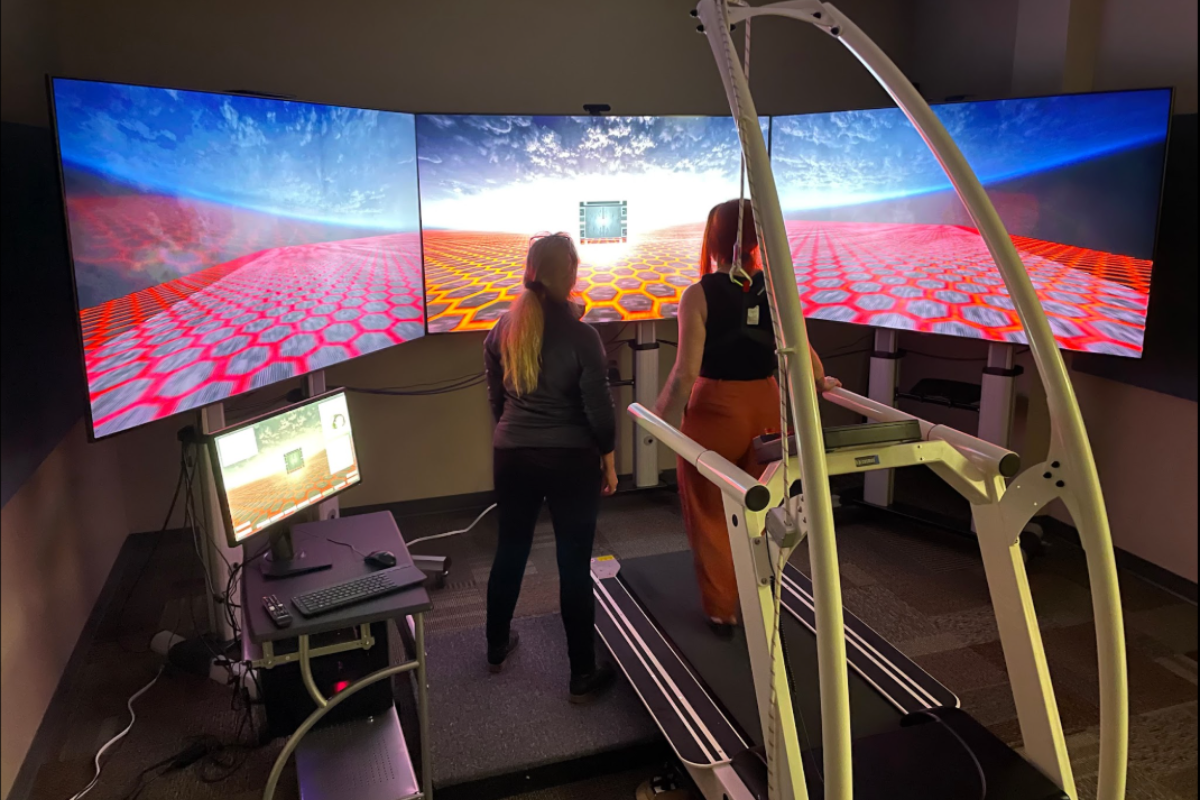
Last summer, a team of international researchers gathered at Corbett Hall on the U of A' s North Campus for a demonstration of an innovative therapy for treating PTSD.
The demonstration was co-presented by educational psychology professor Phillip Sevigny, who has spent the last five years working on the team advancing 3MDR research at the U of A.
This research, which is an initiative of the Heroes in Mind, Advocacy and Research Consortium (HiMARC), has consistently shown incredible promise as a treatment option and has received significant funding, including a $3.75 million investment from Alberta Advanced Education in 2023.
Multi-Modal Motion-Assisted Memory Desensitization and Reconsolidation, or 3MDR as it is commonly known, is a brief exposure-based psychotherapy originally developed in the Netherlands that incorporates elements of Virtual Reality (VR) and treadmill walking.
Participants in the research study have included service members from the Canadian Armed Forces, veterans, first responders and healthcare professionals, who take part in 10-14 weeks of treatment either on campus or at community mental health sites across the province.
Launching an international network
The gathering in Corbett Hall marked the launch of an Academy of Medical Sciences networking grant, designed to spark interdisciplinary collaboration between the U of A and a global network of experts. This international team is made up of researchers from the UK and beyond, including project co-PI Matt Fossey and Richard Smith (Anglia Ruskin University), Nicola Cogen (Napier University), Belinda Lange (Flinders University), and Karl Hamner (University of Alabama).
Their visit kicked off with the highly anticipated demo of a 3MDR session, led by Sevigny and Suzette Brémault-Phillips, the HiMARC director, occupational therapy professor and project co-PI.
Fresh off of international flights, the visitors got their first in-person look at the unique setup required for 3MDR: a treadmill positioned backwards facing three large screens where images selected by participants are displayed throughout the session.
Sevigny and Brémault-Phillips explained that 3MDR inherently prevents the avoidance that is a large part of trauma.
Along with walking on a treadmill, the therapy is built around a carefully structured combination of imagery and music. Participants view five to seven images per session, guided closely by a therapist to explore the themes and feelings they evoke. Cognitive tasks such as reading out numbers displayed on a ball that moves across the screen are incorporated throughout as grounding points to deactivate intense emotions that arise.
Afterwards the participant and therapist engage in a one-on-one discussion focused on what stood out or surprised the participant, what meaning they made of the session, and how they feel in the present moment.
Sevigny and Brémault-Phillips shared that, to date, the study participants, many of whom have not benefitted from other treatment options as they’d hoped, have shown remarkable improvements, with one commenting that it was “the most real and honest experience” they’d ever had.
Through the study they have also trained more than 150 professionals in the skills required to deliver 3MDR.
“The connection between the therapist and participant is key,” said Sevigny. “Everything else – all the bells and whistles – facilitates this connection.”
The approach taken in 3MDR is different from Cognitive Behavioural Therapy (CBT), for example, which is currently the predominant form of therapy in Alberta and elsewhere.
“3MDR therapists need to listen differently and be attuned to people and their micro-expressions,” said Brémault-Phillips. “They let people lead rather than trying to lead them.”
To emphasize the difference, Brémault-Phillips noted that “3MDR therapists need to think on their feet.” Sevigny recalled a comment from a psychotherapist with 20 years’ experience: “Regular psychotherapy is tennis; this is Olympic-level ping pong.”
Expanding the reach of 3MDR
Since this initial meeting, Sevigny and the U of A team have connected with their international partners online every month. They are currently preparing to travel to the UK in May as the next step in a collaboration they hope to continue for many years as they explore further possibilities for the therapy.
While establishing these international connections, HiMARC has continued to receive strong support from local partners to advance existing research and move into new areas.
This includes a recent influx of funding from supporters at the Royal Canadian Legion, who Sevigny gratefully notes have been “partners on this journey from the beginning.”
Sevigny is also excited about a new project evaluating the effectiveness of 3MDR as a tool for early intervention. “Moving Forward: 3MDR Study with First Responders in Alberta” is currently underway after receiving provincial funding last year.
“We want to explore whether an abbreviated round of 3MDR can help support our first responders to offload some of the weight of those difficult calls, and whether or not this helps keep people on the job rather than waiting until they reach a breaking point,” he says.