2026 Distinguished Visiting Speaker
Professor Nina Sun Eidsheim
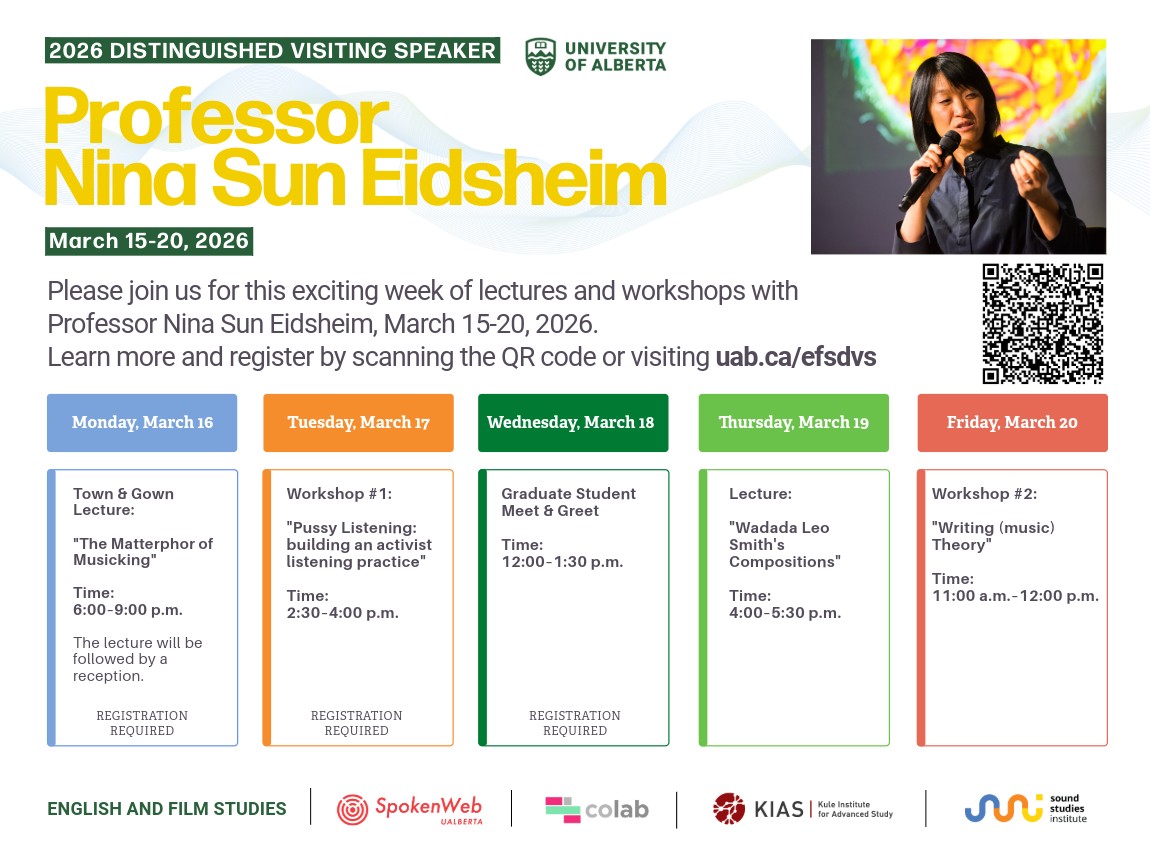
Please join us for this exciting week of lectures and workshops with Professor Nina Sun Eidsheim, March 15-20, 2026.
An internationally recognized expert in the multidisciplinary field of Sound Studies, Dr. Eidsheim is Professor of Musicology at The UCLA Herb Alpert School of Music and founder and director of the UCLA Practice-based Experimental Epistemology Research (PEER) Lab, an experimental research Lab dedicated to decolonializing data, methodology, and analysis, in and through multisensory creative practices. She is also the Associate Director of the Center for the Study of Women | Barbra Streisand Center at UCLA. As a scholar and singer, Eidsheim investigates the multi-sensory and performative aspects of the production, perception, and reception of voice and vocal performance. She is the author of Sensing Sound: Singing and Listening as Vibrational Practice and The Race of Sound: Listening, Timbre, and Vocality in African American Music; she is Co-Editor of the Oxford Handbook of Voice Studies and Co-Editor of the Refiguring American Music book series for Duke University Press.
Monday, March 16
Town & Gown Lecture: "The Matterphor of Musicking"
The lecture will be followed by a reception
When voices are heard to be black, white, yellow, or brown, they are understood through metaphors of color and the sense of sight. They are also imagined through a hierarchy of relative value, often metaphorized onto the binary of human versus animal, or, voice versus noise. When voices are trained to adhere to these metaphors and the related racial profiling, it is the very materiality of our bodies that is shaped to enable such social sonic categories. I am concerned with the metaphorical underpinnings of music discourse, performance, and listening practice and how they contribute to naturalizing music and those musicking. Just as we draw upon our embodied experience of the world to invent metaphors, metaphors also frame our perception, and thus our embodied experience, of the world.
Location: Peter Lougheed Hall City Room
Time: 6:00 - 9:00 p.m.
Registration: You must pre-register for this free event. Maximum attendance is 80 people.
Tuesday, March 17
Workshop: “Pussy Listening: building an activist listening practice”
A large portion of our lives has been (inadvertently) dedicated to listening correctly and to avoid listening “incorrectly.” This kind of relationship to listening comes from a place of submission and forwards the agenda of those in power. In contrast, “pussy listening” is a life-making and meaning-making action. I assume everybody draws on the magic of pussy listening daily, however, to protect our own safety, we may not recognize it as such. This participatory session is dedicated to recognizing pussy listening and to share a multisensory experience creating a material reminder of this ability.
Location: FAB 2-32
Time: 2:30 - 4:00 p.m.
Registration: You must pre-register for this free event. Maximum attendance is 25 people.
Wednesday, March 18
Graduate Student Meet & Greet
This is an informal gathering to provide students with an opportunity to meet with Professor Eidsheim and give her a chance to learn more about their programs of research. Lunch will be served.
Location: Salter Reading Room, Humanities Centre 3-95
Time: 12:00 - 1:30 p.m.
Registration: You must pre-register for this free event. Maximum attendance is 20 people.
Thursday, March 19
Lecture: “Wadada Leo Smith’s compositions— when music must be talked about through the language of friendship and community”
Wadada Leo Smith (1941-) is an international composer and trumpet player whose work has been described as a “cosmology” and a “spiritual meditation about creation in the grand intergalactic sense.” The impact of his work may be compared to that of W.E.B. Du Bois as it is both foundational to black radical thought and provides tools across color lines for intellectual self-fashioning. From beginning to write music at the age of 12 throughout his 69-year career as a composer, he has unearthed the inner relationships within musical forms, from the blues to the string quartet. Smith discovered the musical language Ankhrasmation. It assumes a relational rather than fixed assumption regarding sound. In this talk, I will discuss Smith’s work and one of the dilemma’s it presents: how can we write and develop thinking about relational music and sound if the language we have at our disposal accommodates and reproduces ideals of fixed sound? In trying to address that question, this talk will end up being about listening, creativity, friendship, and community.
Location: Humanities Centre L1-3
Time: 4:00 - 5:30 p.m.
Registration: Not required
Friday, March 20
Workshop #2: “Writing (music) Theory"
In this workshop, participants will contribute to writing a theory of sound, music, listening, and meaning-making. The workshop will draw on Eidsheim’s practices developed in the UCLA Practice-based Experimental Epistemology (PEER) Lab, an experimental research Lab dedicated to decolonializing data, methodology, and analysis, in and through multisensory creative practices. This workshop is open to the public and will be held in conjunction with the English & Film Studies 2026 Graduate Conference.
Location: Education South 3-15
Time: 11:00 a.m. - 12:00 p.m.
Registration: Not required