Postdoctoral Scholars
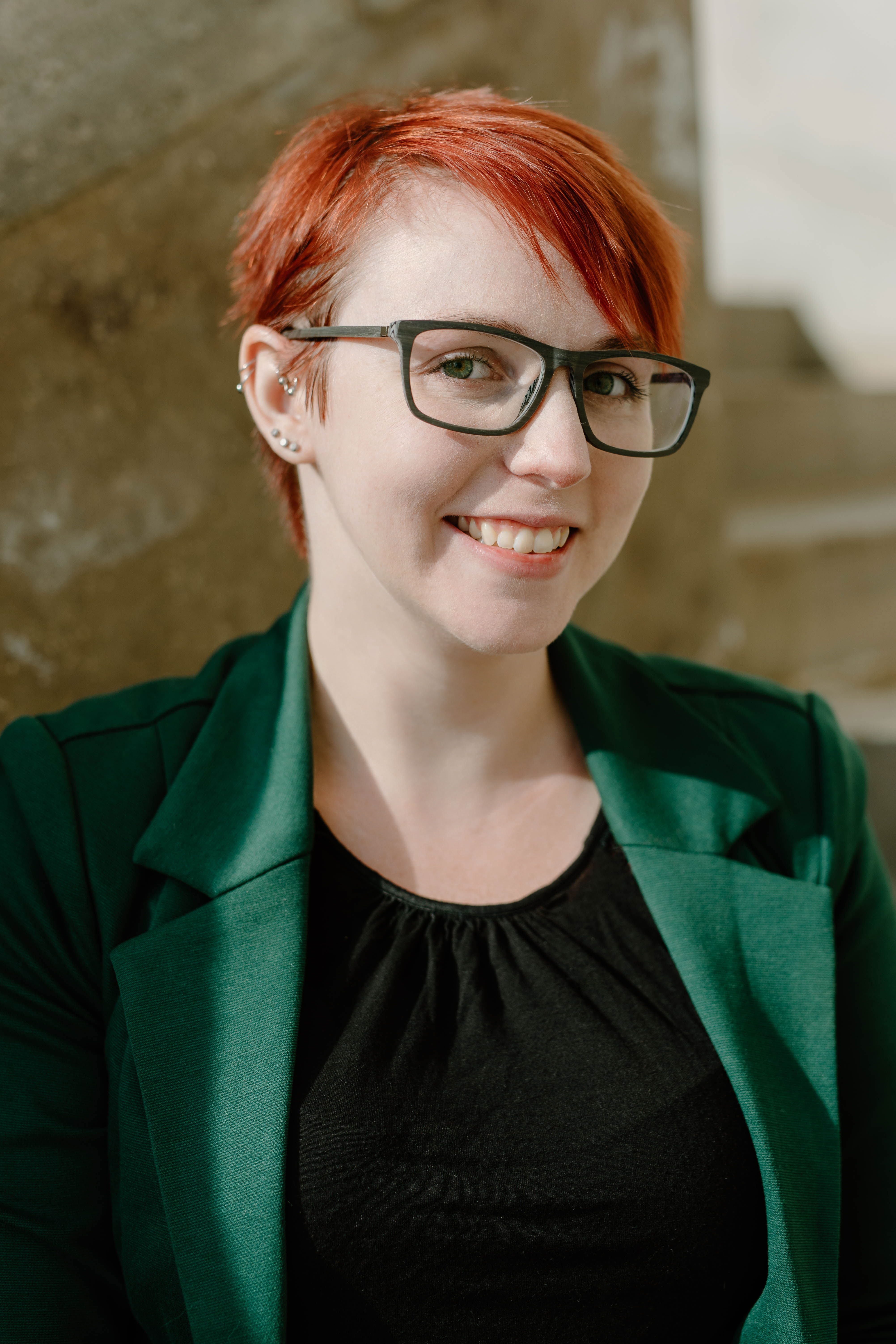
Ellen Forget
ell-en for-zhay | she/they
Supervisor: Danielle Fuller
eforget@ualberta.ca
Ellen Forget completed their doctorate at University of Toronto in the Faculty of Information and the Book History and Print Culture specialization. Their mixed-methods dissertation analyzes accessibility in contemporary independent publishing in Canada, how disabled readers access books, and how access can be improved. Ellen is a graduate of the Master of Publishing and Editing Certificate programs from Simon Fraser University. Ellen is also certified in transcription for unified English braille through the Canadian National Institute for the Blind.
As a Killam Postdoctoral Fellow at University of Alberta, Ellen is working on a project titled “A History of Tactile Writing and Reading” that explores the history of braille, raised type, moon, and other tactile codes. Their work focuses on the intersection of disability studies and book history in addition to contributions from publishing studies, bibliography, and digital humanities. Ellen’s primary research interests are braille, reading, accessibility, print disabilities, indie publishing, digital publishing/reading, and digital research tools.
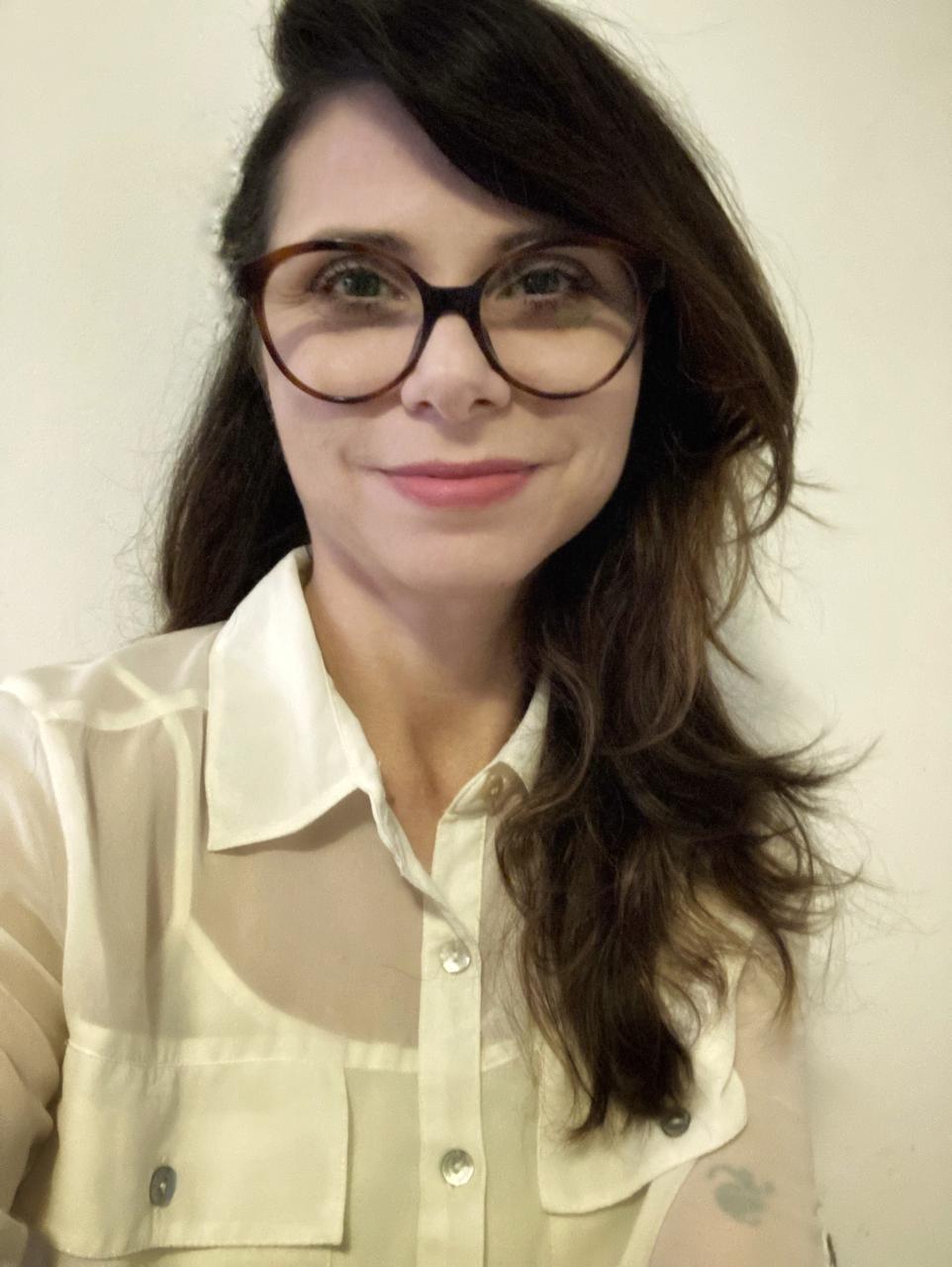
Anna Carolina de Carvalho Mesquita (Carol Mesquita)
Supervisor: Julie Rak
Dr. Carol Mesquita joins EFS in December 2025 and will be working as a Postdoctoral Scholar in the department until November 2026. Carol holds a FAPESP postdoctoral fellowship from the government of Brazil. In 2019 she received her doctorate in Languages from the Universidade São Paolo, Brazil, with the title “O Diário de Tavistock: Virginia Woolf e a Busca pela Literatura.” She currently teaches at the Faculdades Santa Marcelina – FASM in Brazil. Carol has published extensively on the subject of Virginia Woolf’s diaries and translation, most recently in the journal Trabalhos em Linguística Aplicada, in 2023.
Carol’s postdoctoral project is called “M(Other) Tongue: Exophony, Subjectivity, and Migration in Contemporary Literature” and is about the implications, in contemporary literature, of exophony – the choice to write in a language other than one's mother tongue. In the first part, it analyzes how the rise of the monolingual paradigm in the 18th century, linked to the conception of nation-states and national literatures, weakens from the 20th century onwards. Behind such weakening is the intensification of decolonial and globalization processes, which put into question the connection between language, territory, and identity. In the second part, in light of language theories by Walter Benjamin, Jacques Derrida, and Jacques Lacan, it discusses how the voluntary adoption of another language may give rise to poetics in which the monolingual paradigm ends up confronted because it cannot support subjective (re)constitution and identity issues, which are often linked to trauma and exile. To this end, the research draws on three contemporary authors with different exophonic paths – Yiyun Li, Ailton Krenak, and Gloria Anzaldúa – to investigate the possible existence of a Benjaminian double bind (necessity and impossibility) in the process of writing in another language, while discussing some of its manifestations. It is our assumption that translational processes which are typical of exophonic literature (both self-translational ones and mechanisms of appropriation and displacement between languages) raise questions of otherness and estrangement. They inevitably bring about not only changes in the language exophonic writers choose to write, but in the very literary systems in which, through language, they become inserted. Therefore, they defy current notions of what constitutes national literature, becoming particularly pressing with the intensification of migratory flows worldwide.
Carol is particularly looking forward to speaking with members of the EFS and Faculty of Arts communities of scholars interested in critical theory, feminism, migration and translation.

Kristen Smith
Supervisor: Michael O'Driscoll
Dr. Kristen Smith (she/her) completed her doctoral research in English Literature at York University. Her intermedial dissertation examines the multifaceted presence/absence of sound in varieties of visually-oriented poetry from the 1950s to the 2010s. For the selected transnational poets, she interrogates the intersections of aesthetics, cognition, and ethics. As a SSHRC Postdoctoral Fellow at the University of Alberta, Kristen will be undertaking a two-year project, “Investigating Insound: Diverse Sonic Experiences in Composing and Processing Poetry,” which has the overarching goal of exploring the sonic production and reception of poetry and reflecting on the implications of diverse readers in their processing of sound.
Kristen’s academic work has been published by the International Journal of Media and Cultural Politics, Interdisciplinary Discourses, Inter-disciplinary Press, Somatechnics, and [transcript]. Her work on processing non-linguistic poetry appears in the special issue of “New Sonic Approaches in Literary Studies” published by English Studies in Canada (ESC). Additionally, two chapters in separate anthologies will be published by Cambridge Scholars Publishing in Spring 2025.
As a Narrative Poetry Prize winner (2019), a Fineline Competition finalist (2020), and Pushcart Prize nominee (2021), Kristen’s creative writing is an artistic outlet. Her poetry has appeared in Canthius, Mid-American Review, Naugatuck River Review, The New Quarterly, and SewerLid Magazine. After winning the Graham Atlantic Writing Prize (MTA) and participating in the Writing with Style program (Banff Centre), Kristen founded the Toronto-based writers collective The Musings.
In both her academic and creative work, Kristen is interested in the creation of art in community, connection, and collaboration.
Home | About Us | People | Research | Programs | Courses | Student Groups | Meet Our Alumni