Update Six: Writing with the James Bay Cree: On Truth and Reconciliation: Dr. Ruth DyckFehderau
14 August 2026
I’m an Adjunct Professor in the Department of English and Film Studies and I write nonfiction books with the James Bay Cree of Northern Québec. For the past few years, we’ve been working on a book series of Indian Residential School (IRS) recovery stories. We’re a small team, we work closely with Elders, the storytellers own copyrights to their own stories, and I do the story-gathering and writing. I am not Cree, but the Elders requested an outside writer for several reasons, including the fact that most of the stories are trauma stories which make for intense writing and “our own [Cree] writers have enough to carry.”
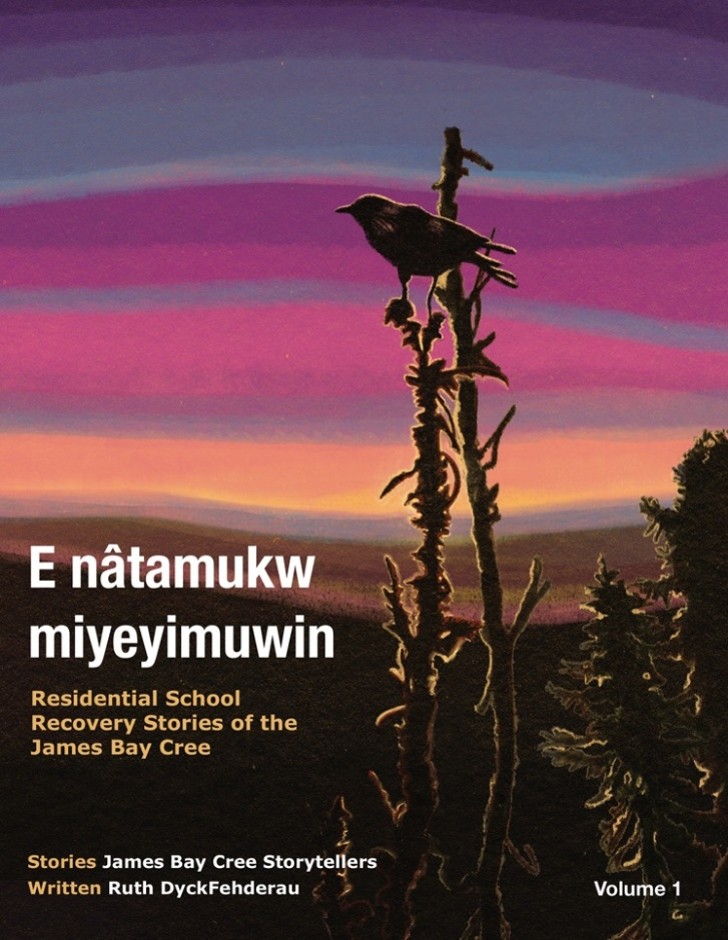
This posting, a requirement of my adjunct appointment, has been approved by the both Elder and the supervisor overseeing the project. Previous posts about this project are here, here, here, here, and here. And more information about our most recent book, E nâtamukw miyeyimuwin: Residential School Recovery Stories of the James Bay Cree, Vol One, including purchase details, is here.
I am often asked whether the people who tell me their stories for inclusion in our books speak about the Truth and Reconciliation Commission of 2008-15 (TRC). The TRC, as many readers will recall, was established by the Indian Residential Schools Settlement Agreement and was mandated to document “the truth of Survivors, their families, communities and anyone personally affected by the residential school experience,” (Truth and Reconciliation Commission of Canada) and then to reveal this truth about the Indian Residential School genocide to all Canadians.
And the answer is yes, many former pupils of Indian Residential Schools have spoken to me of their experiences in the TRC. Unfortunately, their recollections are rarely favourable. Over half of the storytellers I’ve spoken to said that, when they applied to receive the Common Experience Payment (CEP), they learned that their school records had been altered. Records showed that they had attended for fewer years than they had actually attended. And, unless they could provide specific kinds of documentation, their common experience payment would reflect the falsified records.
One storyteller was prepared for what he called “this money-saving feature” of the CEP. Upon learning that the records showed him starting Residential School several years later than he had actually started, he submitted a manila envelope of report cards dating back to Grade One, signed by the school principal. In the end, he received his full CEP – but most of his friends had not kept their Grade One report cards. His eyewitness testimony of being with them in the residential school dorms and classrooms did not count.
I also heard about severe injuries being misrecorded or not recorded at all. One storyteller, for instance, had been choked by an angry teacher and had consequently spent months in hospital receiving and recovering from reconstructive surgery to repair his crushed esophagus. Upon returning to school three months later, the principal warned him: if he ever mentioned the injury to anyone, bad things would happen to his family. Years later, when he recounted his story to the officials of the Independent Assessment Process, he heard that school records placed him in hospital for just a few days – to undergo a tonsillectomy. And his hospital records had been “destroyed in a fire” so there was no way to prove otherwise. (In another hospital, residential school pupil records had been “destroyed in a flood.”) That the storyteller still had his tonsils was not taken into consideration. He was not compensated for his injury.
Having to recount specific details of sexual assaults was a Herculean task for some storytellers. One storyteller couldn’t say all the anatomical words so the official balled up the paper on which he was recording her story and tossed it into the trash, there in front of her. Another official, upon hearing a specific perpetrator named, called him up there in the hearing – the perpetrator was on speed dial – and asked if he had assaulted this particular former pupil. He then turned on his speakerphone and everyone in the room heard the perpetrator (now an old man in a wheelchair) readily admit it. Upon hearing that voice again, however, the former pupil’s long-resolved PTSD symptoms returned.
As these stories accumulated in the communities, former pupils who had experienced the worst assaults and had not yet told their own stories often chose not to participate at all.
I often heard that the lawyers refused to advocate properly. They would help former pupils apply for the basic common experience payment – and simply refuse to advocate for Independent Assessment Process payments that former pupils were meant to receive for major injuries. The lawyers were tired, they said, or these injuries and assaults simply didn’t count. (They did count.) If the former pupils wanted to appeal, the lawyers told them that they had to wait several years to begin the process – by which time the final date to submit applications for appeal was long gone. In some cases, if a former pupil had limited literacy, the lawyers (whose fees were paid by Government of Canada) had the former pupils sign a document allowing the lawyers to take nearly all of the payment which was meant in entirety for the former pupil.
Commonly, former pupils were surprised to learn that the TRC and IAP were separate from criminal proceedings. While former pupils might be compensated, the payment would come from the government of Canada. The perpetrators themselves were rarely held accountable in any way. In one case I often heard about, the perpetrator moved to the community in which lived many of the former pupils he had abused. They saw him on a daily basis – and spoke of how they feared for their children.
The former pupils who did receive payment and spoke to me about it most commonly gave the money away. While they wanted the schools and perpetrators to be held accountable, they didn’t want objects in their homes or lives that would forever remind them of what they had endured, and of the indignities (rather than reconciliation) that followed when they told the truth.