Dale Schulha and the faculty that shaped his life and legacy
Jennifer Fitzgerald - 2 February 2026
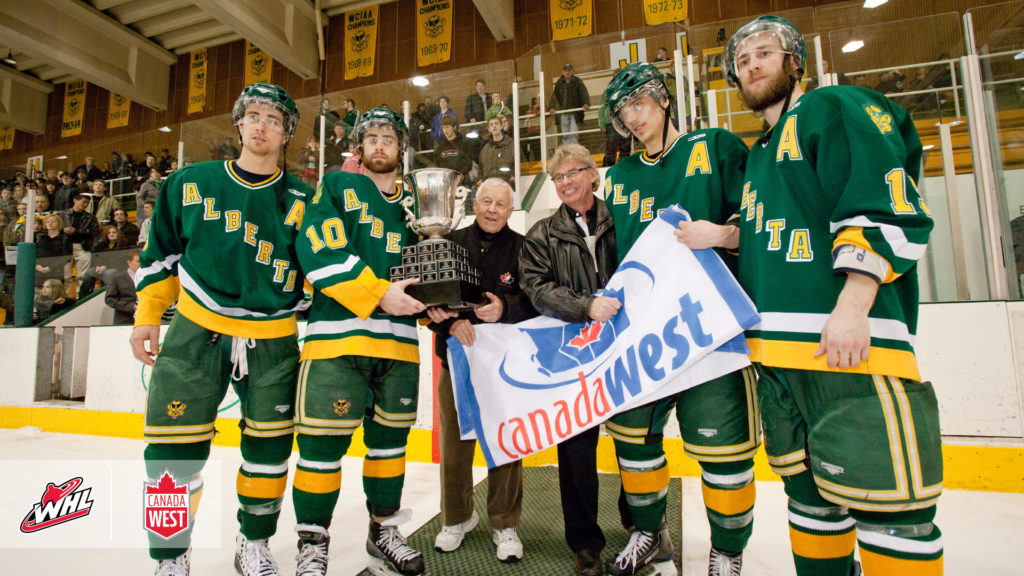
Clare Drake and Dale Schulha present the Canada West Conference championship trophy and banner to the Golden Bears men’s hockey team, circa early 1990s.
When Dale Schulha found out he would be inducted into the Alberta Sports Hall of Fame as a Multisport Builder, his reaction was humble, grateful and reflective.
“Sport has been my whole life,” says Schulha, ’72 BPE, ’74 MSc, ’74 Dip(Ed), a longtime University of Alberta leader, alumnus, coach and donor. “To me, it’s a real endorsement of things I was able to contribute in amateur sport.”
That contribution spans generations and roles: Golden Bears football player and captain, coach, athletics administrator, fundraiser, mentor and builder. But if you ask Schulha what defines his legacy today, he points less to a single win and more to the cumulative work of creating opportunities, especially for student-athletes. For his outstanding contributions to Canadian university sport, Schulha received the prestigious Austin Matthews Award in 2014 and was later inducted into the University of Alberta’s Sport Wall of Fame as a Builder in 2015.
A Bear who finished on the biggest stage
Schulha played defensive back for the Golden Bears during one of the program’s most memorable eras, including back-to-back Vanier Cup appearances in 1971 and 1972.
In the 1972 championship game, his final season, he still remembers the moment that helped shift the outcome: a surprise play in which the team lined up for a routine field goal but instead Schulha improvised a pass into the end zone for a touchdown.
“It was a great way for me to finish my career,” he says.
That kind of decisive, builder-minded instinct would show up repeatedly over the decades, often in rooms where the stakes were higher than a scoreboard.
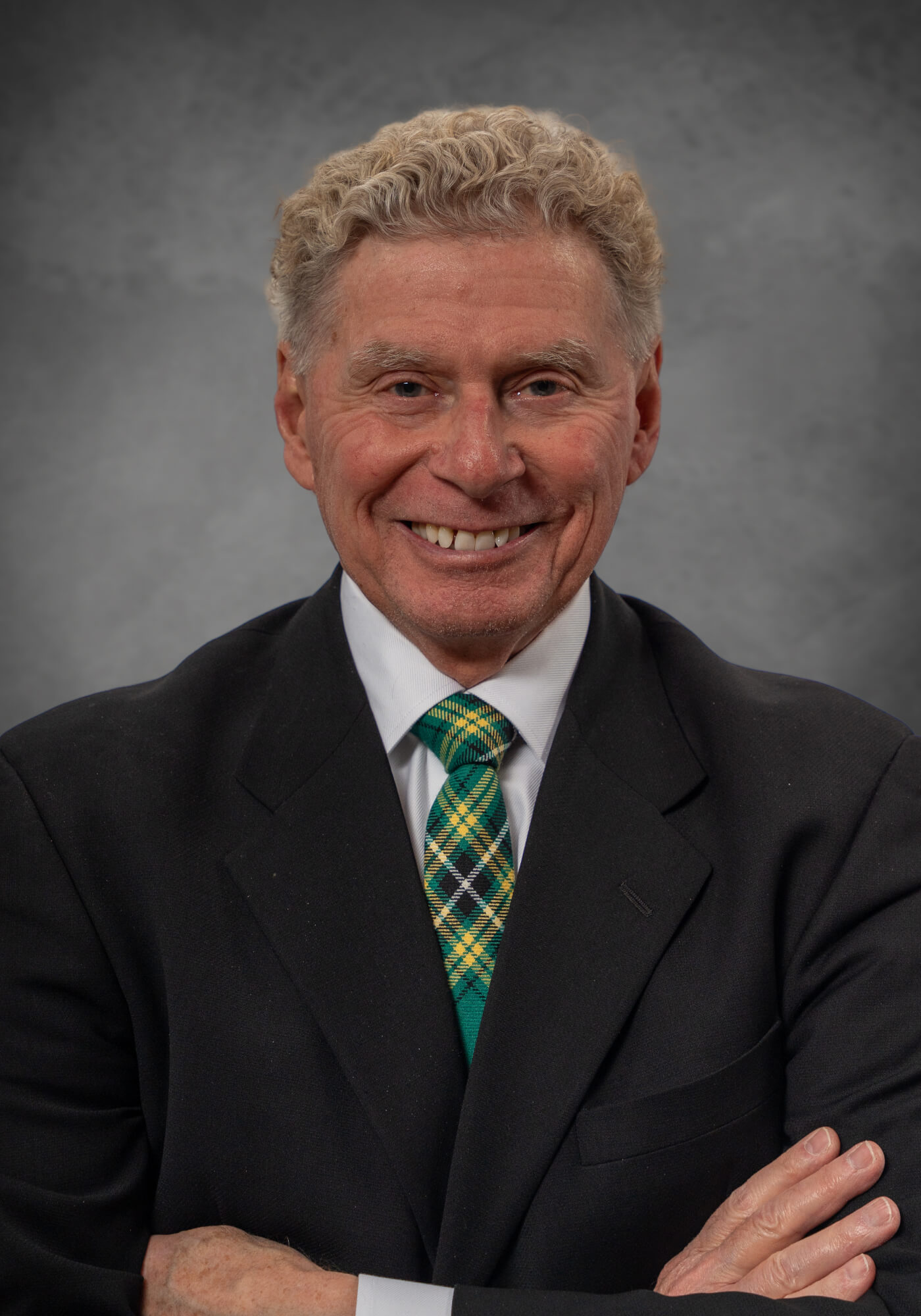
“I liked building. I liked the challenge.”
After completing his graduate studies, Schulha took what he describes as an early career risk: he and his wife, Bonnie, each left full-time teaching positions to accept a 10-month appointment at Medicine Hat College, advice he pursued with encouragement from mentor Gerry Glassford, professor emeritus and, at the time, dean of the Faculty of Physical Education and Recreation.
That move opened doors quickly. In Medicine Hat, he taught, coached and served as athletic director, and most notably helped build a junior football team from the ground up, putting the Medicine Hat Rattlers on the field in just six months.
“When I look back, I see a pattern,” Schulha says. “I like building. I like being the first to step into new roles, starting programs from the ground up and helping shape what comes next.”
Those experiences led to leadership roles connected to major multi-sport events and facilities, including the 1983 Summer Universiade (World University Games) in Edmonton, where he worked in the sports division managing sport venues, equipment, and officials from around the world.
Leadership grounded in student-athlete success
Schulha served as chair of athletics and recreation from 1989 to 1993 and later as the University of Alberta’s director of athletics from 2005 to 2010, overseeing dozens of varsity teams, head coaches and hundreds of student-athletes.
When asked what guided his leadership at the U of A, he returns to one principle: make decisions in the best interest of student-athletes.
“We always wanted to give them the best opportunities academically and athletically,” he says. “The University of Alberta has led the country in Academic All-Canadians for years. That mattered to me. It still does.” That distinction is one KSR has played a central role in, contributing more Academic All-Canadians than any other faculty across the university.
During Schulha’s tenure, U of A teams captured multiple national championships across men’s and women’s programs, reflecting both competitive excellence and long-term program development. These included national titles in gymnastics, soccer, hockey, volleyball and field hockey, with championships spanning from 1990 through 2010.
Schulha also played a key role in hiring coaches who would go on to shape U of A Athletics for decades, including Billy Moores (Golden Bears hockey), Laurie Eisler (Pandas volleyball), Terry Danyluk (Golden Bears volleyball), Trix Baker (Pandas basketball), Liz Jepsen (Pandas soccer), Scott Edwards (Pandas basketball), Eric Thurston (Golden Bears hockey), Bill Humby (Golden Bears and Pandas swimming), and Owen Dawkins (Golden Bears and Pandas wrestling).
“Hiring good people was everything,” he says. “If you bring in the right coaches, they build the culture, they support students properly and the success follows.”
A South Campus legacy that changed what was possible
When Schulha talks about impact, he consistently returns to one transformative chapter: advocating for a lasting legacy facility tied to the International Association of Athletics Federations (IAAF) 2001 World Championships in Athletics in Edmonton.
He believed a legacy footprint was essential, and that South Campus was the right place to build it.
What emerged from that push was Foote Field, a cornerstone of U of A’s South Campus growth and a catalyst for what would become a hub for sport, recreation and community use. Schulha also recalls advocating for infrastructure that would support long-term access, pointing to the importance of LRT transit connectivity as the campus evolved.
“I was convinced, if we could get a footprint down there, then we’d build other things,” he says. “And that’s what happened.”
A family story rooted in KSR
Schulha arrived at KSR, then known as the Faculty of Physical Education and Recreation, as a student and found a community that would shape his career, his values, and over time, his family. He met his wife, Bonnie, in the faculty, and together they built their lives around the university. While Schulha worked on campus, his three children — Ryan, Aaron and Lindsay — were quite literally raised there, spending their formative years in gyms, offices and fields that became as familiar as home. All three would later become U of A student-athletes.
Years later, each of their children chose to study in KSR, following different paths through physical education, recreation, sport and tourism. Today, that connection spans three generations. A granddaughter is now studying in the faculty, and a grandson is preparing to begin, extending a relationship with KSR that has endured for more than half a century.
“They all grew up on this campus,” Schulha says. “It’s like home to them. It’s a second home.”
What binds the Schulha family’s long relationship with KSR is not sport alone, but a deep sense of belonging to a faculty that became a constant presence in their lives. “The U of A gave me and my family everything,” he reflects. “Every opportunity we had grew from here.”
Giving back to the athletes who need it most
In 2019, Schulha established the Schulha Family Golden Bears & Pandas Athletic Award, designed to support student-athletes who are in good academic standing and demonstrate financial need.
Schulha’s goal was to help “the common student” who may not qualify for top academic awards but still works hard, trains hard and needs support to stay on track.
“It makes a difference,” he says. “I like to meet the recipients, hear their stories and make sure the support is going to students who truly need it.”
Ensuring Bob Steadward’s legacy is seen at home
Schulha also recently led fundraising efforts for a new permanent recognition display honouring Dr. Bob Steadward, professor emeritus and a global leader in para sport and disability advocacy. He first approached university leadership to ensure support for a community-led initiative that would be both meaningful and enduring. In the project’s first year, he served as its project manager; in the second, he connected with friends and family of Dr. Steadward to successfully secure the funds required to build the display.
Advice for today’s students
Schulha’s guidance to current KSR students is rooted in experience.
“Welcome opportunities,” he says. “Take them, especially when they’re intimidating.”
Looking back, he sees fear not as a warning sign, but as part of the process.
“Don’t be afraid,” he adds. “Maximize what you can get out of those moments, because they open doors you can’t yet see.”
It is advice shaped by a career built on saying yes before he felt ready, stepping into roles that stretched him and trusting that growth often begins just outside of comfort.