Society and Culture
Society and Culture
Research
Seeing Jinshan: Landscape, Painting, and Poetry of the Imperial Southern Tours
Two treasures from the Mactaggart Art Collection at the University of Alberta — Wang Hui’s Jinshan – A Stopping Point on the Kangxi Emperor’s Southern Inspection Tour handscroll (1691–98, Acc. no. 2004.19.74) and the Nanxun shengdian (Magnificent Record of the Southern Tours, 1771; Acc. no. 2010.20.1), offer ways to encounter Jinshan in Zhenjiang, a hill and an island rising from the Yangtze River in China. Framed through imperial movement and attention, these works show how the site was not only depicted, but also experienced and continually reimagined across the emperors’ southern tours.
A mountain on the move
Jinshan, or “Golden Mountain,” sits near Zhenjiang along the Yangtze River. Unlike a distant peak you approach gradually, Jinshan appears without warning, a steep, tree-covered hill rising abruptly from the water, its temple buildings stacked in tiers up the slope. For travellers on the Grand Canal, it was one of the most striking sights of the journey south. For the Qing emperors, it was also an imperial landmark. The Kangxi emperor (r.1661–1722) and his grandson the Qianlong emperor (r. 1735–1796) each made six Southern Tours, extended journeys combining political inspection with cultural display. Jinshan appeared in both their records, captured first in paint, then in words.

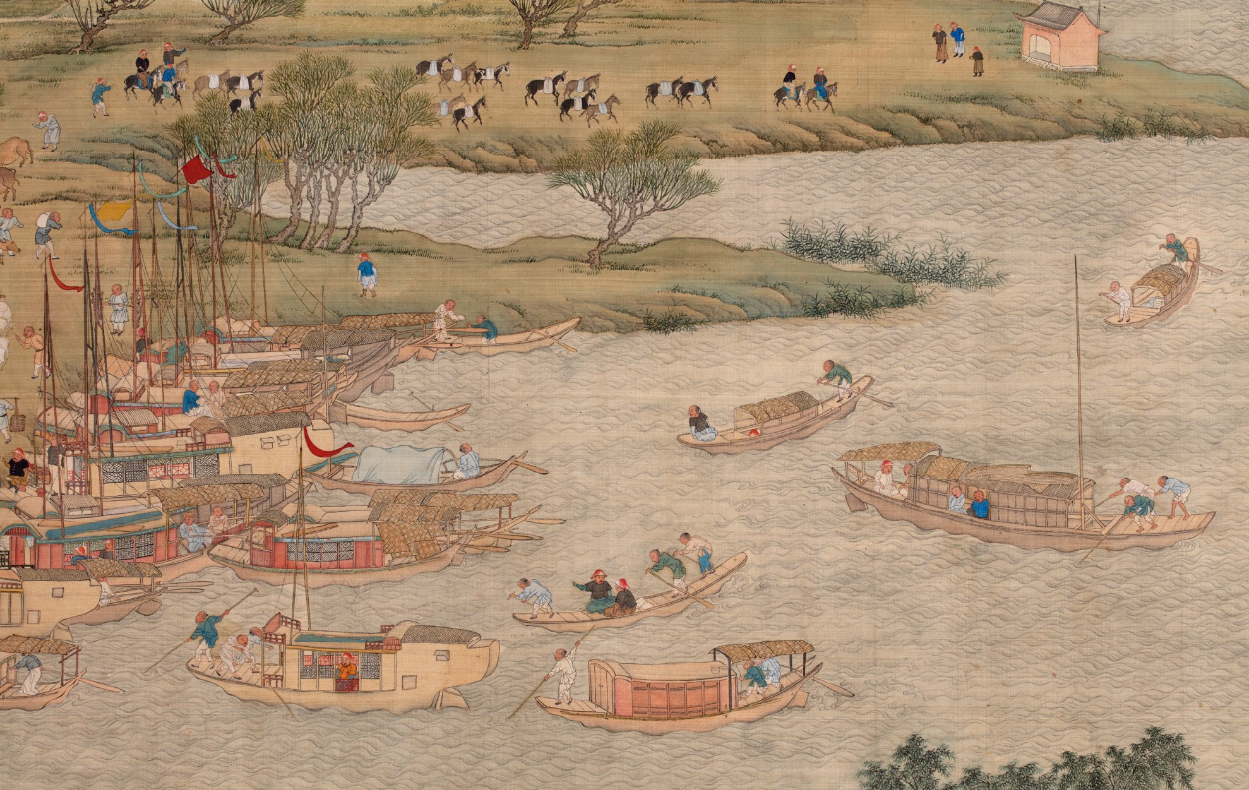
[Jinshan – A Stopping Point on the Kangxi Emperor’s Southern Inspection Tour, Qing 17th century, Wang Hui (1632-1717), et al., ink and colour on silk, Mactaggart Art Collection, 2004.19.74]
The painting: recording the Kangxi emperor’s journey
As the scroll unfolds, Jinshan appears not as an isolated peak, but as a busy and organized site along the river. Boats gather densely along the shoreline, some approaching, others already moored, forming a continuous flow of movement between water and land. Crowds of small figures line the banks and fill the open spaces, while others move inward through gates and along clearly defined paths into the temple complex.
At the center, the architecture rises in layered courtyards and halls, its bright roofs standing out against the softer tones of the surrounding landscape. The arrangement is structured and legible: movement is guided from the river’s edge into enclosed spaces, and the viewer’s eye is led step by step toward the heart of the site.
In this way, Jinshan is presented not simply as scenery but as a place shaped by circulation, gathering, and order. The painting is both a record of the emperor Kangxi’s journey and a visual construction of the spaces through which that journey unfolds.
The poems: what the Qianlong emperor felt
Decades later, the Qianlong Emperor retraced his grandfather’s journey, composing poems and inscriptions during successive Southern Tours that were later compiled into the Nanxun shengdian (Magnificent Record of the Southern Tours, 1771), edited by Gao Jin et al.
On his first ascent of Jinshan, Qianlong recorded his sense of wonder in a poem:
| 初登金山得句 · Lines Composed on First Ascending Jinshan | |
|
萬疊銀堆一點青 |
Ten thousand piled folds of silver, a single point of green — The surging Yangzi already marks a place of grandeur, Changes beyond time are witnessed through the flowing water; River and sky stretch without end, as boundless as the heart — |
Qianlong returned to Jinshan on later tours, each time composing new verses that matched the rhymes of the last — a practice called dieyun 疊韻, or “layering rhymes.” Where the first poem captures the wonder of arrival, a later poem, turns inward:
|
登金山塔頂再疊舊韻 · Ascending to the Pagoda Top on Jinshan, Again Matching Old Rhymes |
|
|
塔巳山尖又塔尖 |
The pagoda crowns the peak, and yet its tip rises still higher — advancing from the pole’s very end, why would one stop? Not only does the gaze open wide across the view, but truly entering into stillness, the spirit grows calm. The stupa has witnessed kalpas of fire and the river’s waves, while the river reflects back the frost now at my temples. Let difficult rhymes be matched a thousand times over — all comes down to nothing beyond the Buddha’s single raised flower. |
How painting and poem speak to each other
Seen together, the handscroll and the poems describe Jinshan through the same visual features. In Wang Hui’s painting, the mountain appears as a compact mass of green set within a wide expanse of pale river. Its slopes are densely covered with trees, and from this base rises a cluster of temple buildings, culminating in a tall pagoda at the summit. The architecture is tightly gathered, so the mountain reads as a single, concentrated form.
Qianlong’s first poem captures this image in a few lines: the river becomes “ten thousand folds of silver,” and Jinshan “a single point of green.” What the painting unfolds in detail, the poem distills into color and contrast, sharpening the visual tension between the moving water and the still mountain.
In the later poem, the perspective shifts. Written from the top of the pagoda, the scene is no longer approached from the river but looked out over from above. The same mountain, river, and tower remain in view, but the experience of them changes with the position of the viewer.
A landscape shaped by return
The first poem records the moment of arrival, when Jinshan appears suddenly against the wide surface of the river. The second returns to the site from a different vantage point, looking back across the same scene from the height of the pagoda.
What shifts is not the landscape itself, but how it is encountered. The viewer moves from approach, to ascent, to reflection. With each return, the same forms—mountain, water, architecture—are seen again, but understood differently.
Together, painting and poem present Jinshan as a place that unfolds over time: not only something to be seen, but something to be revisited, where each encounter offers a new way of seeing.
As the Nanxun shengdian undergoes digitization in 2026 with the support of the University of Alberta Library, readers will be able to access the text more fully and explore not only its many entries on Jinshan, but also its comprehensive record of the Qianlong Emperor’s Southern Tours.
Related Posts
Society and Culture
Seeing Jinshan: Landscape, Painting, and Poetry of the Imperial Southern Tours

Society and Culture