Tanin Shafaati receives award for women’s heart and brain health research
Kalyna Hennig Epp - 2 March 2026
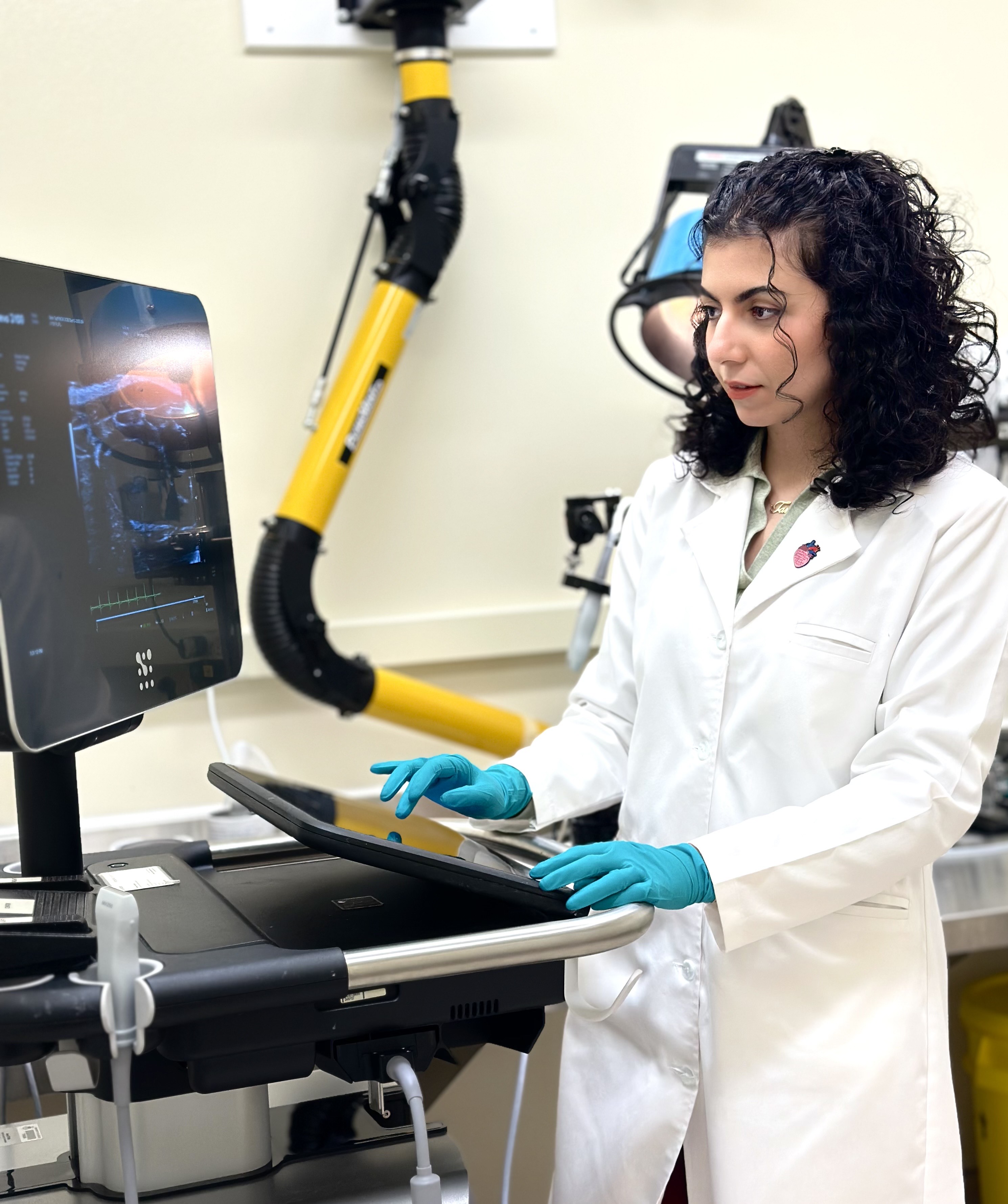
Graduate student Tanin Shafaati working in the lab at the Faculty of Pharmacy and Pharmaceutical Sciences
Around the age of five, Tanin Shafaati — now a graduate student at the University of Alberta’s Faculty of Pharmacy and Pharmaceutical Sciences — was intrigued by the rows of books lining the shelves in her father’s library. She struggled to pull them down.
Her dad, a scientist who spent his career studying pharmaceutical chemistry in the area of capillary electrophoresis, stepped in to help. He sat with Shafaati and flipped through the pages, showing her photos and reading excerpts of text from his human anatomy textbooks.
“I learned how the heart pumped, and how food was ingested,” says Shafaati. “That is my earliest memory of science: heavy books that I could not lift or read, my parents' enthusiasm and my dad’s patience to sit down with me on the floor to show me how the human body works. I believe that my decisions to pursue scientific research all stem from that childhood wonder.”
Today, Shafaati studies type 2 diabetes, and how it affects metabolism and cardiovascular disease, at the U of A under the supervision of pharmacy professor John Ussher. She is also a 2025-26 recipient of the Heart and Stroke Foundation of Canada’s (HSFC) Personnel Award for Women’s Heart & Brain Health, which supports young scholars invested in women’s heart and brain health early in their training and during their transition to becoming independent researchers.
“I want to find out how type 2 diabetes differs in males and females,” explains Shafaati. “We have found that even in our animal model of type 2 diabetes, the female mice show differences in their heart health compared to the male mice, and ovarian hormones seem to play a major role in driving these differences.”
The end goal is to explore how the ovarian hormone estrogen affects diabetic cardiomyopathy — a diabetes-induced cardiovascular condition that is characterized by problems in how the left ventricle relaxes between pumps, often referred to as diastolic dysfunction.
“We want to determine the specific mechanisms by which estrogen alters diastolic function,” she says.
Shafaati explains that she is dedicated to studying women’s health to help fill the gaps that exist due to historically male-centric research studies. Some recent studies, which looked at the percentage of female participants in antidiabetic drug trials and cardiovascular drug trials, show that in most related trials and studies, the percentage of female participants is still less than 50 per cent.
She says that this reality frames her recent HSFC award as more than an encouragement; it is also a responsibility.
“To me, this feels like being part of a community with a goal and common interest in improving the health of women,” she says. “In addition to being provided with major financial support for this project, I am very thankful to have been trusted with this, and I view it not only as an opportunity, but as a duty."
So, what’s next? After her graduate studies, Shafaati says she’s excited to join the scientific community as an independent researcher and academic.
“I believe that academia provides endless opportunities for constant learning and exploration; a treat to a life-long learner!” she says. “Therefore, I will continue to keep this curiosity alive, and I hope to one day return the favour provided to me by the scientific community by educating the next generation of scientists and researchers.”