Convocation 2026: Christopher Moore, BSc Honors, Physics, Lieutenant-Governor's Gold Medal
Donna McKinnon - 25 June 2026
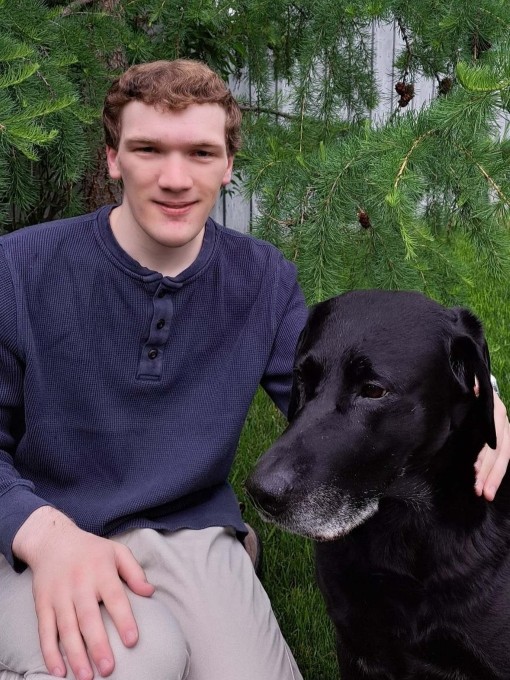
For Christopher Moore, the choice between physics and computing science was an even split. In the end, it was the honors program in physics, specifically particle physics, that captured his imagination and tipped the scales, allowing him to merge his computational skills with an exploration of the deepest mysteries of the cosmos.
Particle physics, which in simple terms is the study of the elementary building blocks of the universe, appealed to Christopher because of his innate curiosity, but also because it occupies a space where established science meets the undiscovered — a frontier he is committed to advancing. It is a passion that has consistently driven him beyond the classroom, including the neutrino research laboratory SNOLAB, located deep beneath the earth in Sudbury, Ontario, where he worked in the summer of 2024, followed by the IceCube Neutrino Observatory last summer.
His momentum carries over to this summer, as well. Following graduation, Christopher will conduct data analytics for the IceCube before beginning a master’s degree program in particle physics under the supervision of Dr. Juan-Pablo Yáñez this fall.
Christopher’s extraordinary academic accomplishments have been recognized with three prestigious awards: the Lieutenant-Governor's Gold Medal, awarded to the graduating Faculty of Science student in an honors program who has shown the highest distinction in scholarship; the Governor General's Silver Medal, awarded to three undergraduate students across the institution who achieve the highest overall academic standing upon convocation; and the Rt Honourable CD Howe Memorial Fellowship — cementing Christopher’s status as the convocating student with the highest overall standing throughout his entire degree program.
Amidst the demands of such a rigorous program, his remarkable achievements stand out as a testament to his resilience and talent.
Congratulations Christopher, space is the limit!
What program are you graduating from?
The Bachelor of Science (Honors) majoring in physics, minoring in computing science.
What led you to choose your current area of study, and why the U of A for your studies?
In high school I knew that I wanted to pursue either computing science or physics but I was not yet sure, so I began in the Honors Computing Science program. However, after first year I found that I resonated more with physics, so in third year I switched into the Honors Physics program with a minor in computing science.
Particle physics in particular is exciting to me because it is currently standing on the edge of the unknown. We’ve pushed the Standard Model to its absolute limits, yet we know it only tells part of the story. The prospect of finding hints of 'new physics' — whether that's uncovering the exact nature of neutrino masses or discovering unexpected interactions that break our current models — is thrilling to me.
I chose the U of A for my studies because it has a strong physics program and a computing science department that is globally recognized for its contributions to AI. Additionally, I grew up in Edmonton so staying here allowed me to study at a top institution while remaining close to my friends and support system.
Tell us about your experience in your faculty.
My time within the Faculty of Science has been full of learning and exploration. The honors physics program gave me the opportunity to study many fascinating areas of physics ranging from the physics of subatomic particles all the way to the evolution of the Universe. Furthermore, outside of traditional classes I have had multiple opportunities to do research over the summer. In particular, in 2024 I worked on PICO, a direct detection dark matter search at SNOLAB. In 2025, and again, this summer, I am working on IceCube, a neutrino detector at the South Pole (although I will be doing the data analysis here in Edmonton). These have been very rewarding experiences that have solidified my passion for particle physics.
What is one of your favourite memories from your time at U of A?
Some of my favourite memories from my time at the U of A are playing Catan with my friends. It was a great way to relax from the stress of the term and we had lots of fun playing.
Tell us about your favourite professor and/or class.
I enjoyed pretty much all of the classes that I took, but one of the ones I enjoyed most was Introduction to Condensed Matter Physics (PHYS 415) with Dr. Frank Marsiglio. The course went into some of the more practical applications of physics, and I felt that Dr. Marsiglio did an excellent job covering the material in an engaging way. In fact, I continued on to do an undergraduate research project with him.
That being said, I also found Introductory Particle Physics (PHYS 485) with Dr. Juan-Pablo Yáñez to be very interesting as it delved into the more fundamental side of physics, and it was my first exposure to some of the theory behind particle physics, which is the area that I am pursuing my masters in.
What advice do you have for current and future students?
If I could give current and future students one piece of advice, it’s to focus on finding what truly interests you. Pay attention to the specific topics, assignments or questions that genuinely catch your attention during your coursework. It is so much easier to excel and stay motivated when it is a topic you are passionate about.
How do you plan on celebrating convocation?
I plan on celebrating convocation by spending some time with my family and going out for a nice meal.
What's next after graduation?
My family has a road trip planned to go visit my grandmother this summer. Then in the fall, I'm continuing at the U of A to complete a Master of Science degree in particle physics working on IceCube.
Christopher joins fellow medal recipients Keira Rawlinson (Dean’s Gold Medal in Science) and Alex Cross (Gold Medal in Science).