Science Talks Webinars
Recent Webinars
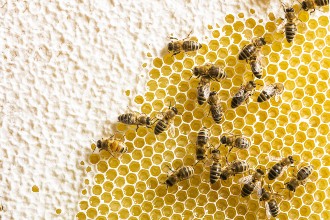
Science Talks: What is bugging the bug?! Undergraduate student experience studying honey bees viruses
Join us to hear from a team supported by the first year of our Science Experiential Skills Advantage, providing flexible opportunities for undergraduate students to build professional experience and receive mentorship through diverse research projects. Ammy Pacheco, Prabashi Wickramasinghe and Olav Rueppell will highlight the fascinating biology and importance of honey bees, including the factors that contribute to the unsustainable losses of honey bee colonies. They’ll discuss virus transmission and the impact on honey bees focusing on a research project funded by the SESA program. Our presenters will also explore the broader implication for the academic careers of current and future SESA participants and the professional development of SESA Scholars.
Science Talks: Mathematical & Statistical Sciences: Can Influenza forecasts be more reliable than weather forecasts?
Cold and flu season is upon us and as individuals and families feel the effects of viruses on our communities, researchers use modelling to understand the dynamics of transmission and spread of respiratory viral infections in Alberta during influenza seasons. Modelling can be used to support public health decisions from community spread to improving hospital capacity planning.
Hear from Michael Li (‘93 PhD) and Marie Betsy Varughese (‘17 PhD) of the Department of Mathematical and Statistical Sciences as they provide a glimpse into their work predicting the peak times of seasonal influenza and some common questions, challenges and misconceptions of mathematical modelling.
Michael Li (‘93 PhD), Professor of Mathematics & Statistical Sciences and Marie Betsy Varughese (‘17, PhD), Senior Principal Mathematical Modeler at the Institute of Health Economics and Adjunct Professor in the Department of Mathematical and Statistical Sciences use mathematical modeling tools to study transmission dynamics of infectious diseases in populations and immune response dynamics to viral infections inside the human body. During the last 10 years, they have both been involved in providing peak time predictions of seasonal influenza for Alberta health authorities.

Material Chemistry: Designing the next-generation materials of tech: Nanographene-based organic materials
Carbon-based materials like graphene have revolutionized electronics, energy storage and materials science. Organic synthesis can be used to build nanographenes — molecular fragments of graphene — with precise control over their size, shape, and curvature. By introducing structural features such as twists, bends, and chirality, we can tune their optical and electronic properties for potential use in next-generation technologies — with possible applications in creating flexible screens and more.
Join University of Alberta grad and professor in the Department of Chemistry, Wesley Chalifoux. This presentation will highlight his lab’s recent advances in the synthesis of these unique molecules, as well as the broader implications for materials design, photophysics, and carbon-based nanotechnology.
View Recording
Previous Webinars
Science Talks: Human-Centred Privacy in a Digital Society
Science Talks: Environmental Chemistry: Safeguarding our Indoor Air
Protecting our oceans: Alien Invaders and how to stop them
Quantum Materials: From exotic particles to new technologies
Cannabis use in the modern era: The highs and lows
Artificial Intelligence - What can language models tell us about the brain?
Climate change on Canada's highest peak
Software Development - Building Better Code through Reuse
Rural Sustainability in Alberta with Bob Summers
Keeping hives alive: Behavioural defence of honey bees against disease with Olav Rueppell
Electric potential: Extracting lithium from waste in Alberta with Dan Alessi
Chasing a cure: New tools in the fight against COVID-19 with Fred West
Brain immune cells - the new frontier in neurodegeneration with Matthew Macauley
ARCHIVES
May: Sleep to remember with Clayton Dickson
April: The Evolution of Ethics in AI with Eleni Stroulia and Nidhi Hegde
February: COVID-19 modelling demystified with Marie (Betsy) Varughese and Michael Li
January: Fostering coexistence over conflict with urban coyotes through evidence-based methods with Colleen Cassady St. Clair
December: Taking Control of the Quantum World: Developing new technologies using ultracold atoms with Lindsay LeBlanc
November: Data permutations: How to understand human speech, the spread of COVID-19, and the Alberta electorate with Adam Kashlak
October: Searching for life outside of Earth: NASA’s Mars 2020 Perseverance Rover Mission with Chris Herd
September: Eavesdropping on communication in wild bats and mice with Matina Kalcounis-Rueppell
August: Community Approaches to Housing Affordability with Joshua Evans
July: The science of Rock, Paper, Scissors with Ben Dyson
June: Perspectives from new Canadian Arctic Ice Cores with Alison Criscitiello
May: Cretaceous Dinosaurs in Northern Alberta with Corwin Sullivan
April: Glycomics- Sugars and Human Health with Lara Mahal