Two degrees, one world
Donna McKinnon - 9 November 2026
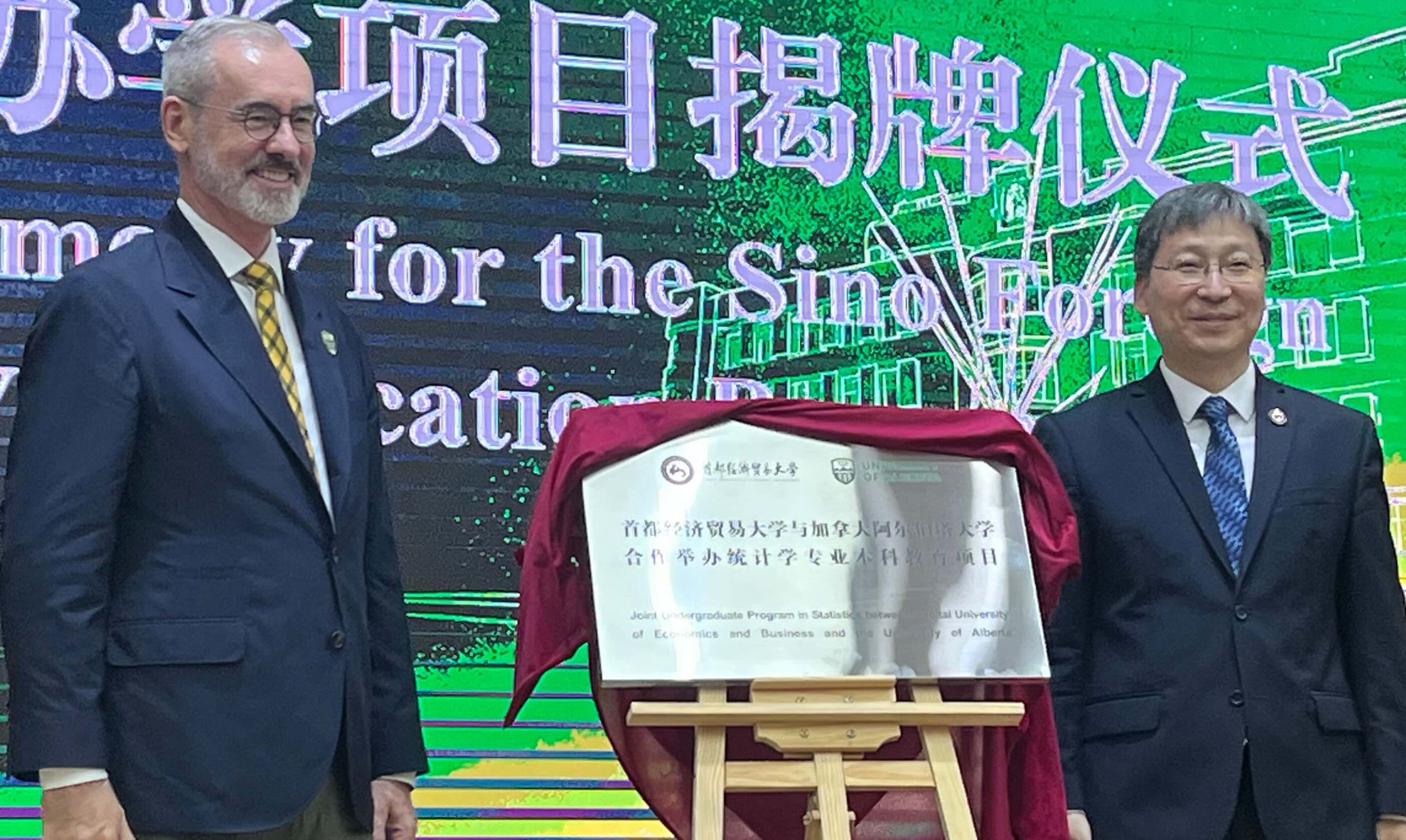
U of A President Bill Flanagan and CUEB President Weixing Wu unveiling a plaque celebrating the launch of the dual-degree program on September 11, 2026, in Beijing.
The University of Alberta’s Faculty of Science is forging new paths in international education with the launch of its first-ever 4+0 dual-degree program in partnership with Capital University of Economics and Business (CUEB) in Beijing.
The initiative allows undergraduate students in China to complete a full four-year U of A Bachelor of Science degree in statistics entirely at CUEB, graduating with credentials from both institutions without needing to relocate abroad.
Bringing such a comprehensive joint program to fruition required extraordinary speed and alignment across borders.
Following an opening in CUEB’s international programming in September 2025, U of A leaders led by Dr. Chris Frei, a professor in the Department of Mathematical and Statistical Sciences, moved quickly to establish a new collaboration. By January, formal agreements were submitted, securing rapid approvals from the Beijing municipal authority, the Chinese Ministry of Education and U of A governance by May.
“CUEB was looking for a new partner, and apparently we were very high on their list of preferences,” says Frei. “It went very smoothly. Once we got approvals, students began to apply and out of a quota of 120 students, 116 showed up which is a really high number for the first year.”
The program was officially launched in Beijing on Sept. 11, 2026, with U of A President Bill Flanagan and Dean of Science Declan Ali attending the ceremony and addressing the inaugural cohort of students.
To earn their U of A degree, CUEB students complete 20 U of A courses delivered alongside 20 CUEB courses. While most coursework covers core mathematical and statistical sciences, the curriculum also incorporates broader educational requirements and introduces students to Canadian perspectives.
Notably, all enrolled students will take a dedicated online section of NS 201: Indigenous Canada, offered through the Faculty of Native Studies. The requirement ensures student learning mirrors the academic expectations of undergraduate science students on the Edmonton campus.
All U of A courses are taught in English and students must also meet the U of A's English language proficiency requirements to receive their U of A degree.
U of A courses are taught by qualified instructors based in Beijing, complemented by visiting U of A faculty who teach intensive short courses. These visits also provide opportunities to connect with prospective graduate students and build research collaborations.
“It also may help later when it comes to graduate recruitment,” says Frei. “These students are already familiar with the U of A, and it increases our talent pool for graduate programs and creates opportunities for summer projects.”
The 4+0 model offers an alternative to studying abroad, allowing students to earn an international degree without leaving their home country. This can be particularly attractive to students facing financial, visa-related or personal barriers to studying overseas.
"This accommodates those concerns,” says Frei. “Students can get a degree from their home university in China, but they also get a U of A degree, which may help them later if they are interested in furthering their degrees or getting a job overseas. Students benefit from both worlds."
Alongside the Beijing initiative, the faculty has also introduced a complementary "3+1" Applied Mathematics Program with Jilin University in Changchun, China. Students spend their first three years at Jilin University, where they take 10 U of A courses alongside their Jilin coursework, before completing another 10 U of A courses during their final year in Edmonton. Both the 3+1 and 4+0 programs offer two distinct international pathways for undergraduate students.
Together, these initiatives support and expand on the U of A’s strategic goals to increase international student enrolment, broaden transnational education networks and extend the university’s international impact. Frei notes that similar dual-degree programs are currently under consideration across other departments and colleges.
"Advancing these programs is critical for our strategic growth and global visibility, establishing the U of A as a trusted partner in key international markets,” says Dr. Michael Serpe, associate dean (International Relations) in the Faculty of Science.
Looking ahead, the Department of Mathematical and Statistical Sciences is working with CUEB to offer a course-based master's program in statistics in Beijing, with a target launch in fall 2027, subject to the necessary approvals.