Labs
Quick Reference
Archaeology Collection and Teaching Lab
Archaeology Preparation Lab
Archaeology Wet Lab (Dirt Lab)
Bio-Anthropology Teaching Lab
Bio-Anthropology Preparation Lab
Bio-Archaeology Lab
Computational Archaeology and Lithic Technology Lab (coming soon)
Digital Imaging Lab
Digital Photography Lab (coming soon)
Film and Print Development Lab
Paleo-environmental Collection Lab
Undergraduate Research Space (coming soon)
Zooarchaeology Collection and Teaching Lab
Concerns?
If you have any concerns that need to be addressed in the laboratory spaces, please fill out the Activity Request Form.
For all lab related inquiries, please contact Chenée Merchant at cmerchan@ualberta.ca.
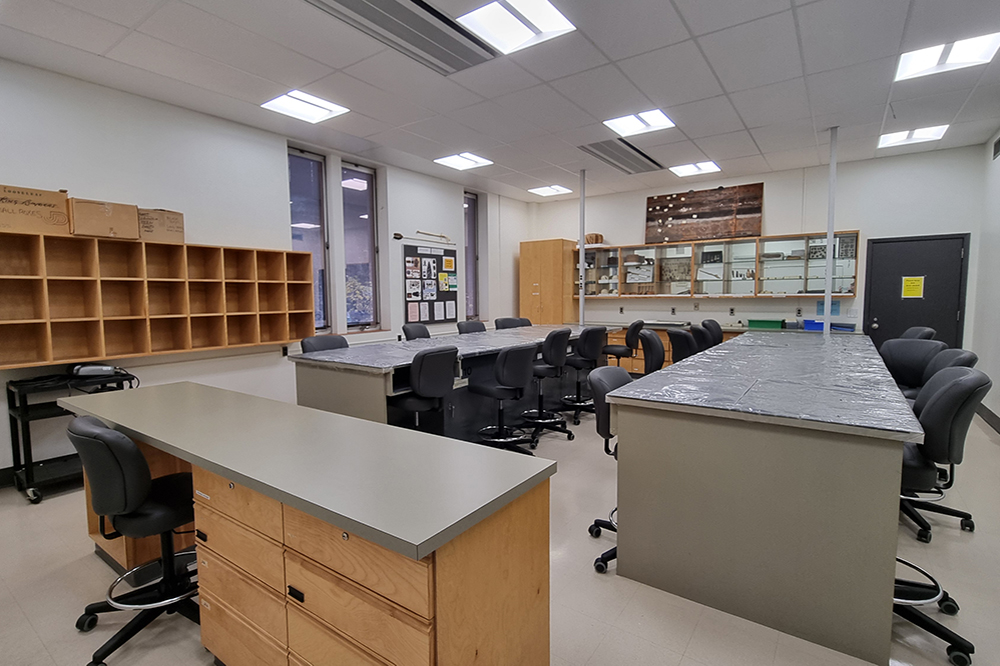
Archaeology Collection and Teaching Lab
Used to teach archaeology courses and labs, as well as public workshops engaging folks in archaeology. See the collections webpage for more details.
- Houses teaching cast material of Paleolithic, Mesolithic, Neolithic, Plains, Eastern woodland, and Arctic stone and bone tools (casts and replicas)
- Also contains archaeological materials from across North America, Central America, and South America
- Artifacts include stone tools, ceramic figurines, whistles, antler tools, and a microwear reference collection
- Experimental stone tools with associated video and documentation


Archaeology Wet Lab (Dirt Lab)
Where archaeological site soil is processed and the artifacts are cleaned, sorted, bagged, and labelled so they are ready to be analyzed.
- Wet lab and drying space
- Temporary storage for field samples
- Workspace for analyzing field samples and artifacts
- Sieves, graduated cylinders, microscopes, scales

Bio-Anthropology Teaching Lab
For teaching courses and labs such as Osteology, Biological, Forensic, and Dental Anthropology, as well as public workshops engaging folks in all aspects of biological anthropology:
- Osteological equipment: osteometric boards, calipers, mandibulometer, anthropometers, tapes, magnifying lights and glasses, X-ray light table


Bioarchaeology Lab (Containment Level 2)
Chemical and biohazard labs meant for higher risk activities, such as macerating or thin sectioning of animal/human tissues, tissue preparation for transportation to other labs, and international or contaminated soil and plant analysis.
- Biosafety cabinet
- Fume hood
- Thin sectioning set up for hard tissues
- Large boiling pot and exhaust vent for tissue maceration
- Drying oven and muffle furnace
- Dissecting supplies and necropsy table
- Basic laboratory equipment like centrifuges, pipettes, and microscopes


Zooarchaeology Reference Collection and Teaching Lab
Used to teach zooarchaeology labs, as well as public workshops engaging folks in zooarchaeology. Students can get involved by volunteering. See the collections webpage for more details.
- Houses modern animal skeletal specimens from Alberta and the Arctic
- Also contains some archaeological faunal material