Witnessing the War on Ukraine Summer Institute 2026
Witnessing the War on Ukraine:
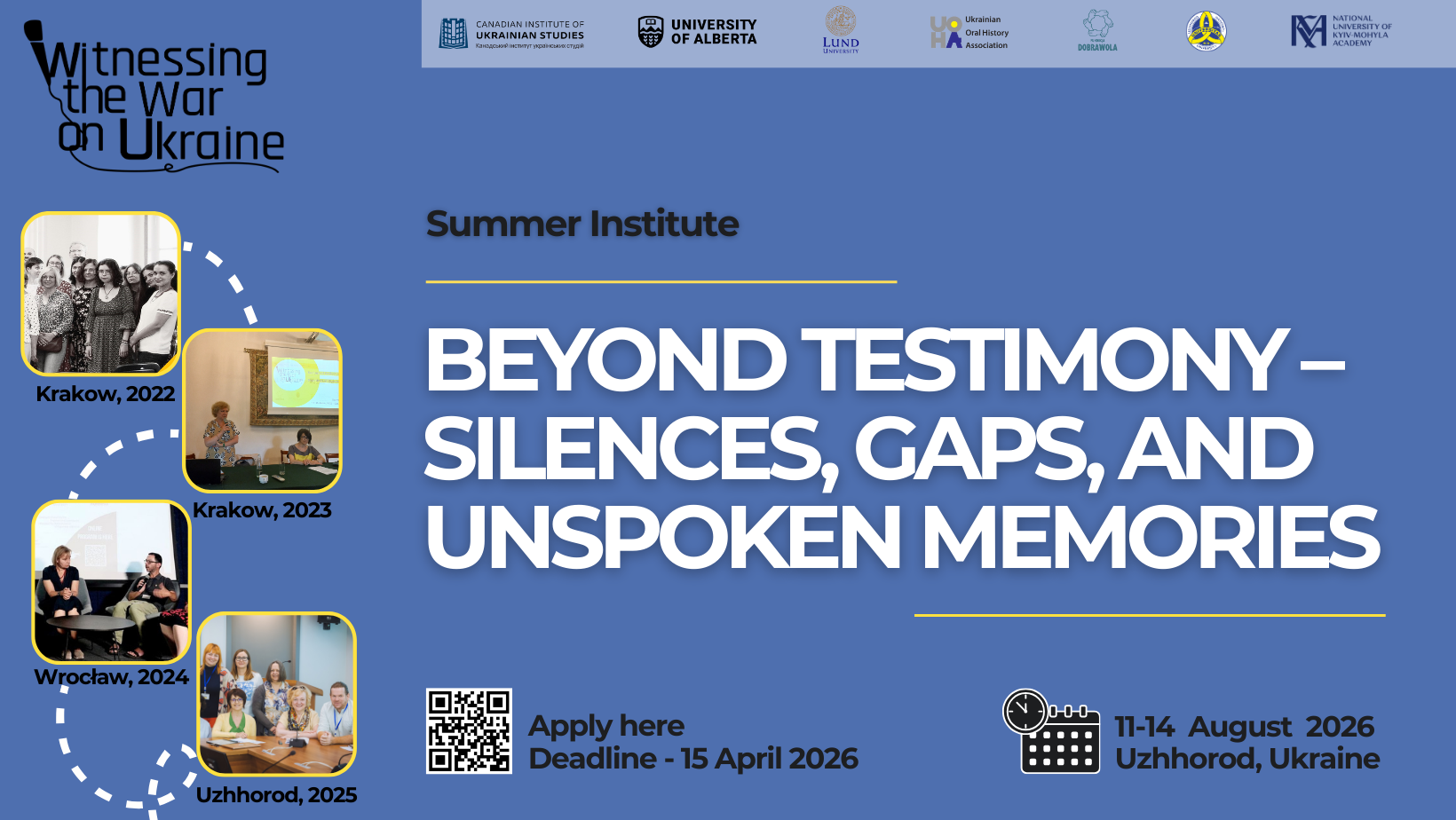
Beyond Testimony – Silences, Gaps, and Unspoken Memories
Summer Institute
11-14 August 2026 - Uzhhorod, Ukraine
Call for Applications
In response to Russia’s full-scale aggression against Ukraine, the Summer Institute Witnessing the War on Ukraine (WWSI) was launched in July 2022 as a joint initiative of several academic and cultural institutions. From the outset, the Institute has been conceived as a professional and ethical response to the urgent need to document wartime experiences and to support junior researchers engaged in the study of Ukrainian war testimonies. It provides a space for sharing expertise in oral history, ethnography, memory studies, interview-based research, and witness literature and art.
Over the past four years, WWSI has developed into a stable international educational platform bringing together scholars and practitioners from Ukraine and abroad. While maintaining a consistent focus on witnessing and testimony, each annual iteration has addressed new thematic and methodological challenges shaped by the evolving context of war:
- WWSI 2022 focused on a “rapid response” to the ethical challenges of conducting research amid ongoing trauma and on how to carry out interviews without causing harm.
- WWSI 2023 examined contemporary scholarly and creative approaches to witnessing the war.
- WWSI 2024 explored testimony research in the pursuit of justice, emphasizing innovative disciplinary approaches and the creation of spaces of trust and dignity for victims.
- WWSI 2025 addressed oral history as a socially and historically responsible research practice, focusing on the conceptualization and preservation of war testimony as cultural heritage and as a foundation for future historical memory in Ukraine.
The Fifth Summer Institute, Witnessing the War on Ukraine: Beyond Testimony – Silences, Gaps, and Unspoken Memories (WWSI 2026), will focus on the limits of testimony and on the methodological, ethical, and interpretive challenges of engaging with silence, self-censorship, and the unspoken in war narratives. In the context of the ongoing war, as well as in relation to earlier wars of the twentieth century, attention to “silent testimonies” makes it possible to identify gaps in collective memory and to analyze mechanisms of repression, self-censorship, and the transformation of experience. At the same time, this perspective opens new avenues for rethinking oral history methodology, interpretive frameworks, and the ways war narratives are constructed in academic and public spaces. In this sense, WWSI 2026 situates testimonial research within broader debates in memory studies and oral history.
WWSI 2026 will have a predominantly theoretical and methodological orientation. The Institute will focus on conceptual debates within oral history and memory studies, including the theorization of silence and absence, the epistemological limits of testimony, the relationship between narrative, experience, and non-narration, as well as the ethical and interpretive consequences of working with gaps, interruptions, and the unspoken. Particular attention will be paid to how silences are produced, maintained, and interpreted in conditions of war, repression, and violence, and to how oral historians and memory scholars can develop analytical frameworks that account for both what is said and what remains unsaid.
WWSI 2026 will bring together researchers and practitioners working on oral history, memory, and testimony in Ukraine and in comparative perspective. The Institute will serve as a space for in-depth methodological discussion, critical reflection on ethics and research practice in wartime, and exchange between scholars at different stages of their academic careers.
Why does oral history matter when testimony is fragmented, silenced, or withheld? How can researchers work responsibly with absence, gaps, and the unspoken? What interpretive tools allow us to address silence without instrumentalizing it? These questions will guide the discussions throughout the Institute.
What to expect
Over the course of four days, the Institute will offer a series of lectures, thematic panels, and workshops. Invited speakers and faculty will lead discussions, book presentations, and film screenings addressing various dimensions of silence, memory, and war. Participants will have the opportunity to present their ongoing research projects and receive feedback from leading scholars in the field.
WWSI 2026 will feature a keynote lecture by Alistair Thomson, a leading oral historian and the author of seminal works including Anzac Memories: Living With the Legend and The Oral History Reader, which have profoundly shaped oral history scholarship globally. The Summer Institute will take place exclusively in person in Uzhhorod on 11-14 August 2026. Some invited speakers may participate online. The working language of the WWSI 2026 is English.
This Summer Institute is organized in partnership with UOHA International Conference 2026 “Testimony Across History” (10-11 August 2026) and will include joint events.
There is no registration fee for participation. Accommodation, travel, and meals will be fully covered for selected participants.
Applications
The call is open to researchers and practitioners engaged in oral history, memory studies, and related fields focusing on war and violence in Ukraine and beyond.
To apply, candidates are required to complete the application form and submit all materials specified there. In addition to a personal statement explaining how participation in the Institute will benefit the applicant’s scholarly work, a short biographical note, and contact information, applicants are required to submit a prospectus of a methodological article (up to 500 words) related to the themes of the Institute. Selected participants will be expected to develop this prospectus into a draft of the methodological article (up to 6000 words) and submit it one month prior to the start of the Institute. These articles will serve as a basis for collective discussion during the Institute. A limited number of the participants will be invited to collaborate on the production of a collection of essays in one of the international publishing venues.
Important Dates
Application deadline – 15 April 2026
Notifications of acceptance – 1 May 2026
Articles submission deadline – 15 July 2026
Summer Institute – 11-14 August 2026
If you have any questions, please do not hesitate to contact us at wwsi@ualberta.ca
Organizers and Partners
Canadian Institute of Ukrainian Studies, Canada
Ukrainian Oral History Association, Ukraine
Uzhhorod National University, Ukraine
University of Alberta, Canada
National University of Kyiv-Mohyla Academy, Ukraine
Lund University, Sweden
Dobra Wola Foundation, Poland
Organizing Committee
- Natalia Khanenko-Friesen
- Eleonora Narvselius
- Gelinada Grinchenko
- Alina Doboszewska
- Pavlo Leno
- Oksana Khomiak
- Anna Olenenko