Amber Simpson
Decoding medical images to improve cancer care
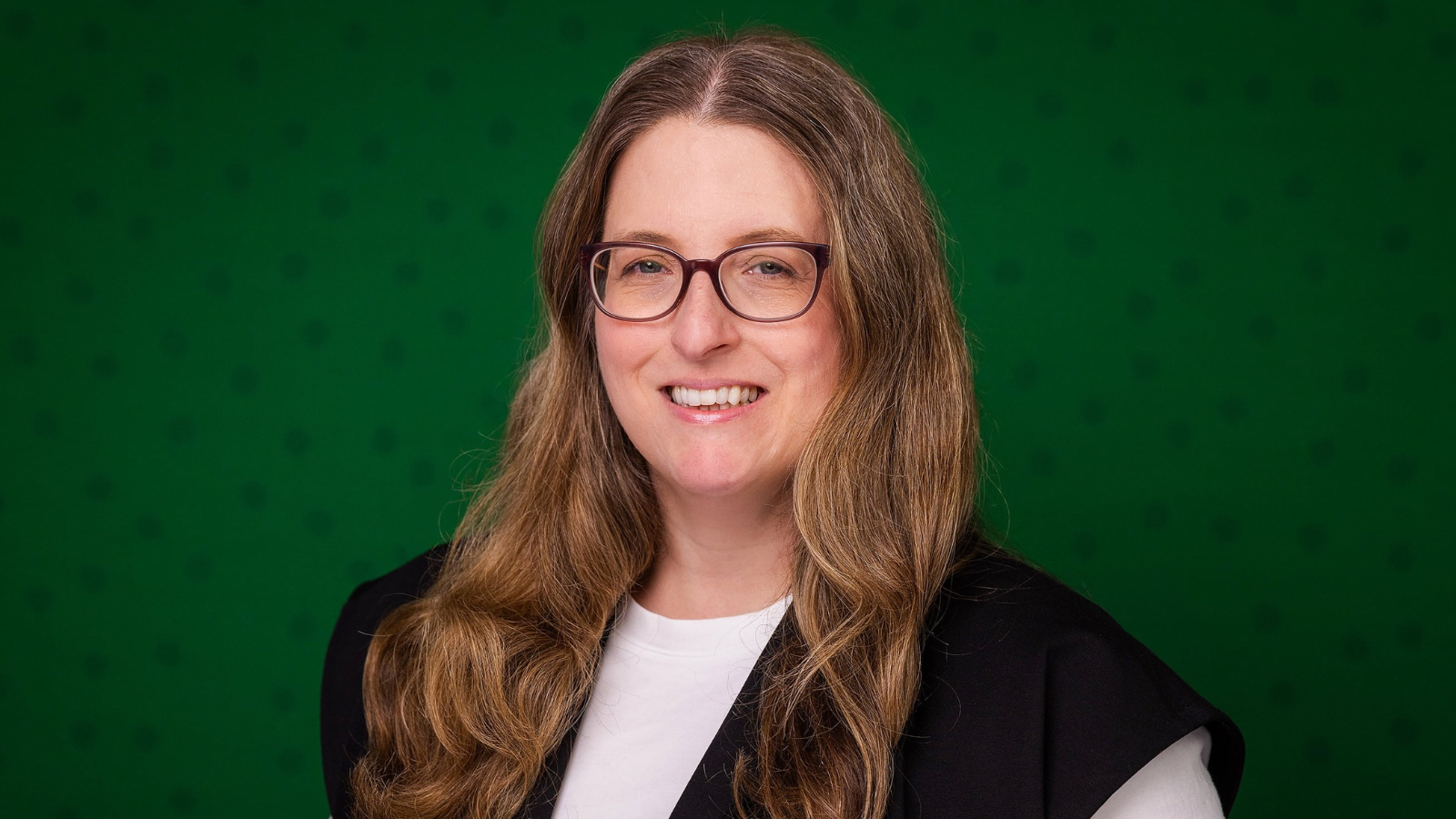
Amber Simpson is Director of the Dianne and Irving Kipnes Health Research Institute, Professor in the Department of Radiology & Diagnostic Imaging, Alberta Machine Intelligence Institute Fellow, and CIFAR Chair in Artificial Intelligence (AI). She is an expert in cancer imaging AI and develops innovative computational strategies to improve human health.
- How did you get into your area of research?
- As a graduate student I was researching theoretical computer science, which didn't really involve talking to anyone and was not applied at all. There was someone doing biomedical computing, specifically image-guided surgery. This is much before the wave of AI and all of the crazy AI-ness. I realized that I could do research in computer science that's applied to human health.
- I switched into biomedical computing for my PhD work, and then took a postdoc at Vanderbilt University in Nashville and started observing surgeons in the operating room doing cancer surgeries. My PI sent me to Memorial Sloan Kettering Cancer Center in New York to run a big project so then I started spending a lot of time with oncologists, surgical oncologists, radiologists, all around cancer care. I was invited to join the faculty of Memorial Sloan Kettering, so my first faculty position was at a cancer centre.
- Please explain your research.
- My research group takes diagnostic images of cancer patients and uses them to mine for predictive and prognostic information. We develop biomarkers so that clinicians can use those biomarkers to make decisions for patients. The images that we work with are routinely acquired, usually computed tomography scans. We use those scans and we look for additional patterns that are invisible to the human eye. We take an image and predict whether a patient will respond to chemotherapy, or predict whether a patient would have a good outcome after surgical resection. The clinician can use this information to decide on things like adjuvant therapy or neoadjuvant therapy, depending on the cancer context. We also take in information that's routinely available on patients. Depending on the cancer, they might have a molecular marker that's interesting. They might have other clinical data that would be available. We also do exploratory studies of information that would not be routinely available. Maybe that's digital pathology, or high throughput genomics, something like whole genome or whole exome sequencing. We’re open to all different types of data, and it just depends whether we want to make a biomarker that's really standard and based on standard data that would be available in a patient, or whether we want to explore the making of a new biomarker and bring in novel data types.
- What impact is your research making, or do you hope it will make in the future?
- We’re known in my lab for a couple of things that we did to change the direction of research in medical imaging and cancer. We ran the Medical Segmentation Decathlon, which was an open source, open data challenge in 2018. That challenge has gone on to create methods for annotating tumors in diagnostic and therapeutic images. That work is now integrated in every clinical system, in every clinical software. It's because we put this challenge out, and we released a lot of data, and the community came together and came up with new methods for doing what we call tumor segmentation. Tumor segmentation is really important in cancer because it's the metric of whether or not a patient has responded to chemotherapy. For most patients, the way response to chemotherapy is determined is whether or not a tumor has shrunk and in order to know if a tumor has shrunk, you need to know how big a tumor is in imaging. These tools can now be used for that. We created the state of the art in the field, and that state of the art has been improved and multiplied on over the last almost 10 years, and has really taken tumor segmentation from being something that was entirely manual to being something that, for some cancers, is solved. Other people have been able to build tools because we released the data publicly, and so that was something that we did in our lab that contributed to a community that really pushed the field forward.
- Where do you see your area of research going in the future?
- We still haven't shown for all cancers the benefit of AI, and I think that's coming now. There was finally a randomized control trial of a breast screening tool that showed benefit of that tool, and we need to do more of that. Those are things that we know how to do. It's low hanging fruit, but we still need to show benefit to the patient. That's really exciting.
- One of the reasons I came to the University of Alberta and joined the Alberta Machine Intelligence Institute is because of their expertise in reinforcement learning. Reinforcement learning, in my mind, has not been sufficiently applied to medicine, and the reinforcement learning problem is really interesting for cancer care, and for understanding tumour dynamics.
- Which elements of your work do you find the most rewarding?
- I like working with actual data from actual patients. I also like talking to patients. I've been involved with the Marathon of Hope Cancer Centers Network since its inception and I’m now also the co-lead of the Prairie Node. I spent a lot of time in my previous role at Queen's University setting up the Marathon of Hope in Kingston, Ontario. I got to meet a lot of patients, and am very motivated to create solutions for them.
- I also find working with students to be pretty brilliant. Being able to help define what young people are going to go on to do in their career is really an amazing part of being a professor. When we see students in undergraduate and in graduate studies, it’s their exposure to us and the work in our lab that is going to define what they do next. That's a tremendous opportunity.
- What research challenges do you face?
- Investigators all face similar challenges. We spend a lot of time writing grants and trying to wrangle funding. It's very difficult to spend time on the really important ideas that are going to drive the field forward. I'm a CFAR chair and have funding associated with it so I can commit to doing blue sky research and changing directions if I need to, but of course, research funding is always a challenge.
- We also have challenges with access to data which we're attempting to address this provincially. I'm also the Director of the Dianne and Irving Kipnes Health Research Institute and one of the things that we're trying to do is set up provincial access to health data in a way that is AI ready. We would take that brilliant health data and pair it with the appropriate compute infrastructure to be able to create predictive and prognostic biomarkers.
- What are you looking for in potential collaborators?
- I'm looking to put together teams that can ask and answer big questions. What I would really like to see is that we capture the imagination of CRINA researchers so that we're working together towards something that none of us could answer on our own. Having teams come together to do team science is what I really want to see and what I'm really excited about with CRINA.
- The Kipnes Institute is a college-level institute and we see ourselves as being core providers of access to health data, could be cancer data or other data, and other core facilities that could support cancer missions as well as other diseases. We see ourselves as really being strong partners with the different centers and institutes that are disease specific. That's also another really interesting thing that's going to be coming, especially with our health data research environment and getting that online, and unleashing some of the benefits of being in Alberta for cancer research.
- What is your main piece of advice for graduate students?
- Take chances. Your advisor can help you take chances, controlled chances, that have a high likelihood of success. The most interesting science happens when you can step outside of your comfort zone and live in that discomfort. That's where the most interesting research happens, so I would tell them to take more chances.
- If you hadn't become a researcher what would you be?
- I've always said that, as a computer scientist, I have a backup plan that I could go maintain web pages for someone. A more serious answer is that I've thought about playing some role with government. I know a lot about health AI.
- What's one thing people might be surprised to learn about you?
- I spend a lot of time in my own head, and I like spending time in my own head. I'm probably fairly boring but it looks really glamorous. I travel, I give great talks, I go to nice places, and I have big collaborations. But most of my day is spent sitting in front of a computer and being in my own head. And I'm okay with that.