Geetha Menon
Improving treatment delivery and streamlining workflows for faster access to radiation treatment
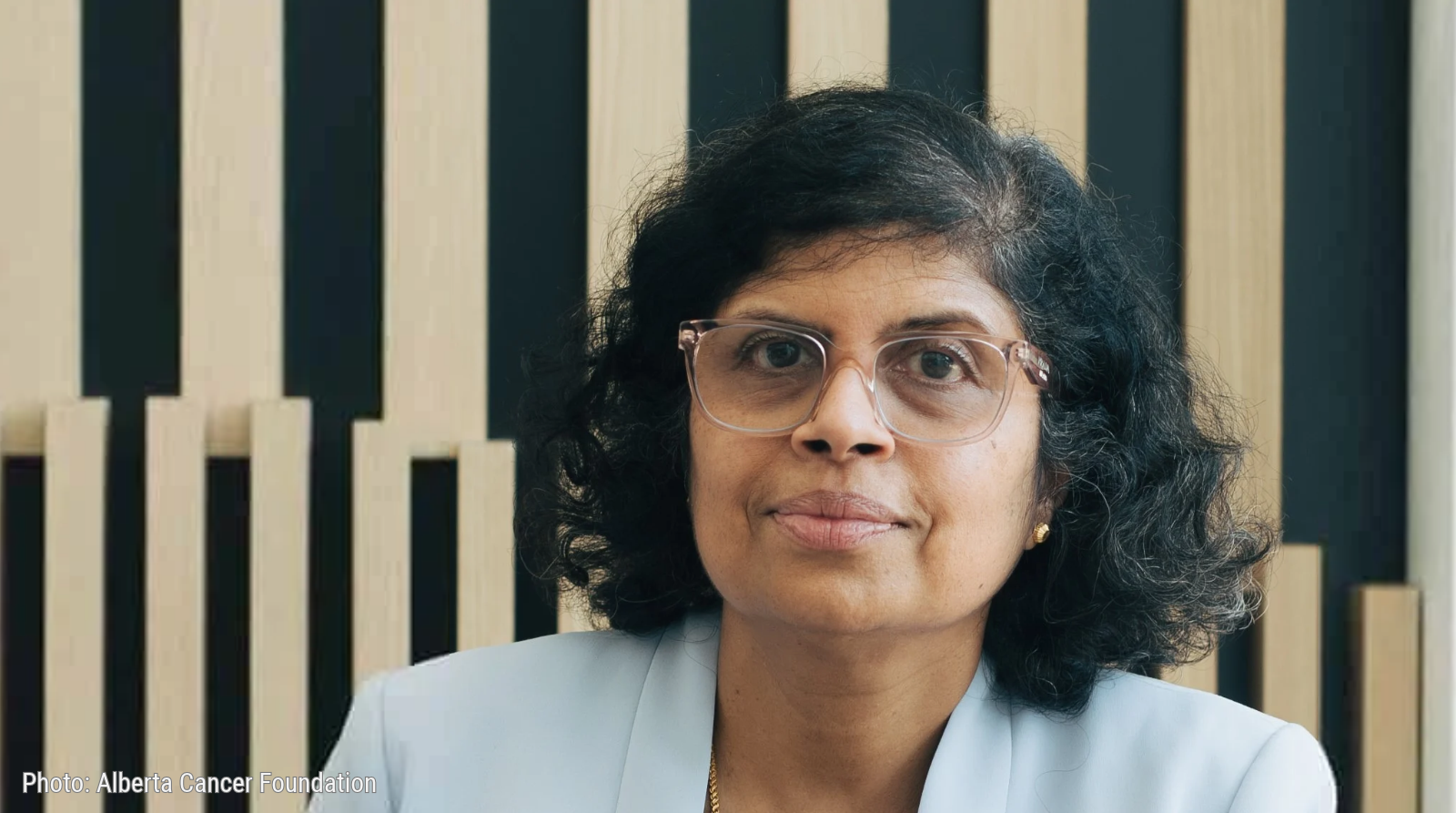
Geetha Menon is a Senior Medical Physicist at the Cross Cancer Institute and a Clinical Professor in the Department of Oncology at the University of Alberta. Her research ranges from investigating radiobiological responses in tumors and normal tissues to developing innovative artificial intelligence applications for radiation oncology, with a strong focus on translating research advances into clinical practice.
- How did you get into your area of research?
- Honestly, I got into my research areas somewhat by chance. The work my graduate supervisor did in brachytherapy was very interesting and working with him and learning from him had a great impact on me. After that I think it was very natural to continue working in the same area. Early in my career, I happened to work on projects in women’s cancers mostly gynecological and breast, and that too largely driven by opportunity. Over time through good collaborations and better research questions, this became my research niche.
- Please explain your research.
- I am a certified medical physicist whose job entails making sure radiation is used safely and accurately to treat cancer. Hence, my research interests are mostly driven by observations made in the clinic for improving both treatment delivery and streamlining workflows for faster access to treatment. My current research is in applications of artificial intelligence in gynecological brachytherapy for developing automation tools to improve treatment workflows. We’re trying to reduce repetitive tasks to give clinical personnel more time for other tasks. One example of an AI tool we developed recently is for automatically generating plans for radiation treatments, which can take two to three hours if performed manually. Automation of this task can significantly reduce the time a patient needs to wait to get treated.
- What impact is your research making?
- Most of my research is designed with clinical translation in mind. The goal is not just to advance knowledge but to create techniques or tools that can be used in everyday practice. I hope in the next few months, we can implement our automation tool clinically as it will be a real game changer.
- Where do you see your area of research going in the future?
- Looking ahead, I see the field becoming increasingly focused on translating AI research into tools that can be used routinely in the clinic. I'm excited about the potential to automate time-consuming processes, support clinical decision-making, and ultimately make cancer treatments more efficient. In the future, I think we'll see more intelligent systems that support personalized treatment decisions in clinical workflows.
- What research challenges do you face?
- It’s difficult to pick one or two challenges and that’s why research in the field of cancer is a multi-disciplinary effort where teams work together to solve complex problems. We have physicians, medical physicists, biologists, computer scientists and excellent students on our teams. A challenge is finding the right collaborators. At this point, collaboration with computer specialists would help expedite clinical implementation of our models.
- Funding is a challenge for all researchers these days, but it is especially difficult for medical physicists because our work is not purely basic science nor clinical and does not always fit neatly into traditional funding categories.
- What are you looking for in potential collaborators?
- At this juncture of my research, I value people who can help bridge the gap to get our automation tools ready for real-world implementation. I'm particularly interested in working with individuals, like computer or AI specialists who can help integrate our research into clinical workflows more efficiently.
- What is your main piece of advice to learners?
- In two words – passion and patience. Choose a research career only if you are passionate, curious, and patient with yourself. Research is full of unexpected roadblocks but there is always a solution that needs to be discovered and needs patience. Another important one is to stay open to constructive feedback.
- If you hadn't become a researcher, what might you be doing?
- No doubt about it, I would have been a lawyer. Growing up in India, family and teachers often influence your career path, and in my case, my grade 10 school principal convinced my parents to put me in science instead of arts. That said, I have no regrets as I genuinely enjoy the work I do in medical physics. Still, one of my favourite pastimes when I reach home is watching courtroom dramas on TV.
- What's one thing people may be surprised to learn about you?
- I'm not a very sporty person, but if there’s one thing I’ll happily rearrange my schedule for, it’s badminton.
- How has CRINA helped support your work?
- CRINA has given me a lot of opportunities to learn about the exciting work that's being done at the University of Alberta. Through CRINA, I’ve had opportunities to hear about potential collaborators. The weekly seminars provide valuable insights into emerging developments across the field and spark new ideas. I also appreciate the opportunities it provides for our trainees to present their work, develop communication skills, and receive support through scholarships.