Kristi Baker
Boosting the immune system to fight cancer
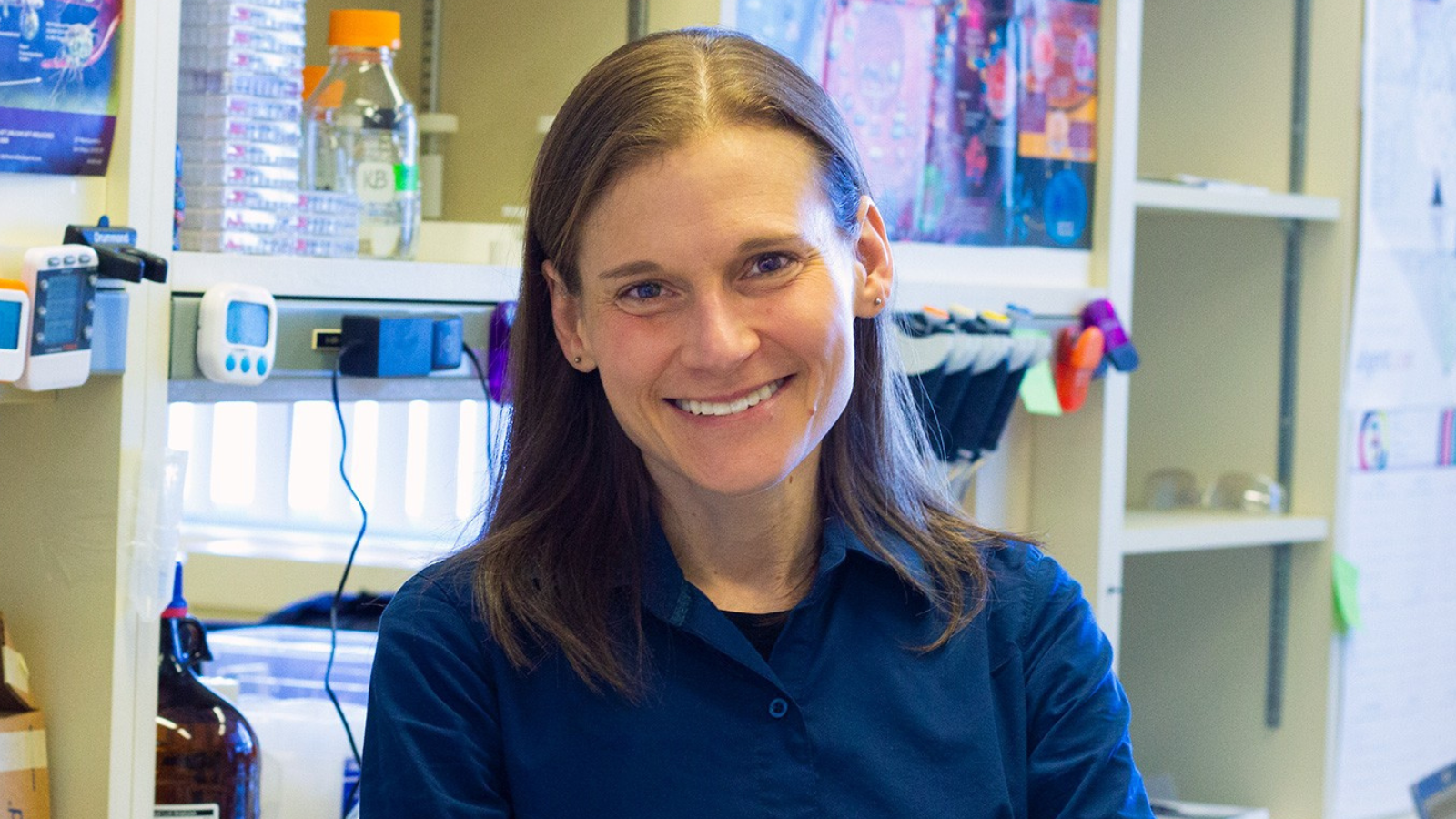
Kristi Baker is an Associate Professor in the Department of Oncology at the University of Alberta. Her research is focussed on trying to better understand the relationship between cancer and the immune system.
- How did you get into your area of research?
- I fell into it! I did my undergrad in microbiology and immunology. I was fascinated by people being infected with things. When choosing where I wanted to do my PhD, the immunology department only had positions where they studied one molecule at a time – that just wasn’t for me. I wanted to look at the bigger picture. The pathology department had a researcher who studied a type of colon cancer closely related to the immune system. This merged my two interests: the immune system and cancer.
- My grandmother died of colon cancer when I was 7, and my grandfather, who I lived with during my undergraduate degree, was also diagnosed with cancer. Cancer was very much on my mind at the time.
- Please explain your research.
- The idea of the immune system as an army in the body that defends us against bacteria and viruses is pretty much a perfect analogy. But, in the case of cancer, it gets a little bit more complicated than that. As abnormal as cancer cells are, they still mostly look like our other cells. It’s hard for the immune system to recognize and distinguish them from healthy cells. Our lab tries to better understand the relationship between cancer and the immune system. We look at both sides – what can we do to boost the immune system in its fight against cancer, and how is the cancer hiding itself from the immune system.
- What impact is your research making?
- We need to know the basic biology about what’s happening in the body before treatments can be optimized and this is where my research fits in. This is where collaboration between biomedical and translational research becomes really important in informing drug design and patient treatment.
- Which elements of your work do you find the most rewarding?
- Constantly being challenged! Questions come from everywhere, whether it be general scientific questions, trainees, students I teach, or colleagues. I like working with my collaborators, and watching trainees grow. It’s always great to see trainees go from calling me ‘Dr. Baker’ to ‘Kris,’ and feeling confident enough to argue with me about answers.
- If you hadn't become a researcher, what might you be doing?
- I would like to be involved in building stuff. I love the idea of mechanics and putting things together. Even in my current career as a researcher, we build ideas and research programs, among many other things.
- What's one thing people may be surprised to learn about you?
- I am an introvert with a pathological fear of public speaking, and yet somehow manage to lecture and give talks all the time. I’m not sure how I manage to do it – I just close my mind and get it done.
- My grandfather passed while I was doing my PhD, and he was always one of my biggest supporters. I wanted to give the eulogy at his funeral, and ever since I was able to do that, I’ve been able to work through my fear of public speaking.
- How has CRINA helped support your work?
- CRINA has provided funding for me and my trainees, as well as opportunities for me to connect with colleagues that I would otherwise likely not have met. CRINA provides a space for cancer researchers to communicate about our work, even when we’re in such different areas.