Have You Met Velvalee?
27 October 2025
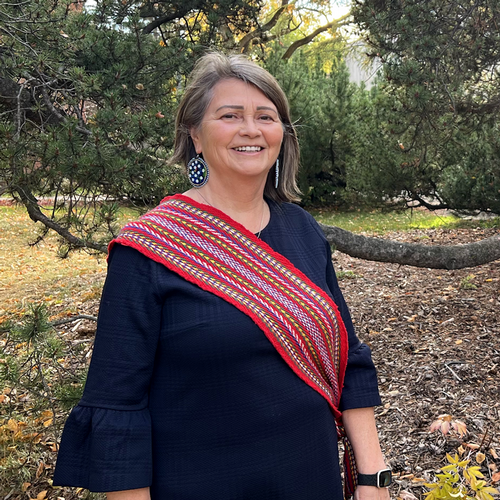
Velvalee Georges
CTL is excited to welcome Dr. Velvalee Georges as our new Senior Consultant, Indigenous Pedagogies and Curricula. Associate Director, Cosette sat down with Velvalee to get to know the person behind the title.
Would you tell us a bit about where you are from, Velvalee?
I was born and raised in Sakitawak, Saskatchewan. It is in the northwest area of the province; its anglicized name is Ile a la Crosse. It is a Métis community with a significant history, a place where people continue to speak Northern Michif.
When you think about your work: what drives it, what do you feel you uniquely bring, and what do you care most about in the process?
I believe my work as an educator is influenced by a mix of personal values and my ‘lived experience’ as a Métis person. My early encounters with ‘education’ and teaching were viewed predominantly from a Western or mainstream lens. However, over time, I have begun to appreciate and prefer teaching and learning that is grounded in and informed by Elders, Indigenous wisdom, and the scholarship of Indigenous People, such as
-
Elder Evelyn Day, who reminds us that “education should be a healing practice,” and teaching and learning should offer space for reconciliation
-
Wahkohtowin and weechihitowin, Metis and nehiyaw teachings that promote lifting everyone and acknowledging that everything is connected. This supports the University of Alberta’s strategic plan, where we “centre mutuality, reciprocity, responsibility and interdependence” (Changing the Story, p.10) for the benefit of all.
-
Willie Ermine’s (2007) model of ethical engagement, along with the Anishinaabe Seven Sacred Teachings, which guides us through encounters that enable movement toward transformational learning and relationships.
-
The Three-Eyed Seeing Framework (Meryle Ballard, 2012), which integrates Western and Indigenous Science and ‘Our Relatives’ through processes of bridging, braiding, and weaving (Ballard, 2022), and Two-Eyed Seeing (Marshall, 2023).
This is just a beginning sample; there are so many Indigenous people to listen to and learn from. I intend to help others understand and appreciate the value of knowledge that emerges from this land.
How will you approach your work at the University of Alberta specifically?
I think I will draw heavily on the Braiding Past, Present and Future: University of Alberta Indigenous Strategic Plan, which is driven by the Sweetgrass teachings, will be fundamental to engaging teaching staff on transformational journeys. Journeys that contribute to building safe spaces for learning by drawing on Indigenous pedagogies and principles that guide us to conduct ourselves, “in a good way.” Journeys that promote seven-generations thinking, where teaching staff are empowered to see themselves as the pivot point between three generations past and three generations into the future.
Like the plan, it is also about recognizing that everyone is at different places on the path to reconciliation; some are just beginning to get comfortable with our collective past, while others have begun to challenge and act on untruths, and some are well on their way to supporting a future where side-by-side engagement and collaboration with Indigenous, People, and knowledge are expected and valued.
What are your experiences or background with Decolonizing, Indigenization, and Reconciliation?
I bring several decades of ‘lived’ experience, scholarly inquiry, and educational leadership to the efforts of Decolonization, Indigenization, and Reconciliation. Learning to address and disrupt the effects of colonization, both personally and professionally, and to look beyond the present state to the wisdom shared by Elders and Knowledge Keepers for guidance is foundational to my practice and life-long learning. I understand reconciliation as a series of individual actions that collectively result in transformational, systemic change; therefore, everyone who chooses to live in Canada has a role to play.
I also realize that people are at different places when it comes to understanding helpful/harmful efforts to Decolonization, Indigenization, and Reconciliation. In my previous position in the public education system, I took on numerous roles and responsibilities to move teachers and administrators from knowing very little about the First Nations or Metis students and parents they were educating to understanding why and how they need to be included if engagement and sustainability in learning were to occur. Teachers and instructors occupy roles of influence, so they have a great responsibility to ensure that their students are ready and prepared to engage with a future that is beneficial for everyone. My expertise and energy will be directed to those who want to be involved in decolonizing their syllabus and Indigenizing their teaching practice. It takes effort, but it does result in transformation in the people and teaching and learning spaces shared by Indigenous and non-Indigenous People.