Breaking Barriers for Visually Impaired Students
30 April 2026
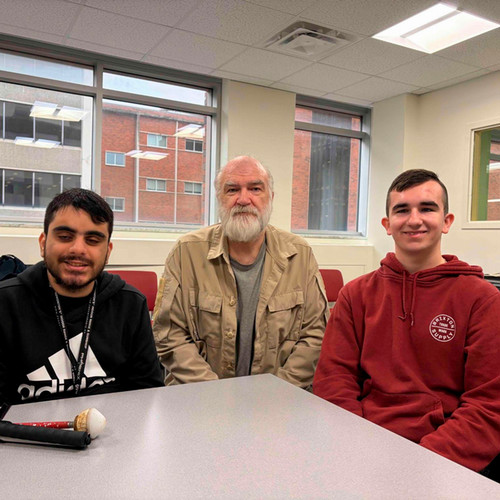
Aarush Bhat (left), Tim Erickson (middle), and Caden Johnson (right).
CTL’s Senior Consultant for Natural and Applied Science, Richard Li, sat down with two students with visual impairments in Computing Science at the U of A, Aarush Bhat and Caden Johnson, as well as their math tutor and accessibility coach, Tim Erickson, to learn about their lived experiences in navigating barriers in STEM education at the U of A.
Thank you all for getting together today to share your stories. Can you please first introduce yourselves?
Tim: My name is Tim Erickson. Officially, I’m kind of a tutor, but I prefer to call myself a "coach". I’m coming up on 27 years of working with students who are trying to get by in higher education with various barriers or challenges with mathematics. My role is to help navigate the challenges and try to make math a successful experience.
Aarush: I’m a second-year international student from Delhi, India, specializing in software practice within the Computing Science program. Regarding my vision, I have LCA (Leber Congenital Amaurosis), but all I have is basically light perception; I can distinguish light and shadows. My condition also causes my vision to slowly deteriorate in my 20s, and I’ve been noticing it depleting a little bit recently.
Caden: I’m a first-year student in Computer Science. I actually started in Engineering, but switched because CompSci is a lot more flexible for picking courses that aren't so visual. I have a specific gene mutation where the protein that goes to my retina isn't produced. I can see where chairs are or where big crowds of people are, which helps me navigate, but I can't tell you what colour your shirt is or see fine details.
Based on your experiences, what barriers do students with visual impairments face in STEM education?
Aarush: The biggest barrier is the institutional inertia and this inherent belief that blind people "inherently cannot partake in STEM courses". Back home in India, I wasn't even allowed to take high-level STEM courses initially and faced public ridicule when trying to get into mainstream schools. I was expecting an established accessibility framework when I arrived in Canada, but I encountered a system that was fundamentally unprepared for a blind student in high-level STEM, yet there was a distinct reluctance to admit the system was imperfect and needed an overhaul.
Caden: A big misconception is that blindness means no sight whatsoever, but there is a massive spectrum. In class, if a professor is just pointing at the board, saying "this equation, that equation," I lose everything. Also, web-based applications like Accommodate are full of dropdowns that you literally can't close or interact with.
Tim: One major barrier is what I call "eye candy". Authors and instructors love using images. But this is of no use to the blind student. In other STEM courses, slides often contain an image of text; a screenshot of code, perhaps, in a computer science course, instead of just pasting the code into a text block. To screen reader software, that’s just the word "image", thus information is lost. Also, consider the use of professional software for data analysis. In statistics, as an example, R and R Commander or SPSS are totally lacking accessibility features. This lack of accessibility in the user interface is a major hindrance to STEM students, as software for data analysis is the de facto method.
Can you please share a bit about the approaches you took to navigate these barriers?
Caden: I use a "BrailleNote Touch" for most of my work—it’s an Android tablet with a refreshable braille display that uses magnets to move pins up and down so I can read with my fingers. I also use Meta glasses to read signs and an app called "Be My Eyes," which uses AI to describe images or connects me to a sighted volunteer.
Aarush: On the technical side, I had to figure out a workflow that bridged the gap between what a screen reader can understand and what a professor needs to see. This led to combining ASCII Math, LaTeX, and Markdown. When standard tools outright failed, I had to patch them myself—like writing a Python wrapper for the inaccessible RARS assembly emulator or fixing the ERDot library so I could programmatically generate visual database diagrams from simple JSON text. However, these technical tools only solved the symptoms. To solve the root cause, I had to escalate the issue higher up the administrative chain to prove that the standard accommodation model was failing for STEM.
Tim: I narrate my thought process. The words that come out of my mouth are the words going through my head, so a student can follow along without needing to see the board. If I need inspiration for teaching a concept in a concise manner, I will sometimes look at old Russian or German math translations because they are often very to the point and present ideas in a way quite different from those commonly seen in the English-speaking world. Perhaps the difference lies in the context of the culture and the times the books were written in. They certainly provide a new perspective on an idea. As to guiding principles, I begin with “Meeting the student where they’re at”. In general, I keep in mind to explain what a topic is useful for, and, even though it may be difficult initially, understanding comes with time and experience.
What institutional resources have you benefited from, and what can the U of A do better in supporting visually impaired students?
Aarush: The move to the Canvas LMS was a genuinely good step. It follows WCAG guidelines and uses MathJax, which allows math to be read by screen readers. We need backward compliance for the website. There are multiple versions of web pages with conflicting information from different years, like the academic calendar. Also, accessibility shouldn't be layered on as a separate version; it should be integrated so everybody can use it at the same table.
Caden: The library staff are doing a great job because they are baking accessibility into their search systems from the ground up. Also, some professors are amazing; Professor Peggy Jankovic adapted really quickly and started reading all her board work aloud, which helped everyone in the class. We need to fix the specific tools like Accommodate and Bear Tracks. It's frustrating when software meant for exam scheduling in an accessible manner lacks the most basic accessibility features.
Tim: The Mathematics Department teaching staff have been very open and extremely helpful. I’d like to acknowledge professors Valerie Budd, Peggy Jankovic, Haile Gessesse and Paul Cartledge. They have been willing to try new ways for my students to submit work, as well as being mindful of their teaching styles with respect to visually impaired students. In a larger context, the university needs to test software by engaging the people who actually use it. Certain applications that students need to use are limited, or worse, in functionality for the visually impaired. Before they spend money on a vendor’s product, they should have students like Caden and Aarush sit down and try to use it. If it doesn't work, the school is wasting money on the product and shifting the burden onto people who need to spend time assisting the student.
Starting this summer, Tim and Aarush will be working on an Undergraduate Research Initiative (URI) project to formally document their technical workflow and pedagogical approach mentioned in the interview. Their goal is to inspire more meaningful actions toward removing barriers for visually impaired students within and beyond the U of A.