Dear Maddi: How can I stop picking my skin and biting the insides of my cheeks?
Becky Ponting, Registered Psychologist - 5 November 2026
Dear Maddi,
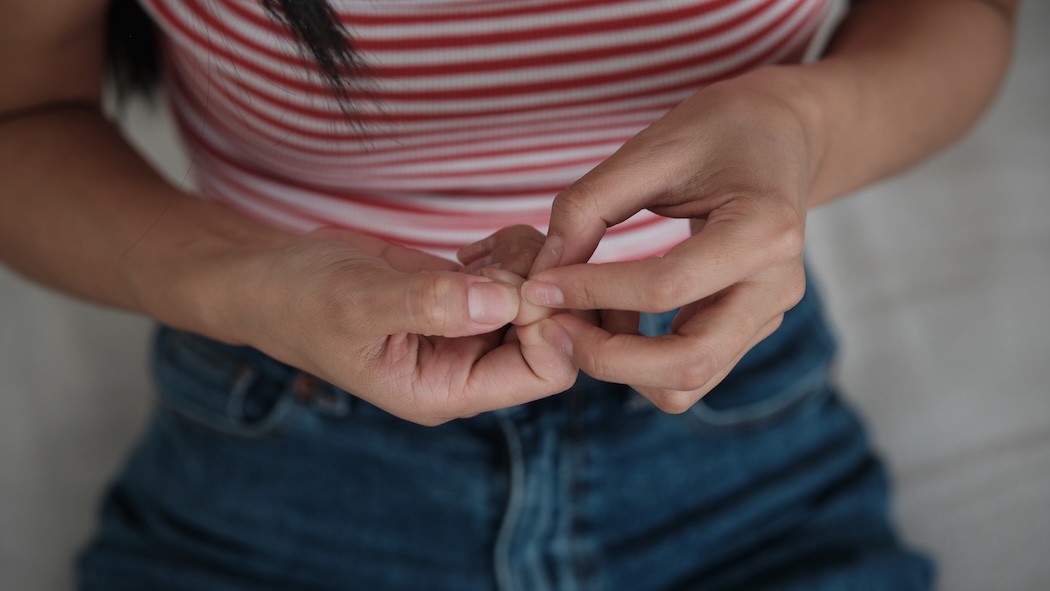
I pick at my skin a lot, usually around my fingers and feet, and sometimes I chew the inside of my cheeks. Could this be due to anxiety? How can I stop?
Signed, Wanting Relief
Dear Wanting Relief,
It’s excellent you reached out because secrecy is often part of skin picking. Many people suffer in silence for years because they feel too much shame to admit what they are doing and ask for help. By breaking the silence, you are taking the first step towards changing this unwanted behaviour.
What is skin picking?
Many people occasionally pick their skin slightly, such as briefly picking at a dry cuticle or sloughing off a small scab. However, sometimes skin picking becomes compulsive and frequent, leading to tissue damage. When skin picking produces significant sores, causes distress or gets in the way of daily functioning, and you feel you can’t stop despite repeated attempts, the clinical term for the problem is skin excoriation disorder.
It affects at least 1.4 percent of the population, according to the DSM-5 (the main diagnostic guide for mental health conditions). It is not a direct subset of obsessive-compulsive disorder (OCD), but clinicians who work with OCD often treat excoriation disorder, because both involve repetitive behaviours and difficulty controlling urges. It is classified as a body-focused repetitive behaviour, alongside hair-pulling, nail-biting and the cheek-biting you mentioned (more on that later).
Body-focused repetitive behaviours can be viewed as self-grooming behaviours that have taken on a life of their own. People tend to target spots they see as imperfect like dry patches, scabs or acne. Skin picking exists on a continuum. When severe, people can spend an hour or more per day picking at their skin, resisting urges to pick, or hiding the damage with heavy make-up or bandages. Some people become very isolated because they want to skin-pick in private and may also avoid people because they feel self-conscious about their skin.
What is cheek-biting?
Chewing the inside of your cheeks is more common than you might think. In one study, about one in five undergraduate students surveyed reported doing it at least 5 times per day (Woods, Miltenberger, and Flach, 1996). When cheek-biting causes bleeding, ongoing damage, infection and scarring, it may be worth seeing a doctor.
Do I pick my skin or bite my cheek because I’m anxious?
Your question about whether picking and cheek-biting could be due to anxiety was an insightful one. The answer is… it’s worth investigating! These behaviours often come up in the context of anxiety, and many people notice their picking gets worse when they are under pressure, such as when writing exams or dealing with family stress. On the other hand, there is a bit of a paradox, because the other feeling most closely associated with these behaviours is actually boredom. People who track their habits find it happens while reading, talking on the phone, lying in bed, studying, watching a show or scrolling on social media. So for you it could be anxiety, boredom, or both. Read on to learn a method to help you figure it out.
There is hope: Habit Reversal Training, also known as HRT
Habit Reversal Training (HRT) is one of the best-supported, first-line behavioural treatments for a number of body-focused repetitive behaviours. It works by retraining the nervous system, as you increase your awareness of the behaviour and replace it with a safe, physical alternative. There is evidence that HRT can work well as self-help (Moritz, Wittekind, Hauschildt, & Timpano, 2011).
Step 1: Observe without judgment
The first step is not to try and stop. You’ve likely been trying unsuccessfully to stop for some time, which can be frustrating and demoralizing. Instead, observe your picking and biting behaviours for one week, without trying to change them. You would be surprised how much you can learn by just observing your habits with a non-judgmental, curious stance.
Use a simple chart to track where you were when the picking or biting started, your thoughts and emotions just before, what you did (type of skin excoriation) and then resulting thoughts and emotions. Here is an example:
| Location + activity | Preceding thoughts + emotions | Type of skin excoriation | Resulting thoughts + emotions |
|---|---|---|---|
| Caught in traffic when driving to campus |
Thoughts: I might be late for class Emotion: Stress, anxiety |
Chewed on the inside of cheeks, served as a diversion, caused a blister |
Thoughts: Now I want to bite my cheek even more Emotion: Frustration |
| Studying in bedroom at home |
Thought: I don’t understand this class Emotion: Boredom, frustration |
Felt a dry spot on arm, then scratched, drew blood, had soothing trance-like sensation |
Thought: I regret that; I hope it doesn’t make a scar Emotion: Shame |
| Washing face at home before bed |
Thought: I have a breakout starting. My skin needs to look perfect, I better deal with this Emotion: Worry, disgust |
Found several acne bumps on face, felt compelled to pick at them until they bled. |
Thought: I’m such an idiot. I’ll never be able to stop picking. Nothing can help. I look terrible now. Emotion: Anger, sadness, despair, shame |
Keep your notes concise. After a week, check whether you have enough entries to spot patterns, or track for one more week.
Step 2: Look for patterns.
What happens just before you pick your skin or bite your cheek? What emotions do you notice? Do you feel restless? Frustrated? Bored? How about your thoughts? Do you have perfectionistic thoughts about how your skin should feel and look, such as “I shouldn’t have any bumps on my arms” or “the skin of the insides of my cheeks should be perfectly smooth”? Do you notice cravings to pick or bite where you are imagining how satisfying it could be? And what behaviours might you notice? Do you move towards the mirror, brighten the lights, pick up tweezers? Do you roll up sleeves and “inspect” your skin? Do you feel around in your mouth with your tongue searching for imperfections? Whatever your particular patterns are, try and identify them. It is very important that you keep a self-compassionate and non-judgmental attitude towards yourself as you do this, as harsh self criticism will only needlessly increase your suffering.
Step 3: Develop a competing response.
Now that you can pinpoint what happens right before you bite your cheek or pick your skin, choose a new response that is incompatible with either biting or picking. The goal is for the new behaviour to block or freeze the old unwanted habit. Ideally choose something subtle enough to do in public if needed. Here are a few suggestions from Free from BFRB: Self Help Techniques from the University Medical Centre in Hamburg, Germany:
- Clench your hands into fists
- Clasp your hands together
- Sit on your hands by moving them under your thighs while you’re seated
- For cheek-biting, try pressing the tongue against the roof of your mouth
- For cheek-biting you can alternatively try pressing your lips firmly together, while taking care not to grind your teeth
Hold the pose for one to three full minutes, until the urge passes. It will take some time for the urge to pick or bite to fully go away and holding the pose for longer helps re-train the nervous system.
If the competing response behaviours listed don’t fit for you, feel free to choose another one. For cheek-biting, it could be lightly stroking the inside of your teeth with your tongue. For skin picking, you could try massaging your skin with hand lotion for one minute or longer (and make sure to have a little bottle on you at all times in that case). Experiment at first, then commit to one so it becomes a habit. To speed things up, practice a few times a day in situations where you usually pick or bite.
Step 4: Track progress.
Keep tracking with your chart. Expect setbacks and seek support from understanding friends and family who can keep your spirits up on difficult days.
Some people find it motivating to work towards a reward. For example, every time you resist the urge to pick, you give yourself a point. Once you earn twenty points you can give yourself a small reward like an ice cream cone or a new book.
Tracking excoriation can be motivating, because even a 20 or 30 percent drop is real progress and worth celebrating.
When to seek professional support
Sometimes body-focused repetitive behaviours require professional attention. Some signs that you may need help:
- Physically:
- Your wounds are not healing because you keep reopening them
- Scarring is present
- Signs of infection such as swelling, warmth, pus or severe redness.
- Behaviourally:
- You haven’t been able to reduce or stop despite repeated attempts
- The time you spend picking or thinking about picking starts to detract from your studies, daily chores, leisure activities and social time
- You have become dependent on an extremely lengthy makeup routine
- You’ve become avoidant of everyday activities due to fears that people will see your skin.
- Emotionally
- You are experiencing severe shame and guilt, anxiety, self-blame or self-hatred as a result of skin picking or cheek-biting.
What type of professional should I see?
To have infected or damaged skin assessed and treated, you can see your family doctor. If you are biting your cheeks, you also have the option of making an appointment with your dentist. Your doctor and/or dentist can treat any infections that have set in and may be able to give tips to prevent scarring. A family doctor may discuss with you the option of taking medication to help you reduce your skin picking. Recent research suggests a class of medications called selective serotonin reuptake inhibitors (SSRIs) may help (Modanlo, Yan, & Bourgeois, 2025).
Another option is to seek out counselling/psychotherapy. It can help you process your emotions about your skin picking and cheek-biting, and potentially work through any shame or self-blame and/or help with strategies to minimize the impacts of the problem.
Some mental health clinicians are also specifically trained in helping people reduce their body-focused repetitive behaviours. This is not an area of practice in which all therapists are equally qualified. Look for a practitioner who lists this as one of their areas of specialized clinical training and practice.
You’ve already taken the first step
Wanting Relief, I would like to congratulate you if you have made it this far in my reply. I am wishing you much energy and tenacity as you tackle this problem. You didn’t choose to suffer with body-focused repetitive behaviours, but you did choose to reach out for help. I believe you can choose to take the next step too, whatever that looks like, and that this problem doesn’t have to be with you forever! You’ve got this.
Sincerely,
Becky
Online Resources:
- Free From BFRB: Help for trichotillomania, nail biting, skin picking, lip-cheek-biting and other BFRBs
- Skin Aware App: A habit-tracking and support app designed to help with BFRBs
- Skin Aware App Blog: Helpful articles on the topic of BFRBs
- TLC Foundation for Body-Focused Repetitive Behaviours: an advocacy, awareness and connection organization with the goal of supporting individuals living with BFRBs
Where to Get Help
- University Health Centre
- Oral Health Clinic (University of Alberta)
- Counselling resources on the University of Alberta campus.
- Affordable counselling resources in Edmonton and the surrounding community.
- The International OCD Foundation keeps a list of mental health clinicians who have expertise and specialized training in the treatment of skin excoriation. You can type “skin picking” in the Find Help search bar, then list your city, and a current list of clinicians should appear.
References:
- American Psychiatric Association. (2013). Diagnostic and statistical manual of mental disorders (5th ed.). American Psychiatric Association.
- Hayes, S. L., Storch, E. A., & Berlanga, L. (2009). Skin picking behaviors: an examination of the prevalence and severity in a community sample. Journal of Anxiety Disorders, 23, 314–319.
- Modanlo, N., Yan, X., & Bourgeois, J. A. (2025). Pharmacologic management of skin-picking disorder: An updated review. Journal of the Academy of Consultation-Liaison Psychiatry, 66(5), 417–428.
- Moritz, S., Wittekind, C. E., Hauschildt, M., & Timpano, K. R. (2011). Do it yourself! Evaluation of self-help habit reversal training versus decoupling in pathological skin picking: A pilot study. Journal of Obsessive-Compulsive and Related Disorders, 1(1), 41–47.
- Moritz, S., Muller, K, Schmotz, S. (2020). Escaping the mouth-trap: Recovery from long-term pathological lip/cheek-biting (morsicatio buccarum, cavitadaxia) using decoupling. Journal of Obsessive Compulsive and Related Disorders, 25.
- Moritz, S., Penney, D., Bruhns, A., Weidinger, S., & Schmotz, S. (2023). Habit reversal training and variants of decoupling for use in body-focused repetitive behaviors: A randomized controlled trial. Cognitive Therapy and Research, 47(1), 109–122.
- Woods, D. W., Miltenberger, R. G., & Flach, A. D. (1996). Habits, tics, and stuttering. Prevalence and relation to anxiety and somatic awareness. Behavior Modification, 20(2), 216–225.