Convocation ‘26: Brendan Flynn, BSc in engineering physics
Donna McKinnon - 18 March 2026
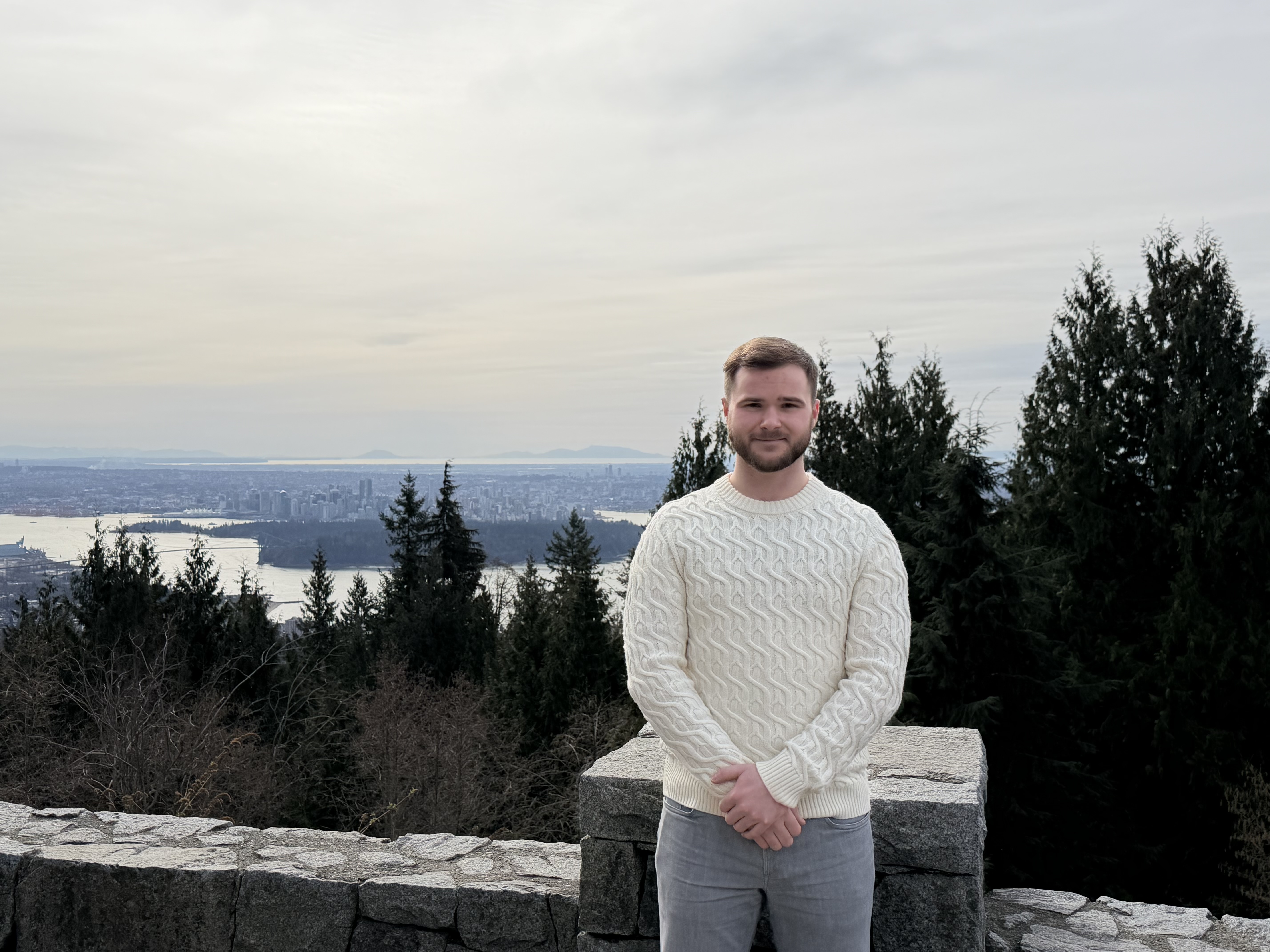
Photo Supplied: Brendan Flynn
Brendan Flynn's path to engineering was defined not by a straight line, but by a pivotal moment of risk. After a challenging first year that left him without a placement in his chosen discipline, he stood at a crossroads: accept a path that didn't align with his goals or advocate for a "last shot" in the Year 2 qualifying program (Y2Q2). Choosing the latter, Brendan overhauled his approach to learning, transforming a difficult start into a higher GPA and admission into his first choice program in engineering physics.
This experience taught him that technical mastery is built on a foundation of self-reflection and persistence — lessons that proved vital when he later played a key role in the development of four autonomous robots and held a leadership position at the Autonomous Robotic Vehicle Project while balancing a rigorous academic load.
As his degree progressed, Brendan broadened his knowledge adding a minor in computer science to learn more about machine intelligence. Using the strong mathematical foundations of his degree he intends to build a career in machine intelligence and remains committed to supporting the development of his colleagues and the broader professional community.
Congratulations Brendan!
Which faculty, program and department are you graduating from?
The Bachelor of Science in Engineering Physics program (minor in computing science) in the Faculty of Engineering.
What led you to choose this area of study, and why the U of A?
I chose engineering physics for its broad, fundamental knowledge base, one that positions me to understand and adapt to emerging technologies. As I progressed through university, a growing interest in machine intelligence led me to add a minor in computing science. I originally chose the U of A for its strong engineering program, both nationally and globally, and its state-of-the-art facilities like the NanoFab.
Tell us about your favourite professor and/or class
CMPUT 365 (Introduction to Reinforcement Learning) with Marlos Machado. I found this material particularly compelling given its applications across robotics, autonomous vehicles and finance. The semi-flipped classroom model encouraged active questioning, exploration beyond core content, and Professor Machado made it a welcoming environment to explore ideas freely.
The U of A's depth in reinforcement learning research also created unique opportunities to hear from leading contributors in the field, including Rich Sutton. Additionally, Professor Machado's own research, including work on building computational models that explain how the brain learns to represent and navigate its environment, made the material feel grounded in something much larger than the classroom.
ECE 447 (Data Analysis and Machine Learning for Engineers) with Marek Reformat. One of my first machine learning courses, where I learned and applied a range of techniques in practical engineering contexts.
Did you take on any leadership or volunteer roles while you were a student? If so, please share your experiences.
I took on various roles as a student, including serving as Merchandise Coordinator for the Engineering Physics Club, (2022-2024) where I designed the club logo, jerseys and club-branded merchandise. I also dedicated a significant portion of my time to the Autonomous Robotic Vehicle Project (ARVP, 2022-2025), which designs and builds autonomous underwater vehicles for the international RoboSub competition. Some highlights from my time at ARVP include:
- Part of the team that placed 3rd globally and 1st in North America among 34 universities, including Cornell, Stanford and the University of Singapore.
- Sponsorship Lead (2022 to 2023): Led outreach to sponsors andhelped develop a new sponsorship package. Electrical member to senior electrical member (2022 to 2024): Contributed to external battery pod, a new underwater communication tether,electrical system management, andmember training.
- Electrical co-lead (2024 to 2025): Co-developed a multi-stage electrical onboarding program, supporting 27 members and increased member retention, growing the electrical team to nearly half of ARVP's total membership. Initiated a full electrical system overhaul with updated documentation procedures to reduce knowledge-transfer loss. Led design of new autonomous underwater vehicle (AUV) internals and supported systems integration across subteams.
Did you face any significant challenges while you were a student, and if so, how did you respond?
I began my engineering degree in 2019 with a difficult transition, earning a 2.0 GPA and missing entry into every discipline I had selected.Rather than accept that outcome, I advocated persistently with the faculty and was ultimately transferred into Year 2 Qualifying Year 2 (Y2Q2) for another opportunity to apply for my desired discipline. I still remember being told in the final meeting that this was my last shot – I was giving up my placement in a discipline and would need to prove myself or leave the faculty of engineering entirely. I believe the risk was worth it.
That summer, I reflected deeply on my study habits, my mindset and how I approached learning. Returning with renewed focus, I achieved a 3.55 GPA, earning admission into the engineering physics (traditional) program.
By my final year, I was simultaneously co-leading the ARVP electrical team, managing our current AUV, supporting the design of two new AUVs, building a separate capstone robot and completing coursework.It was quite challenging to do everything that was required in a given week but I broke it down step-by-step, worked through long nights, and was inspired by the dedication the team at ARVP brought to every challenge we faced. In those moments I reminded myself of how far I had progressed and every obstacle I had overcome to get there.
What advice do you have for current or future students?
Never give up, and don't accept no until you've genuinely exhausted every path. Choosing to push for Y2Q2 after my first year changed the entire course of my degree (EP, CS minor, ARVP) and what I will do after graduation.
One of the most valuable skills I developed is problem definition. Early on I would jump to solutions and occasionally solve the wrong problem entirely. Breaking down the problem with a first-principles approach to ensure I am fully understanding the problem and what needs to be done to solve it has served me well ever since.
Join clubs. U of A has a wonderful experiential learning program spanning robotics, rocketry, satellites, autonomous vehicles, cars and more, offering students a opportunity to apply what they are learning and grow beyond the classroom. Some of my most formative experiences came not from coursework but from the people I met and the challenges I faced within these communities.
How do you plan on celebrating convocation?
Skiing has been a passion of mine since childhood. Growing up I raced competitively out of Grouse Tyee in North Vancouver, including one year on the FIS circuit with the Vancouver Ski Team. To mark the end of my degree, I celebrated by traveling to Sapporo, Japan for sidecountry powder skiing, one of the best trips of my life, where our guides took us to hidden spots with fresh tracks for most of the trip. Beyond the skiing, immersing myself in the food and culture made every moment off the mountain just as memorable.
What's next after graduation?
Toward the end of my degree I developed a strong interest in machine learning and reinforcement learning, and I am actively pursuing machine intelligence roles where I can apply the analytical and technical skills built throughout my engineering physics and computer science studies. A leadership role at ARVP showed me how rewarding it is to support and develop others, and it is something I hope to carry forward in my career.