Opening doors for future nurses
Sasha Roeder Mah - 11 September 2026
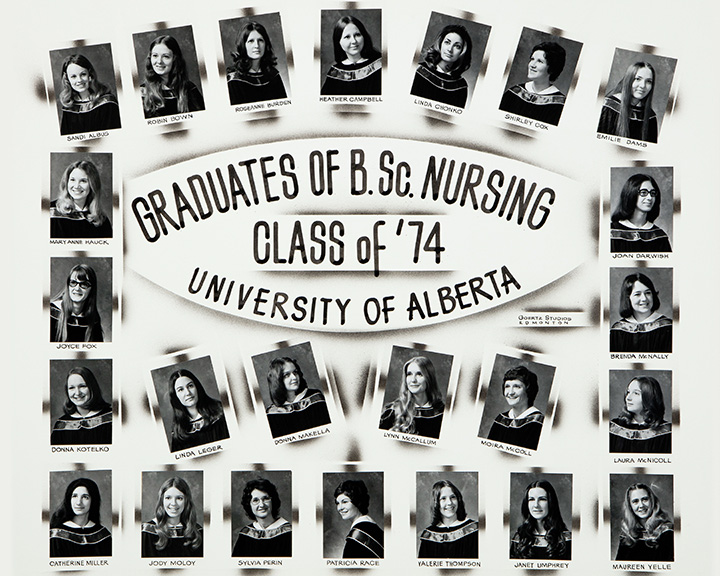
When Dr. Donna Romyn came out of nursing school at the University of Alberta in 1974, she and her classmates could not have pictured the big changes to come in nursing education in Canada. At that time, there were only a handful of master’s programs offered — mostly in the East — and any budding researcher interested in pursuing a PhD had to leave the country. It also, she recalls, cost about $500 per year for tuition.
Romyn began her career as a bedside nurse but it wasn’t long before her love of teaching and mentoring brought her back to the U of A for a master’s and then a PhD — as one of the first classes of the brand new PhD program in 1991. Her career has involved a great deal of nursing education both in the classroom and in the hospital setting, and culminated at the University of Athabasca where she served as dean in the Faculty of Health Disciplines and later associate vice-president of research, before her retirement in 2020.
Romyn and her classmates have gathered often in the decades since their 1974 graduation, to reminisce about their early days and to chat about the future of the nursing profession. Conversations often turn to the rising costs of a degree. “These days, tuition is closer to $13,000 per year. We were blown out of the water to hear that,” she says. “So at our 45th reunion, someone suggested an endowment.”
It wasn’t until the group’s 50th reunion that the ball really got rolling on plans for what is now the BScN Class of 1974 Award in Nursing, Romyn says. They invited Brianne Arkison, the faculty’s assistant dean of advancement, to explain everything involved and the idea finally began to take shape. Led by Romyn, a small group of volunteers began compiling decisions from their classmates about the planned endowment — who should it be for, what should it focus on, what should it be named.
The group quickly agreed to keep the terms quite broad. Any undergraduate nursing student, in any year, who maintains satisfactory academic performance and has shown leadership qualities, is eligible as long as they can demonstrate financial need. “We want to support not just the brightest and best, because they tend to be the students who can get financial help anyway,” says Romyn. “If you’re a single parent working part time to push yourself through, and your grades are just kind of average, we don’t want those students to be excluded — they’re doing a phenomenal amount of work to be successful.” And with the increased expense involved in pursuing the degree these days, she adds, “We think any student facing those costs could use some help.”
Since the campaign to fund the endowment got underway less than a year ago, says Romyn, the total amount raised is already around $25,000. To officially launch, it must be at least $50,000, a goal they’re working toward over the next few years. Of course, laughs Romyn, “If it was more, we’d be ecstatic!”
Everyone in the Class of ’74 is driven to support the next generation of nurses, says Romyn, whether it be through mentoring or fundraising or some other means. “Our nursing education opened a lot of doors,” she says, noting that among her graduating class some continued to work in various clinical and research settings, some became nurse practitioners or health-care administrators, many went into public health, one became a dentist and a few ended up practising law.
“And now there are so many specializations, so there are lots more opportunities to branch out within nursing itself.” Not to mention the potential for more growth and change in the future. “We know how much nursing has changed in the 50 years since we graduated, but what might it look like 50 years from now?”
Whatever that future holds, Romyn and the rest of the Class of ’74 want to be part of helping today’s nursing students get there.