500 Years Entwined History
Central and Ottoman Europe
Budapest | 11–13 May 2026

About the Conference

500 Years Entwined History: Central and Ottoman Europe gathers invited scholars at ELTE University, in collaboration with the Wirth Institute, to mark the 500th anniversary of Mohács. Moving beyond dominant conflict-centered narratives, the conference explores the deep and often overlooked histories of collaboration, coexistence, and exchange between Central Europe and the Ottoman world, fostering new perspectives on a shared and interconnected past.
 

Keynote Talks

Two keynote speeches will frame the conference by offering reflective perspectives on the long-term entanglements between Central Europe and the Ottoman world.

Panels

Scholarly panels will bring together experts in Habsburg and Ottoman history.

Concert Performance

Enjoy a special performance by renowned violinist, Guilluame Tardif.


Program Highlights

MAY 11

4:00 PM – Keynote

Ottomans, Habsburgs, and the Shaping of Central Europe

Dr. Gábor J Ágoston


MAY 12

6:00 PM – Concert

Exclusive performance by

Guillaume Tardif (violin), Eszter Karasszon (cello) & Éva Szalai (piano)


MAY 13

10:00 AM – WAN Keynote

From Hereditary Enemy to Ally: Habsburg Perspectives on the Ottoman Empire, 1526-1918

Dr. Franz AJ Szabo


Keynote Speakers
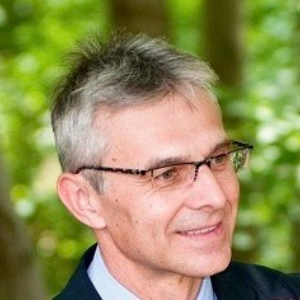
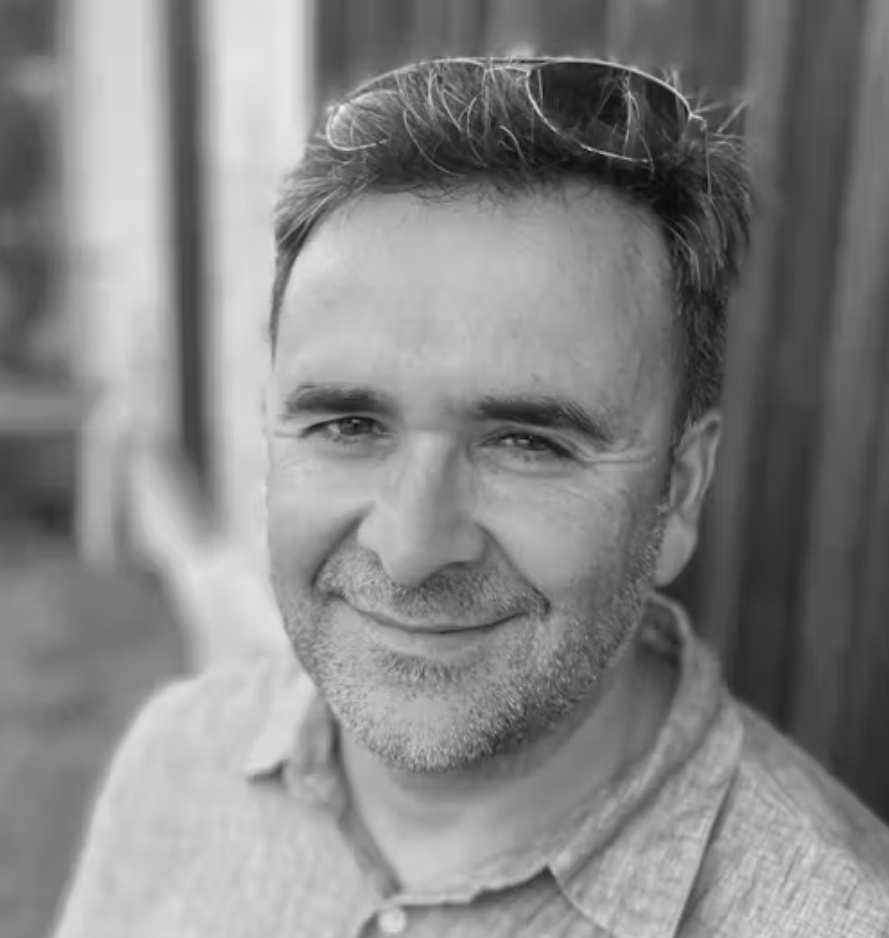
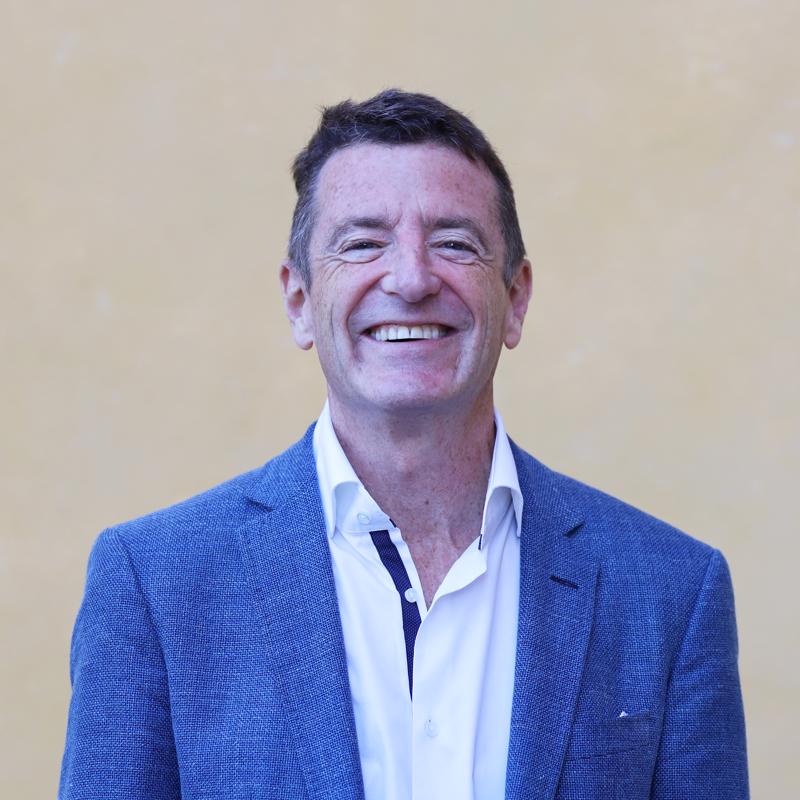
Dr. Gábor J Ágoston

Conference Keynote

Dr. Franz AJ Szabo

Wirth Alumni Network Keynote

Participant Name
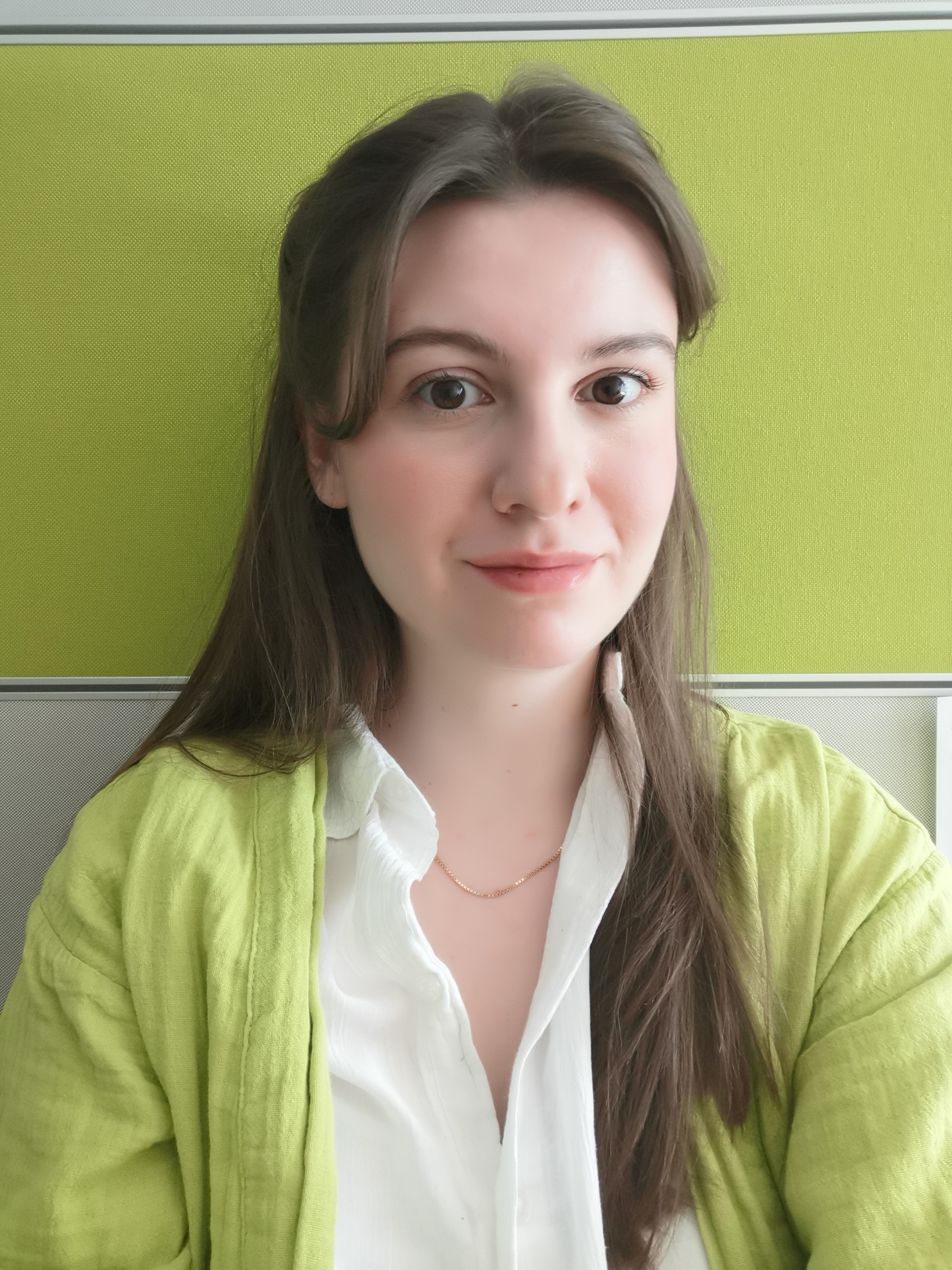
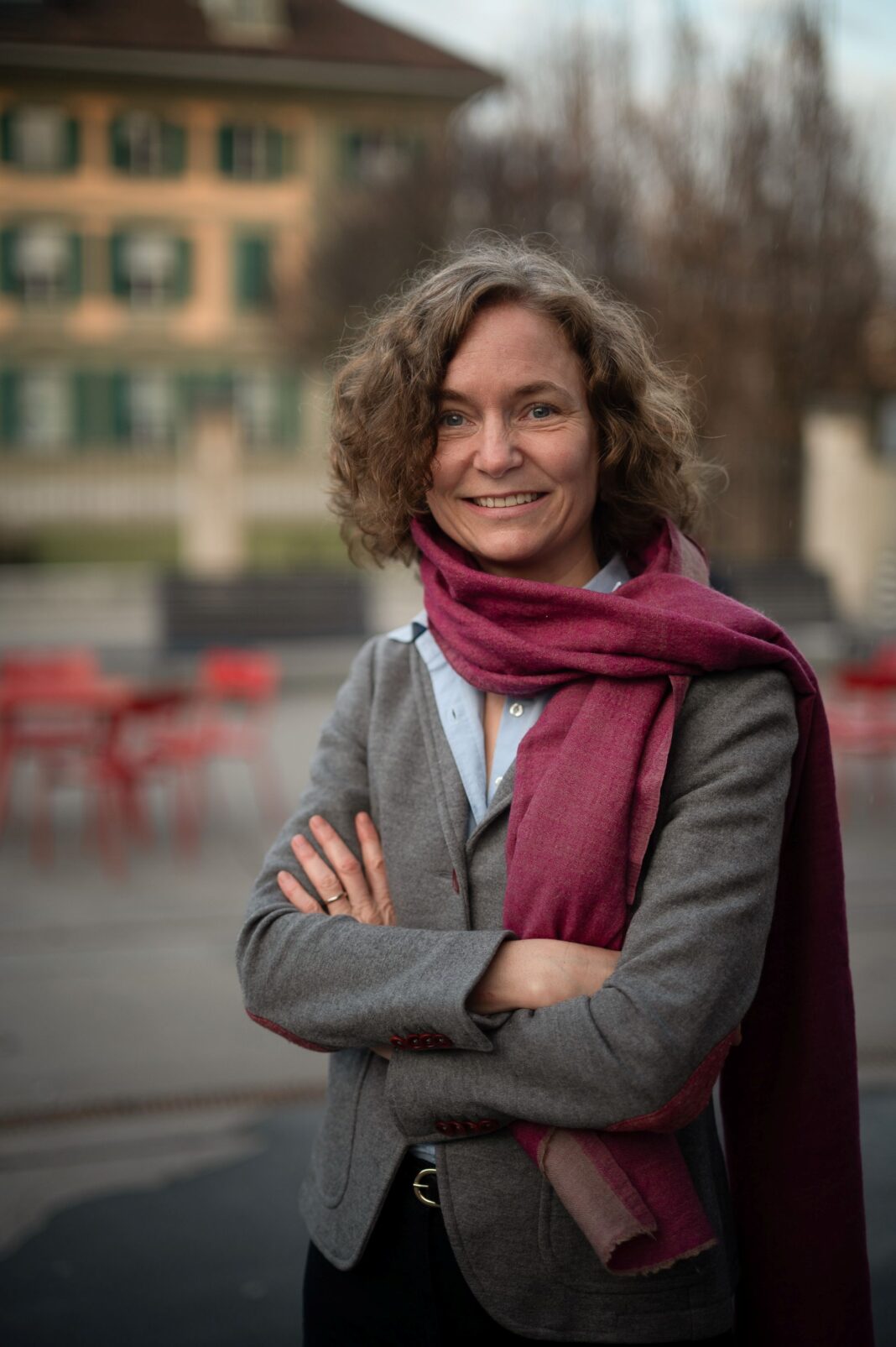
Sophia Abplanalp
University of Vienna, Austria
Sophia Abplanalp holds a Master’s degree in Art History from the University of Vienna...
where she specialized in Islamic Art History, and an MLitt in Art History from the University of St Andrews, Scotland. In 2025, she enrolled in the doctoral program of the University of Vienna, and is currently working on her dissertation under the supervision of Prof. Noémie Etienne. Ms. Abplanalp served as a teaching assistant at the Department of Art History at the University of Vienna between 2016 and 2023. From 2020 to 2023, she was a researcher in the international COST Action: Islamic Legacy: Narratives East, West, South, North of the Mediterranean (1350-1750), where she contributed to a range of interdisciplinary projects, before being appointed Scientific Communication Coordinator in 2022 during which she played a pivotal role in the development of the MOOC Islamic Legacy in Europe. In recognition of her academic excellence and promising research, she was awarded the Grant for Projects by Young Scholars of The Society of Turkic, Ottoman and Turkish Studies (GTOT) in 2024, which enabled her to conduct field research on Ottoman objects preserved in an Austrian noble collection. Additionally, Ms. Abplanalp has published various aspects of her research and regularly presents her findings at conferences, for instance at the UCLA, Universität Wien, UNED Madrid or Freie Universität Berlin.
Participant Name
Gábor Ágoston
Georgetown University, United States
Gábor Ágoston joined Georgetown University’s Department of History in 1998...
as a specialist on the Ottoman Empire. Before Georgetown, he taught Ottoman, Hungarian, and Balkan history at the Universities of Budapest (ELTE) and Pécs (JPTE), Hungary. His research has focused on the Ottoman Empire and its Habsburg, Russian and Safavid imperial rivals, and on Ottoman and European warfare, diplomacy, and intelligence gathering. In 2003, he was visiting professor at the University of Vienna, Austria. In 2008 and 2009 he taught at Georgetown's McGhee Center for Eastern Mediterranean Studies in Alanya, Turkey, and in 2018 at Georgetown’s Doha, Qatar, campus. He is the author of ten monographs and collected studies on Ottoman history, including Guns for the Sultan: Military Power and the Weapons Industry in the Ottoman Empire (Cambridge University Press, 2005) and The Last Muslim Conquest: The Ottoman Empire and Its Wars in Europe (Princeton, NJ: Princeton University Press, 2021). He has written more than ninety scholarly articles and book chapters in English, Turkish, and Hungarian on Ottoman, European, and Hungarian history. He is also the co-author of the first English-language Encyclopedia of the Ottoman Empire (2009) and the co-editor of the upcoming Cambridge History of War.
Participant Name
Mustafa Aksakal
Georgetown University, United States
Mustafa Aksakal is Associate Professor of History and Nesuhi Ertegün Chair...
of Modern Turkish Studies at Georgetown University. He is the author of The Ottoman Road to War in 1914 and The War That Made the Middle East: World War I and the End of the Ottoman Empire.
Participant Name
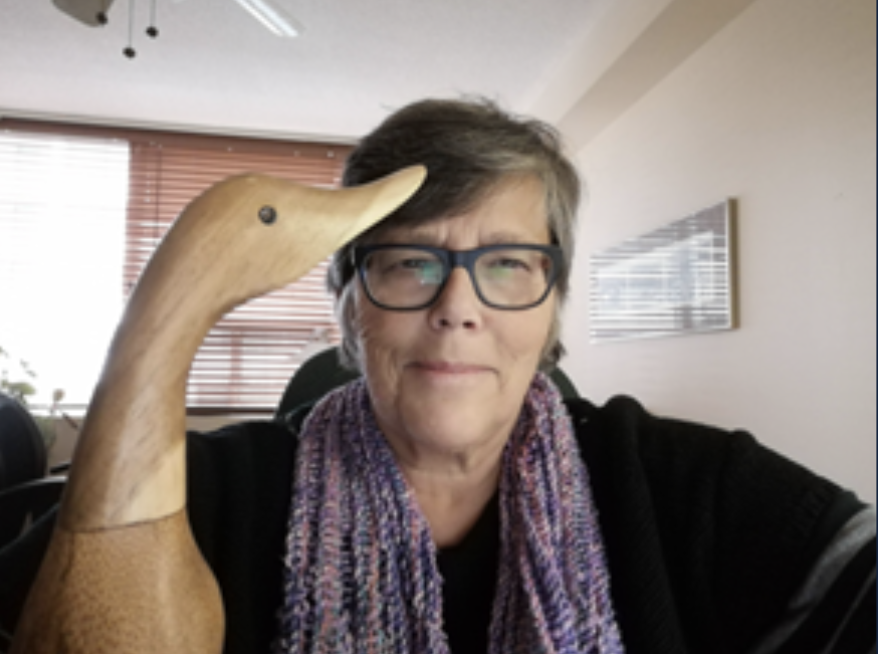
Virginia Aksan
Professor Emerita, McMaster University, Canada
I began my journey as a dual citizen – Canadian-American – in 1982, when Oktay...
Aksan, my black-eyed Turk, carried me off to Toronto. There, he gave me a choice – go back for the PhD or continue to work in libraries. I did both. I enrolled in an MA and then the PhD program in Middle East studies at the University of Toronto, a decade after doing a library degree at Berkeley and almost two decades after graduating from Allegheny College with a BA in French (1968). While writing the PhD, I worked at Robarts Library, in charge of cataloguing the Middle Eastern collections. I was appointed to the McMaster History Department in the fall of 1991 where I had the great privilege to teach until I retired in 2014, mainly classes in Ottoman, Islamic, Middle Eastern and Mediterranean history. I taught modern Middle East history (more accurately the Arab-Israeli question) more than a dozen times, and served two more years post-retirement as Director of the School of the Arts (2018-2019) at McMaster.
Research pubs: My research interests include military history and trans-imperial intellectual encounters and the circulation of knowledge in the pre-modern Mediterranean and Eurasia. My research focus has largely been comparative war & society, especially Ottoman, Austrian & Russian, 18 th -mid-19 th centuries. I have a special interest in the European obsession with the "Turk," then and now. Publications include a study of an Ottoman reformer: An Ottoman Statesman in War and Peace: Ahmed Resmi Efendi, 1700-1783, Brill, 1995; Ottoman Wars, 1700-1870: an Empire Besieged, Pearson-Longman 2007, and with Daniel Goffman, a co-edited volume entitled The Early Modern Ottomans: Remapping the Empire, CUP 2007. With Veysel Şimşek, eds., we organized "Living Empire: Ottoman Identities in Transformation, 1700-1850." (Conference papers from April 2012 McMaster conference.) Special issue. Osmanlı Araștımaları/Journal of Ottoman Studies 44 (2014). The Ottomans 1700-1923:An Empire Besieged, a revised version of Ottoman Wars, was published by Routledge in 2022. In 2024, I organized a seminar around the Cedid Atlas Tercumesi – miraculously purchased by McMaster University’s library – the twelve ruminations were just published as “Putting the Ottomans on the Map,” in the IJTS issue 24:1/2 fall 2025.
Sample articles: "Mobilization of Warrior Populations in the Ottoman Context 1750-1850," in Erik Jan Zürcher. ed. Fighting for a Living, Amsterdam, 2013; “The Ottoman Absence from the Battlefields of the Seven Years War,” in Patrick J. Speelman and Mark J. Danley, eds. Seven Years War as a Global Conflict. Leiden, 2013; "Who was an Ottoman? Reflections on 'Wearing Hats' and 'Turning Turk,'" in Barbara Schmidt-Haberkamp, ed. Europe und die Türkei in 18. Jahrhundert / Europe and Turkey in the Eighteenth Century (Göttingen: 2011); “What’s Up in Ottoman Studies?” Journal of the Ottoman and Turkish Studies Association 1:1-2 (2014).
Participant Name
Peter Becker
University of Vienna, Austria
Peter Becker studied history, sociology and art history at the University of Graz...
He received his doctorate in 1988 with a dissertation on marriage behaviour and premarital sexuality in St. Lambrecht. He then worked as a research assistant at the Max Planck Institute for History in Göttingen and at the German Historical Institute in Washington, DC. He completed his habilitation at the University of Göttingen in 2000 with a thesis on the history of criminology as discourse and practice. As Professor of Central European History at the European University Institute in Florence (1997-2005), he developed a new research project on the cultural history of administration. Between 2005 and 2009, he held the Chair of Modern and Contemporary History at the University of Linz. Working in a research group at the Centre for Interdisciplinary Studies in Bielefeld gave him the opportunity to deal intensively with the new criminal biology and its increasing relevance in criminological and security policy debates. Since 2014, he has been Professor of Austrian History in the 19th and 20th Centuries at the Department of History at the University of Vienna.
Participant Name
Paulina Dominik
University of Vienna, Austria
Paulina Dominik is a historian of the nineteenth and early twentieth centuries whose...
research connects Central and Eastern Europe, the Ottoman Empire, and the Mediterranean. She is currently a Dan David Fellow at Tel Aviv University and was previously a Max Weber Postdoctoral Fellow at European University Institute. Her work focuses on empire, political exile, mobility, and the practices through which political actors operated across and within imperial settings. She is currently completing her first book, Against Empire Through Empire: Political Exile and Transimperial Mobilisation in the Late Ottoman Mediterranean, which examines anti-imperial activism and cross-imperial political networks linking Central and Eastern Europe, the Ottoman Empire, and North Africa in the early twentieth century.
Participant Name
Aimee Genell
Boston University, United States
Aimee Genell is an Assistant Professor of International History at the Pardee...
School of Global Studies at Boston University. Her research focuses on the history of the late Ottoman Empire and its entanglements with Europe in the arena of international law. Her manuscript, Empire by Law: The Ottoman Origins of the Mandate System in the Middle East (Columbia University Press, 2026), traces the Ottoman roots of the post-imperial political order through an analysis of the inter-imperial contest over autonomous Egypt in the late nineteenth and early twentieth centuries. She has published and co-authored several articles on Ottoman legal history from an international perspective, including, among others, “The Well-defended Domains: Eurocentric International Law and the Making of the Ottoman Office of Legal Counsel” (Journal of Ottoman and Turkish Studies Association).
Participant Name
Emily Greble
Vanderbilt University, United States
Emily Greble is the Nelson O. Tyrone, Jr. Chair in History at Vanderbilt...
A Balkan historian, she is the author of two books: Sarajevo, 1941-1945: Muslims, Christians, and Jews in Hitler's Europe, which has been published in Italian, Bosnian, and Turkish, and Muslims and the Making of Modern Europe, which was named a best book in History by the Financial Times in 2022 and is being translated into Bosnian and Arabic. Her research has been supported by many grants and fellowships. She currently serves on the boards for the Association for Slavic, East European, and Eurasian Studies (ASEEES) and the Toynbee Prize and she is co-editor of the international book series at the University Press Sarajevo, which translates scholarly work on the region into Bosnian. Today’s talk comes from her current research on enslaved women and the archive of slavery in the nineteenth century Balkans.
Participant Name
Tetiana Grygorieva
National University of Kyiv-Mohyla Academy, Ukraine
Tetiana Grygorieva obtained her MA degree from Central European University...
(then in Budapest) and her PhD from National University of Kyiv-Mohyla Academy. Her dissertation theme was “Diplomatic Relations of the Polish-Lithuanian Commonwealth and the Ottoman Empire in 1622-1678: Embassies and Diplomatic Ceremonial.” She has published on diplomatic relations and ceremonial communication between the Ottoman Empire, the Polish-Lithuanian Commonwealth, and Cossack Ukraine, as well as about diplomatic discourse in a literary context. Since 2022, she has been a member of the ERC project “The Diplomacy of Small States in Early Modern South-eastern Europe”. In 2025, she published a monograph, “The Ottoman Chessboard. The Peace of Khotyn (1621) and the Diplomatic Odyssey of the Prince Krzystof Zbaraski” (in Ukrainian).
Participant Name
Pieter Judson
European University Institute, Italy
Pieter M. Judson is a Senior Fellow at the European University Institute in Florence...
and a member of the American Academy of Arts and Sciences. From 2014 to 2024, he held the Chair in Nineteenth and Twentieth Century History at the EUI. Before that he taught for 21 years at Swarthmore College as Isaac Clothier Professor of History and International Relations. Judson holds a Ph.D. in History from Columbia University (1987). He has authored articles and prize-winning books on diverse aspects of the history of Central and Eastern Europe. Most recently, The Habsburg Empire: A New History (Harvard-Belknap, 2016), has been translated into twelve European and Asian languages. In 2025 Oxford University Press will publish The Great War and the Transformation of Habsburg Central Europe (written together with Tara Zahra). For ten years Judson served as editor of the Austrian History Yearbook, and he was President of the Central European History Society of North America (2020-2022). He has received fellowships from Guggenheim, Fulbright, the NEH, the American Academy in Berlin, Phi Beta Kappa, and in 2010 the Austrian government awarded him the Karl von Vogelsang state prize for Guardians of the Nation. Activists on the Language Frontiers of Imperial Austria (Harvard 2006).
Participant Name
Barbara Karl
Heeresgeschichtlichen Museums, Austria
Barbara Karl studierte Kunstgeschichte in Wien und Innsbruck, bevor sie ...
Forschungsstipendien ins Ausland führten. Sie forschte am Warburg Institute in London, dem Bard Graduate Center in New York, gefolgt von Forschungsprojekten an der Scuola Normale Superiore in Pisa und der Österreichischen Akademie der Wissenschaften in Wien, wo sie zu Objekten der islamischen Welt in den Museumssammlungen Wiens arbeitete. Als Kustodin für Textilien und Teppiche am Wiener MAK - Museum für angewandte Kunst/Gegenwartskunst - verantwortete Karl die Sammlung von Textilien und Teppichen, die Depotorganisation sowie die Ausstellungen und Forschungsprogramme des Fachbereichs. Ab 2017 leitete die geborene Grazerin als Direktorin das Textilmuseum St. Gallen, habilitierte an der Universität Innsbruck und übernahm 2022 die wissenschaftliche Leitung des Ballenberg Freilichtmuseums der Schweiz. Seit Juni 2025 leitet Barbara Karl die Sammlungsabteilung des Heeresgeschichtlichen Museums. Kontakt: sammlung@hgm.at
Participant Name
Gábor Kármán
Institute of History, Hungary
Gábor Kármán holds a PhD in early modern history from the Eötvös Loránd University...
(2009) and another one from Central European University (2010) in the comparative history of Central, Eastern and Southeastern Europe. He published widely on the history of the Principality of Transylvania, early modern confessional politics and the Ottoman tributary states. At the moment he is research fellow of the Institute of History in Budapest, which until recently belonged to the Hungarian Academy of Sciences, and is currently placed under the supervision of ELTE. He is principal investigator of the ERC-financed international project "The Diplomacy of Small States in Early Modern South-eastern Europe" (SMALLST).
Participant Name
Markus Koller
Ruhr University Bochum, Germany
Markus Koller studied Southeastern European History, History and Culture...
of the Near and Middle East, Turcology and Ancient History at the University of Munich. He defended a PhD at the Ruhr University in Bochum with a dissertation about violence in 18th-century Bosnia and finished his post-doctoral dissertation (Habilitation) on the late Ottoman rule in Hungary. His books and articles focus on the social history of the Ottoman Balkans as well as the cultural and political relationships between the early modern European states and the Ottoman Empire. Since 2011 he holds a professorship in History of the Ottoman Empire and Modern Turkey at the Ruhr-Universität Bochum and since 2016 he is director of the Centre for Mediterranean Studies in Bochum. Koller conducted various research projects (mainly funded by the Deutsche Forschungsgemeinschaft) about Ottoman-Venetian diplomatic relations and military conflicts in the Mediterranean.
Participant Name
Timothy Olin
Central College, United States
Tim Olin is an Associate Professor of History at Central College in Iowa. He...
was awarded his Ph.D. in history from Purdue in 2015. His book, The Banat of Temesvar: Borderland Colonization in the Habsburg Monarchy, was published in 2025 by Stanford University Press. Based on archival research in Austria, Hungary, Romania, and Serbia, the book explores issues of migration, assimilation, and inter-ethnic relations on the Habsburg frontier. He has also recently published articles on the treatment of Roma (“Gypsies”) and Jews in the eighteenth century Banat in Eighteenth-Century Studies and Shofar: An Interdisciplinary Journal of Jewish Studies respectively. His most recent article, “Overseas or Overland?: Habsburg Colonialism and the Banat of Temesvar,” will appear in Oxford University Press’s Handbook of Global Habsburg History later this year.
Participant Name
Jana Osterkamp
Czech Academy of Sciences, Czechia
Jana Osterkamp is a historian and lawyer who specialises in the history of the...
Habsburg monarchy and its successor states in the 19th and 20th centuries. Her habilitation on the Habsburg history of federal ideas and federal administrative practices was widely recognised in the international community, was also published in Czech as ‘Řád v rozmanitosti’ (Argo 2022) and will be published as ‘A federal history of the Habsburg Monarchy, 1818-1918’ by Oxford University Press in 2025. Her constitutional history dissertation was the first scholarly monograph on constitutional jurisdiction in the interwar period of Czechoslovakia. Osterkamp has been a professor of the entangled history of Germany and Eastern Europe and director of the Bukowina Institute at the University of Augsburg since 2023. In recent years, Osterkamp has been able to raise prestigious third-party funding for projects in the fields of political, religious and administrative history, as well as digital humanities.
Participant Name
Will Smiley
University of New Hampshire, United States
Will Smiley is a historian of international law, with a particular interest in the...
Ottoman and Russian Empires. He is an Associate Professor at the University of New Hampshire.
Participant Name
Arno Strohmeyer
Institute for Habsburg and Balkan Studies, Austria
Arno Strohmeyer studied history and ethnology at the University of Vienna...
and received his PhD in 1992. From 1994 to 1996, he worked as a researcher on the project ‘Edition der Korrespondenz der Kaiser mit ihren Gesandten in Spanien’ funded by the Austrian Science Fund at the University of Vienna. From 1996 to 2001, he was a researcher at the Leibniz Institute for the History and Culture of Eastern Europe (GWZO) in Leipzig, and from 2001 to 2007 research associate at the Department of History at the University of Bonn where he completed his habilitation in 2004. In 2006, Arno Strohmeyer was visiting professor at the Department of History at the University of Vienna and was appointed Professor of Modern History at the University of Salzburg in 2007. From 2011 to 2015, he was head of the Department of History at the University of Salzburg. He was called to the University of Vienna in 2012 but declined the post. He has been a corresponding member of the Austrian Academy of Sciences since 2013. He was Research and Deputy Director of the INZ rep. IHB from April 2017 to March 2021, from April 2021 to June 2023 Institute Director. He has resumed the position of Deputy Director of the IHB since July 2023.
Participant Name
Franz AJ Szabo
Professor Emeritus, University of Alberta, Canada
Franz AJ Szabo is Professor Emeritus of Austrian and Habsburg History...
at the University of Alberta and was the founding Director of the Wirth Institute for Austrian and Central European Studies from 1998 to 2011. He has published widely in Europe and in North America on the subject of Austrian and Habsburg history and culture and is the author of the multi award-winning Kaunitz and Enlightened Absolutism, 1753-1780 (Cambridge 1994) and of The Seven Years War in Europe, 1756-1763 (Pearson-Longman 2008). Franz Szabo has also had an ongoing interest in art and music history, into which he takes an occasional scholarly foray.
Participant Name
Hacer Topaktaş Üstüner
Istanbul University, Turkey
Hacer Topaktaş Üstüner is a professor and the head of Slavic Languages and...
Literatures at the Faculty of Letters, Istanbul University (Türkiye). She holds an MA in History from Karadeniz Technical University in Trabzon and a PhD in History from Hacettepe University in Ankara. She has been as a researcher at many European universities such as the University of Warsaw, Jagiellonian University, Bonn University, UCL and HSE. Her areas of expertise include history of Turkish diplomacy from the 18th to the 20th centuries, particularly the historical relations of Eastern European countries with the Ottoman Empire, and Republic of Türkiye, and Turkish-Polish relations. She has published numerous books and articles on these subjects. Topaktaş Üstüner is the recipient of the Turkish Academy of Sciences (TÜBA) Young Scientists Award (2017). She received the Benedyk Polak award (2021), and with her book on Polonezköy, the award for best Polish history book in a foreign language from the Polish Minister of Foreign Affairs (2022), and she was honoured with the Knight’s Order by the President of Poland (2024). She is a full member of the scientific board of the Atatürk Research Center.
Participant Name
Yasir Yılmaz
Institute for Habsburg and Balkan Studies, Austria
Yasir Yılmaz is a principal researcher at the Institute for Habsburg and Balkan Studies...
of the Austrian Academy of Sciences. He is broadly interested in the comparative histories of the Habsburg Monarchy and Ottoman Empire, with an ongoing research focus on Habsburg-Ottoman diplomatic encounters in the early modern and modern era. He is a member of the QhoD Project at the Institute for Habsburg and Balkan Studies, a permanent, digital humanities project of the Austrian Academy of Sciences, with a broad focus on Habsburg-Ottoman diplomatic contacts. In addition, Yılmaz is the principal investigator of a continuing project funded by the Austrian Science Fund (FWF) concerning the history of the office of grand vizierate and chief ministry across early modern Eurasia. Yılmaz has most recently prepared for publication thematic research dossiers and forums for the Austrian History Yearbook (2026) and the Review of Middle East Studies (2023). Yılmaz has taught more than 30 undergraduate and graduate level courses in the US, Turkey, Czech Republic, and Austria.
Return to Participant Index

Directions to Conference Venue

Faculty Council Room - Room 39, Building A

ELTE Faculty of Humanities

Múzeum körút 4/A

The conference venue is located in the Trefort-Yard campus of ELTE Faculty of Humanities in the city centre of Budapest. The conference venue is accessible on foot from the city centre, however we recommend that you use public transportation if you are approaching from a longer distance. Tickets can be purchased online or at the BKK ticket machines installed at the major stations. The campus is located near the "Astoria" metro M2 station, bus, and tram stop. Using metro line M3 or M4 from other directions, please exit at "Kálvin tér" station and on foot to the campus (5-6 min walk). After entering Trefort-Yard, the first building on the left after the barrier is Building A.
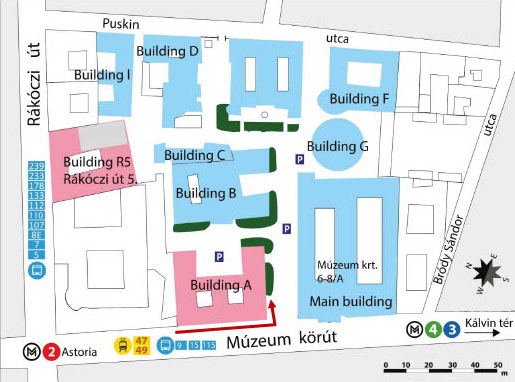
Map to ELTE's Faculty Council Room

Questions?

Contact us via e-mail at the address below.

Contact Us