Jewish Studies
Jewish Studies Week Fall 2026
Monday, November 2-6
Regular Building Hours
Rutherford Library Atrium
Exhibit: Unfinished Lives
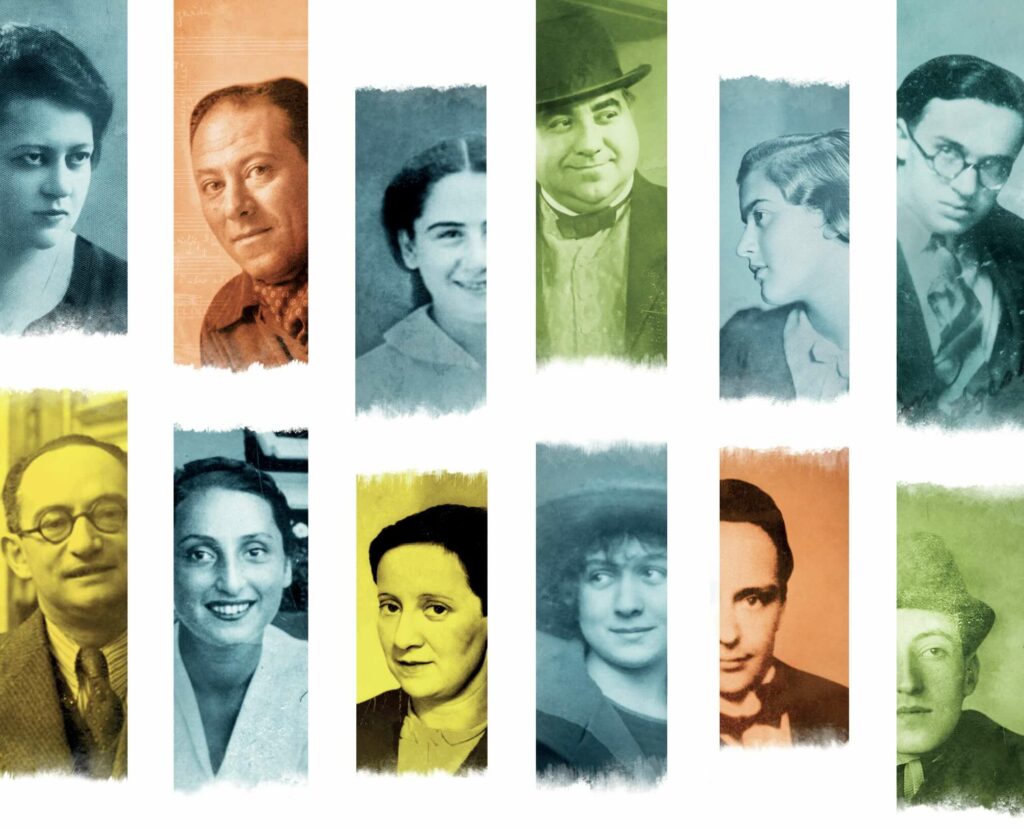
An exclusive North American showing of Bente Kahan’s Unfinished Lives, an exhibition reflecting on European Jewish artists who, amid the horror of the Holocaust, continued to express themselves through literature, music, visual art, and performance.
Monday, November 2
4:00 pm
2-58, Henry Marshall Tory Building
Tvrtko Jakovina Lecture
Tvrtko Jakovina, professor, Faculty of Humanities and Social Sciences, University of Zagreb, MIREES, Universita di Bologna
Join us for a thought-provoking talk by renowned Croatian historian Tvrtko Jakovina exploring how the Holocaust is understood, remembered, and discussed in Croatia and the wider post-Yugoslav region. A prominent political historian, author, public commentator, and former television host, Jakovina examines the ways twentieth-century history, memory, and nationalist narratives continue to shape contemporary understandings of the region’s past.
Thursday, November 5
4-5:00 p.m. MT
T LB-1, Tory Lecture Building (Tory Turtle)
2026 Annual Toby & Saul Reichert Holocaust Lecture
Beyond Violence? Survivors’ Returns to Poland after the Holocaust
Anna Cichopek-Gajraj, Arizona State University
About the Lecture
What did it mean for Jewish survivors to return “home” to Poland after the Holocaust? This is a familiar story: survivors returned to find their families murdered and their homes occupied, while facing their Polish neighbors’ hostility, violence, or indifference. Yet these common postwar experiences do not tell the whole story. Although loneliness, pain, fear, and sorrow were palpable, survivors also exhibited resilience and creativity in their search for a new sense of belonging in their old country. They sought justice, entered schools and workplaces, and tried to recover some measure of normality in the shadow of the genocide. They often attempted to start new families and rebuild communities, succeeding in creating a vibrant, if brief and fragile, Jewish community in Lower Silesia. In all this, many hoped to find their permanent place in postwar Polish society, while others decided to leave; their decisions rarely immediate or obvious. Grounded in a rich historiography and illustrated with images from the period, this lecture reconstructs survivors’ returns as an uncertain process of searching for home amid loss, fear, and hope.
Anna Cichopek-Gajraj is Associate Professor of History at Arizona State University. Her research focuses on the social history of Jewish survivors in Poland after the Holocaust. She is the author of Pogrom Żydów w Krakowie 11 sierpnia 1945 r. (Jewish Historical Institute, 2000) and Beyond Violence: Jewish Survivors in Poland and Slovakia, 1944–1948 (Cambridge University Press, 2014), which was a finalist for the 2016 Jordan Schnitzer Book Award and received an Honorable Mention for the 2015 Barbara Heldt Prize. In 2016, she was honored with the Shofar Zakhor Award for her work on Holocaust education in Arizona. Most recently, she co-edited, with Nina Paulovicova and Joanna Michlic, Shattered Liberation: Sexualized Violence against Holocaust Survivors, 1943–1946 (Purdue University Press, 2025). Currently, she is writing a book on the social and cultural history of gendered violence in postwar Poland (1945–1946).