Balanced Assessment Plans
A balanced assessment plan helps you measure student learning accurately while keeping both student workload and your grading load manageable. By combining low-stakes practice with higher-stakes evaluation, you create clear, sustainable pathways to student success and gain steady insight into students’ progress throughout the term.
Read on to discover practical strategies for:
- Aligning assessments with your key learning goals
- Choosing the right mix of ungraded practice, low-stakes tasks and high-stakes evaluations
- Varying your assessment formats to ensure fair and equitable evaluations
- Weighting and timing your assignments to reduce student anxiety and keep your grading load sustainable
Aligning your assessment plan
To accurately capture student learning, align your assessment tools with specific goals. Those could be:
- diagnosing students’ prior knowledge to check for misconceptions before launching into a topic, or to proactively integrate a review of difficult concepts
- providing ongoing feedback during learning (formative)
- evaluating learning against your outcomes (summative)
Educational researcher Jay McTighe compares a single assignment to a snapshot, capturing only a moment in time (watch Toddle’s vodcast here). A balanced strategy acts like a photo album, gathering diverse pictures over time to give you a more comprehensive view of student learning. Achieving this balance requires thoughtful decisions about how you combine low-stakes practice with higher-stakes evaluation, how you weight your assignments, and how you distribute them across the term.
Balance practice and performance
Combining low-stakes practice with higher-stakes evaluations sets your students up for success, giving them safe opportunities to self-assess and apply feedback before major assignments, as Pippitt and colleagues (2022) found. Regular practice also reduces test anxiety and builds performance while giving you early feedback on common misconceptions or misunderstandings to address during class.
Ungraded practice: Immediate, risk-free opportunities for you and your students to gauge understanding.
- Live polls or friendly competitions, such as Wooclap
- Ungraded quizzes with automatic feedback, such as pre-lab checks with unlimited retries
- Scenarios or roleplay simulations, such as interviews, patient intake, client consultations, and immersive language learning activities
- Quick in-class flashcard activity (virtual or paper)
- Opening reflections posted on discussion boards prior to seminar meetings
- Weekly quizzes in Canvas with automatic feedback
- Written, audio, or video reflections on readings or learning habits (How do I study? In what kind of environment do I learn best?)
- Concept sketches or prototype reviews
- Lab notebook checks
- Practice clinical interaction
- Peer-reviewed legal case briefs
- Preparatory assessments modelled on the high-stakes assessments that will follow in the course
- Cumulative or non-cumulative midterm or final
- Design project or capstone report
- Formal research paper or essay
- Portfolio exhibition with jury review
- Lab practical exam
- Oral presentation
- Scaffolded essay: Topic proposal → Annotated bibliography → Peer-reviewed draft → Final essay
- Web design: Mockup → Prototype → Peer prototype testing → Instructor usability review → Publication and demonstration
- Gallery walk: Ideation board → Mid-point review with instructor critique → Final gallery submission + written artist statement
- Unfolding case study: Evaluation of case study information → Clinical decision in response to the information → Feedback + further information about the case (two or more times) → Final decision on case
- Experimental research project: Experimental design proposal → Peer critique of design → Raw data collection → Instructor input for focus of analysis → Final scientific lab paper
- Digital story map: Observational land-journal entries on an urban green space → Synthesis connecting personal observations with local Indigenous knowledge and Treaty context → Draft environmental story map → Final multi-layered digital map
About giving feedback
Detailed feedback is most useful at moments in the course when students can actively apply it to upcoming work. For end-of-course summative work, focus on helping them understand how their work was judged, for example, using a rubric, and what they should carry forward into later work.
To learn more about this, explore our resource on Timing Feedback for Impact.
Vary your assessments
Offering students multiple ways to demonstrate their learning is a core principle of Universal Design for Learning (UDL) and is key to fair, effective assessment. It also allows students to play to their strengths. Varying your assessment methods promotes equity in several key ways:
- Mitigate test anxiety: High-stakes exams can trigger severe test anxiety, which Malespina and colleagues (2024) found disproportionately affects women. This prevents the evaluation from accurately capturing student mastery of the course material.
- Support all learners: Frequent, varied practice tasks paired with clearly defined expectations help demystify unwritten academic expectations ("the hidden curriculum"). This is especially valuable for first-generation and multicultural students, helping them build confidence to navigate higher education.
- Honour Indigenous ways of knowing: Move beyond timed testing to include scaffolded projects, oral presentations, journal reflections, or collaborative work. This creates space for relational, holistic, and community-connected approaches to learning.
Need inspiration as you design your assessment plan? Explore our Choosing Assessment Formats resource to compare assignment types based on practical considerations.
Weight your assessments
When determining how much weight an assignment should carry, ensure the grade reflects the effort and complexity of the task. In a meta-analysis of over 7,800 university students, Sotola and Crede (2021) found that regular quizzing consistently raises course grades and pass rates, especially when quizzes are online, provide immediate feedback, and carry a small grade weight rather than being ungraded.
Keep the following in mind:
- Estimate student time commitment. For example, a five-page research paper should carry a higher weight than a brief reading reflection.
- Align weight with outcome complexity. Assign higher weights to major course learning outcomes and lower weights to foundational or supporting skills.
- Break heavily weighted assignments into stages. Distributing grades across multiple stages gives students early feedback to improve their work, and the stronger final products that result make final grading easier.
- Account for generative AI: Take-home tasks traditionally carried higher weight due to student time commitment. Today, you might weight in-class tasks more heavily to encourage students to engage in real-time problem-solving without AI assistance. Assessment strategies in the age of AI are still very much in flux, so rely on your context and judgment to decide what best fits your discipline.
Reminder
In each course in which a final examination is held, a weight of not less than 30 percent and not more than 70 percent will be assigned to the final examination, except where a departure from this arrangement has been authorized by the council of the Faculty in which the Department offering the course is situated. The remaining weight for the course will be assigned to term work. For more details, see the Academic Regulations section of the University Calendar.
Time your assessments
Strategically timing your assessments helps manage student stress and ensures feedback actively supports learning. Build in enough time for students to receive and apply formative feedback before tackling higher-stakes evaluations. Keep these guidelines in mind:
- Where possible, coordinate with departmental colleagues to avoid overlapping major assignment deadlines or exam dates.
- Return term work promptly so students can use your suggestions on upcoming tasks. Ensure students receive substantive feedback and meaningful grades (like a midterm, paper, or quiz series) before the official course withdrawal deadline so they can accurately gauge their progress.
- Return regular term work on or before the last day of classes, and final major assignments by the scheduled final exam date or the end of the exam period (refer to the Academic Regulations in the University Calendar).
- Use a student workload calculator to ensure total commitment stays realistic. Aim for a total student commitment (both in-class time and independent work) of six to eight hours per week for a standard three-credit course.
Assessment strategy examples
There is no “best” assessment strategy that works for every course. As Pedlow et al. (2026) note, every approach involves trade-offs, in which prioritizing one goal limits another. You will need to make intentional decisions to create a plan where different activities complement each other over the term, resulting in a balanced plan aligned with your learning outcomes.
The following examples show three approaches: an exam-focused plan, a varied and scaffolded plan, and a practice-based plan with labs. Each one lists pros and cons to show how the plan might shape student learning.
Strategy 1: Exam-focused plan for a large introductory course
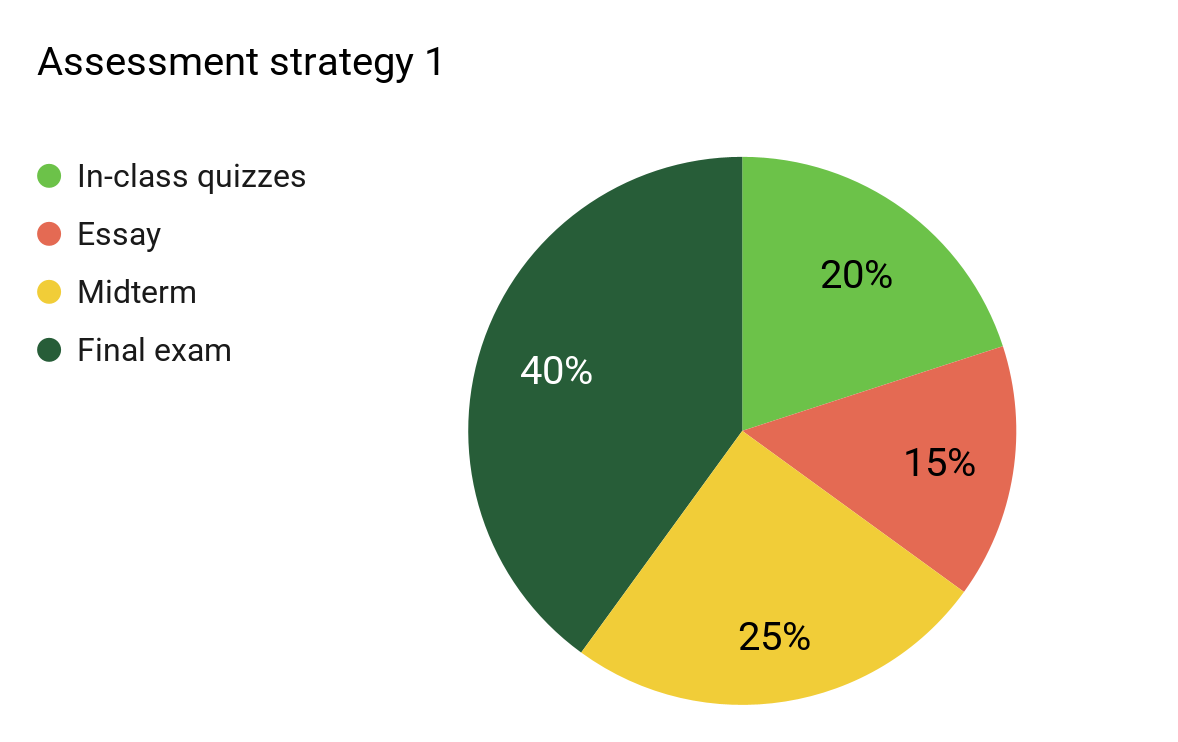
This plan prioritizes efficient grading for a large class. Most of the grade comes from exams, with quizzes and an essay adding practice and variety.
It is made up of four main assignments:
- ten in-class quizzes, worth 20% of the final grade
- a critical essay, worth 15% of the final grade
- a midterm, worth 25% of the final grade
- a final exam, worth 40% of the final grade
Pros:
- Exams and quizzes are quick to grade, or automatically graded if they are on Canvas, which makes them especially useful in large classes.
- The ten in-class quizzes spread out over the term make up part of the grade, encouraging regular study and showing you early where students are struggling.
- The critical essay allows students to demonstrate their understanding in a format other than an exam.
Cons:
- Exams and quizzes usually favour students who are accustomed to high-stakes testing or who perform well under exam conditions.
- Heavily weighted midterms and finals may lead students to focus only on getting a passing grade, which encourages cramming (surface-level understanding and short-term knowledge).
- Few opportunities for feedback are built into the term. However, if the in-class quizzes are done on Canvas, you can add answer-dependent feedback when you create the quiz to guide future study.
Strategy 2: Varied, scaffolded plan for a mid-size social sciences course
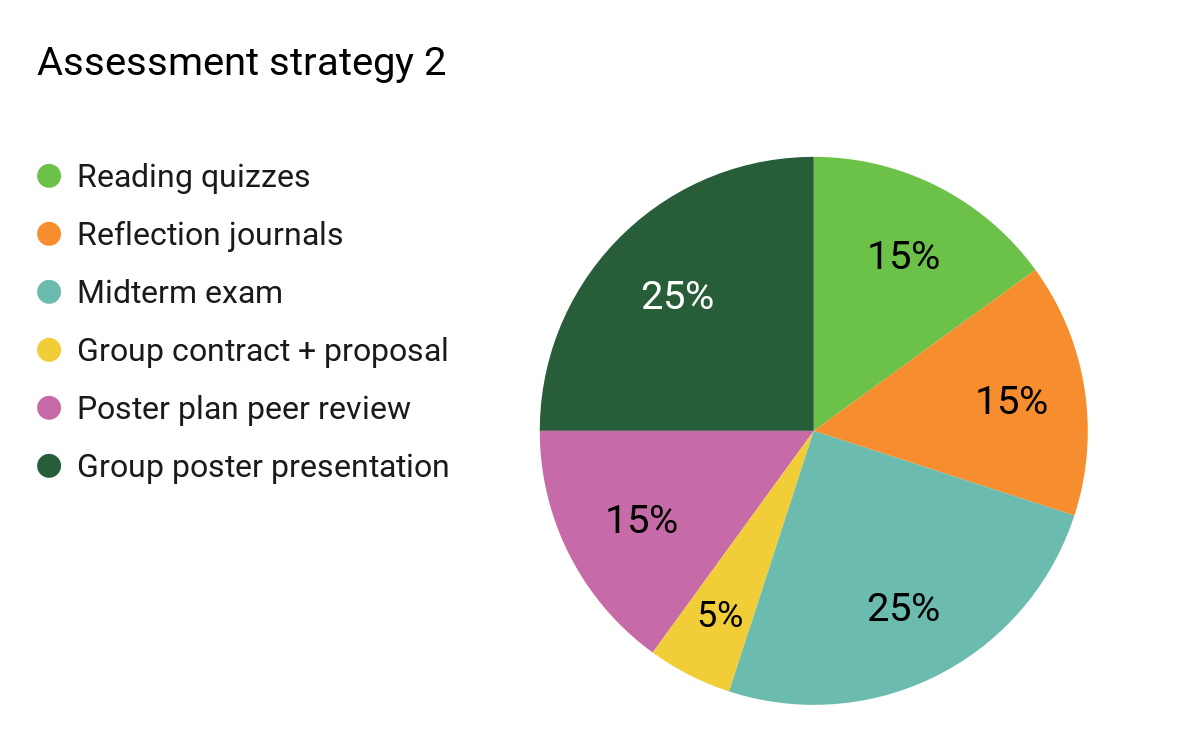
This plan prioritizes frequent feedback and varied formats. It spreads the grade across low-stakes tasks and a group project built in stages.
It is made up of four main assignments:
- six pre-lecture quizzes, graded as complete/incomplete, worth 15% of the final grade
- five written or video reflection journals (one for each unit in the course), worth 15% of the final grade
- a midterm exam, worth 25% of the final grade
- a scaffolded group project structured as:
- group work contract and topic proposal, worth 5% of the final grade
- a peer review in the early stages of the group project, worth 15% of the final grade
- a group poster presentation, worth 25% of the final grade
Pros:
- Grades are distributed across diverse formats, and lower-stakes assessments provide opportunities for continuous, formative feedback.
- The peer review assignment gives students early, low-stakes feedback, allowing them to apply those insights to improve their group poster before the final grading stage.
- Frequent reflection journals and low-stakes reading quizzes encourage students to engage with the course material consistently, promoting long-term retention rather than cramming.
Cons:
- Evaluating reflection journals and peer reviews increases grading time, making this plan challenging for large classes without teaching assistants, robust rubrics, or a complete/incomplete grading system.
- Group projects require clear expectations for team members and a well-designed rubric to ensure individual accountability.
- Juggling multiple assignment types and overlapping deadlines requires strong organization to prevent both you and your students from feeling overwhelmed.
Strategy 3: Practice-based plan with labs for a fourth-year pharmacy course
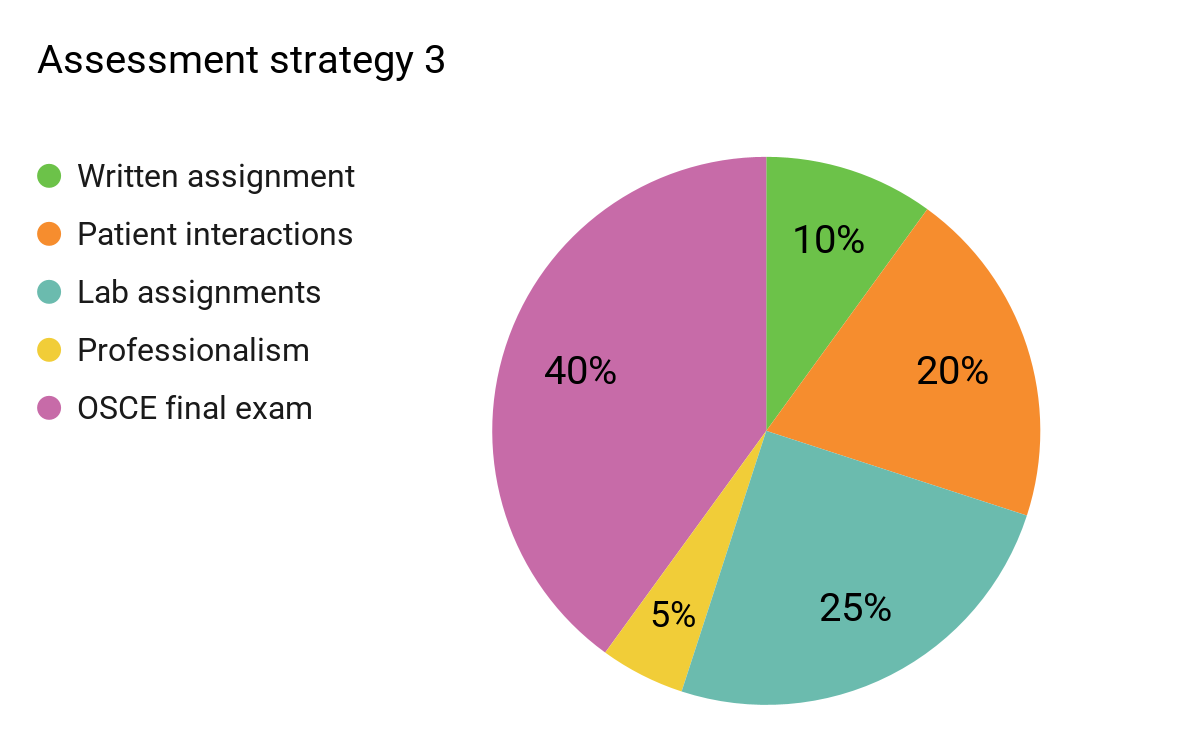
This plan prioritizes authentic, hands-on practice that mirrors pharmacy work, with lower-stakes checkpoints leading up to a final OSCE.
It is made up of five main assignments:
- a case-based written assignment, worth 10% of the final grade;
- two patient interaction observations in the style of an Objective Structured Clinical Examination (OSCE), worth 20% of the final grade
- lab assignments (mix of individual and group), worth 25% of the final grade
- professionalism (behaviour and actions), worth 5% of the final grade
- a cumulative final OSCE, worth 40% of the final grade
Pros:
- Assessments are practical and authentic, reflecting real-world pharmacy practice.
- Patient interaction observations help prepare students for the final OSCE by allowing you to give actionable feedback at lower-stakes checkpoints.
- The plan evaluates diverse skills in various formats (written reasoning, hands-on work, peer collaboration, professionalism).
Cons:
- Running multiple OSCEs, especially with larger class sizes, requires significant administrative coordination and is generally resource-intensive.
- Evaluating “professionalism” and group lab contributions requires clear, highly standardized rubrics to ensure consistent, transparent, and objective scoring across evaluators. Professionalism should only be assessed if it is directly connected to the course learning outcomes.
- With 40% of the grade on a single final OSCE, the plan still ends with a high-stakes assessment, which can disadvantage students with performance anxiety.
Putting it into practice
Use the strategy examples above as a model, and reflect on these questions as you review your current assessment strategy or develop a new one:
- How does each assessment connect to one or more of your course learning outcomes?
- How does your assessment plan provide opportunities for low-stakes practice before summative, higher-stakes assessments?
- How many different ways can students demonstrate their learning in your course? Which students might be disadvantaged if most of the grade depends on one format?
- Where in your course could you break down a high-stakes assessment into multiple lower-stakes components?
- How manageable are your grading load and your students’ workload during peak weeks of the term? Which assignments could you shift to ease them?
Learn more
Malespina, A., Seifollahi, F., & Singh, C. (2024). Bioscience Students in Physics Courses with Higher Test Anxiety Have Lower Grades on High-Stakes Assessments and Women Report More Test Anxiety than Men. Education Sciences, 14(10), 1092.
McConlogue, T. (2020). Assessment and Feedback in Higher Education. UCL Press.
Pedlow, M., Fischer, J., & Williams, A. (2026). Trade-offs in assessment and feedback design: a trilemma-based model. Assessment & Evaluation in Higher Education, 1-19.
Pippitt, K. A., Moore, K. B., Lindsley, J. E., Cariello, P. F., Smith, A. G., Formosa, T., Moser, K., Morton, D. A., Colbert-Getz, J. M., & Chow, C. J. (2022). Assessment for Learning with Ungraded and Graded Assessments. Medical Science Educator, 32(5), 1045–1054.
Shaker, A., Riach, A., Marshall, E., Kuveke, R., & El-Ayoubi, M. (2026). Low-stakes early assessment in higher education statistics: reducing anxiety, building confidence and improving student performance. International Journal of Mathematical Education in Science and Technology, 1–29.
Sotola, L. K., & Crede, M. (2021). Regarding Class Quizzes: A Meta-Analytic Synthesis of Studies on the Relationship Between Frequent Low-Stakes Testing and Class Performance. Educational Psychology Review, 33(2), 407–426.
Toddle, McTigue, J., & Bartlett, K. (2023). School Leaders Project | Beginning with the end in mind: Rethinking assessment [video]. YouTube.
Wyatt-Smith, C., Klenowski, V., & Colbert, P. (Eds.). (2014). Designing assessment for quality learning. Springer Netherlands.