A Passion for Pollinators
Donna McKinnon - 13 January 2026
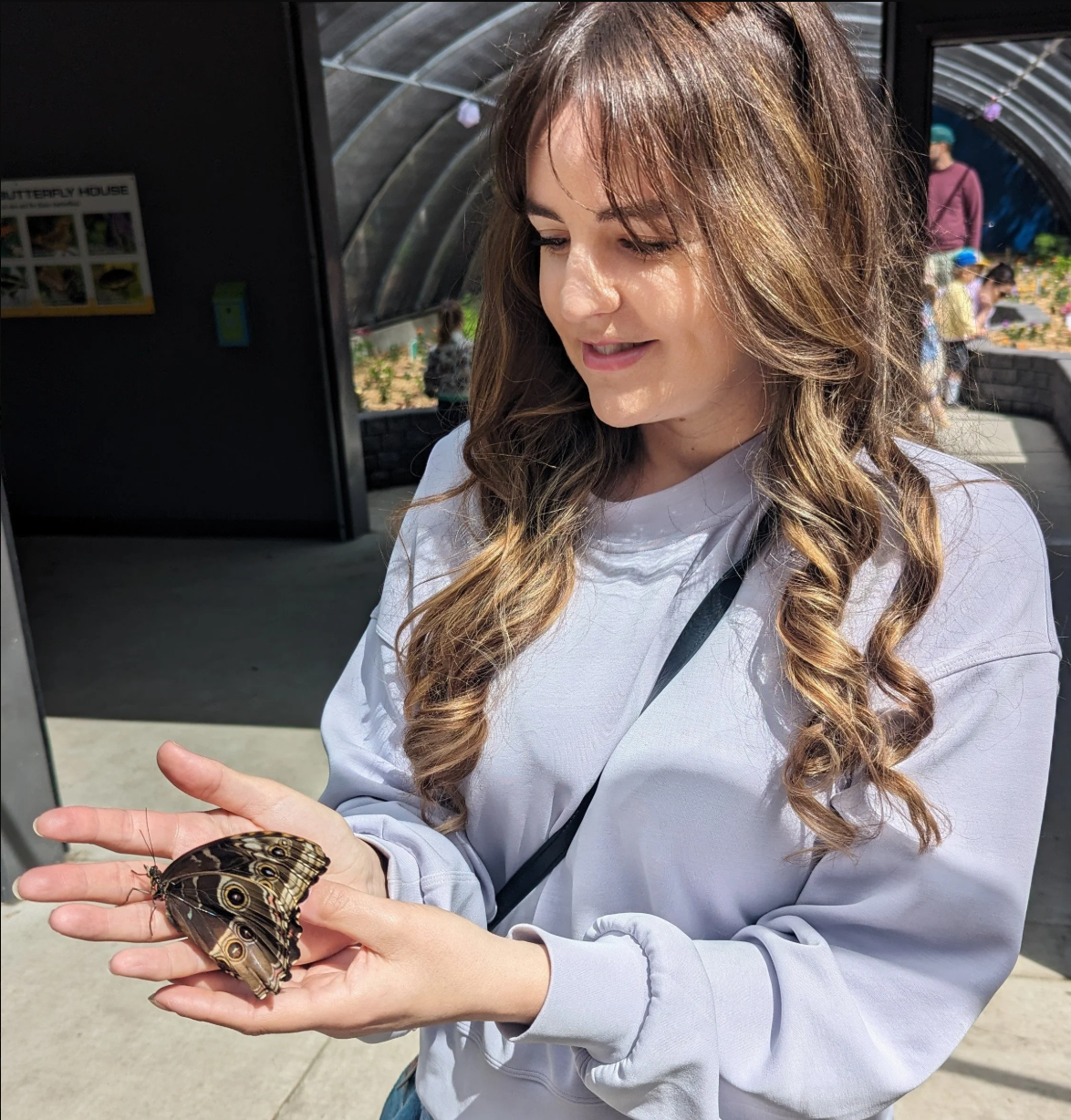
The catalyst that inspires or, in some cases, deepens a passion is often serendipitous in nature. Unexpected, and yet powerful enough to alter a path toward something more fulfilling. Originally enrolled in the highly competitive paleontology program, Sydney Worthy made the decision to pivot to conservation biology in the Faculty of Agricultural, Life & Environmental Sciences after her first year, recognizing that it was more closely aligned with her interests and professional goals.
It was in this program that she discovered a love for entomology, specifically pollinator ecology, after working with John Acorn on an undergraduate project on hover flies, a type of bee mimic. That passion culminated in a master’s degree in conservation biology in 2021.
“Growing up, I was always catching insects and bringing home all the creepy crawlies my mother hated, so there was that initial interest,” says Worthy. “Once I started learning more about what was really out there, it was like seeing a whole new layer of the world that had always been all around me — I just hadn't taken notice. From that point on, I was hooked.”
This fascination persisted throughout her studies, reinforced by a course she took with professor Felix Sperling, Advanced Terrestrial Arthropod Diversity, where she learned about the distinctive characteristics and classifications of arthropod groups and their evolutionary relationships. One of her classes involved the investigation of a handful of soil she had dug up from the river valley.
“Seeing how much life this soil had was mind-blowing to me,” says Worthy. “There are these tiny insect cousins called springtails, and just in this little scoop of soil there were three different groups of them. Before this class I was so focused on pollinators, but I learned about how many kinds of microscopic or extremely small insects and arthropods are out there. It was really eye-opening.”
Dream job
As a graduate student, Worthy studied a wide range of pollinators, a classification that includes ‘effective pollinators’ like bees, butterflies, and some flies that are designed to pollinate, and others, like certain groups of wasps, that are ‘incidental’ pollinators. Her thesis focused on the European honey bee, an introduced species that — while essential for honey production and agricultural pollination (and therefore beneficial to humans) — competes with other bees and offers limited ecological value to native ecosystems.
Worthy now works as a Native Bee Stewardship Specialist for the Alberta Native Bee Council (ANBC), but notes that it wasn’t a direct path to her “dream job”. Following graduation, she was hired by the City of Saskatoon as the city’s entomologist, leading protocols for the treatment, monitoring and prevention of urban insect pest species, including mosquitoes and bark beetles. Her role with the ANBC, which she began in 2025, is the result of her educational training and the connections she made while working in a non-related field.
“I was still able to keep up with my passion for pollinators and conservation by joining the Entomological Society of Saskatchewan,” says Worthy, adding that she still volunteers with their species-at-risk committee. “I also volunteered with the ANBC from 2018 until I was hired. Even if you can't follow your passion into your day job, find a way to keep it alive on the side in some capacity. If you can build on that excitement, there is a good chance it might lead you to your dream job, which is how I was able to transition into my current role.”
Stewarding the pollinators
There are four known endangered bee species in Alberta, explains Worthy, though there are likely more. One of the mandates of the ANBC is to track and identify where declines are most severe, and as a bee stewardship specialist, Worthy conducts species taxonomy and analyzes climate projections to predict future shifts in bee populations and diversity. She is also developing best management practices for rangelands and greenhouses to mitigate habitat loss, promote habitat restoration and regulate managed bee populations effectively.
A key public-facing aspect of her role is the outreach and the development of identification guides, as well as a web app that will empower individuals and developers to support pollinators in their gardens and other landscape settings. While development of the app continues, Worthy offers simple, actionable advice for anyone wishing to support native pollinators or create more drought resistant habitats.
“Plant native plants, or plants that are very closely related to native plants in your garden,” she says. “This includes plants that will bloom at different times in the season. Have lots of different colour variation and plants that have hollow stems because some of our bees will nest in these stems, as opposed to most of our solitary bees who nest in the ground.”
Worthy approaches her current role with the same wonder and curiosity she felt as a student, when a single scoop of soil revealed to her a vibrant, diverse ecosystem. It is this passion that continues to fuel her commitment to pollinator conservation and stewardship.
“I am very lucky to be able to do a job that I love.”
To find information about what native plants to plant in your area, check out these ANBC guides.
Read more about Sydney here.