Convocation 2025: Yinxue Yang
Donna McKinnon - 14 November 2025
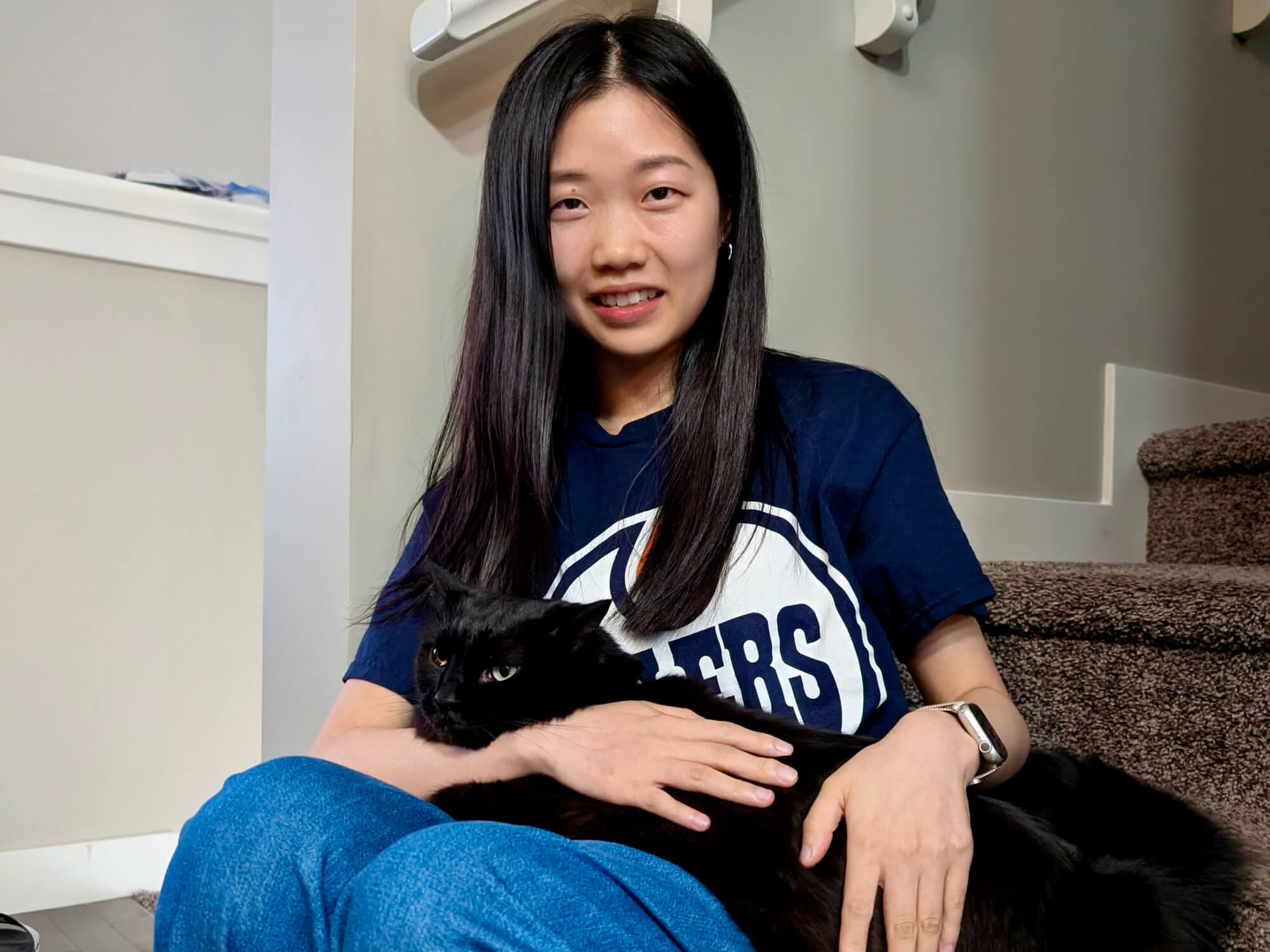
After completing a Bachelor of Law in Beijing and an MFA in theatre from Nanjing University, Yinxue Yang decided to relocate to Canada for further education before she had even finalized a specific program and university. Her interest in Taiwanese cinema ultimately led her to the U of A's East Asian Studies graduate program, and specifically, Christopher Lupke. His expertise in modern and contemporary Chinese literature, culture and cinema directly aligned with her research interests. The path forward was clear.
It wasn’t always a smooth transition. Navigating a new academic culture and finding her voice in a second language proved to be a significant challenge for Yinxue. It was through this experience, however, that she learned an invaluable lesson: uncertainty can be a creative force.
“I realized it could open space for new ways of thinking and feeling,” she says. “That shift changed how I approached research, and even how I understood belonging.”
Yinxue completed her second MA thesis (her first, in China, was a full-length Peking Opera, the most widely known and influential style of Chinese opera) on queer Taiwanese documentary filmmaker Mickey Chen. Though he passed away unexpectedly in 2018, his work lives on thanks, in part, to Yinxue who has been instrumental in introducing it to English-speaking audiences.
While a PhD remains a possibility, Yinxue is welcoming the uncertainty of her next steps as she gains valuable professional experience.
Congratulations, Yinxue!
What led you to choose this area of study, and why the U of A?
I’ve always been drawn to stories that explore identity and belonging — how people see themselves and how they’re represented. My research led me to Taiwanese queer cinema, where I found a powerful lens to examine visibility, memory and emotion. Studying these films allowed me to think about how personal and collective experiences intertwine across cultures.
Frankly speaking, I chose Canada before choosing the U of A. I browsed all East Asian Studies programs and found that Christopher Lupke's research interest aligns perfectly with mine. It turns out that I am super lucky to be here because I have met so many supportive and amazing people who have accompanied and helped with my study here. The mentorship and community I found here encouraged me to grow as both a thinker and a person. Looking back, this journey has shaped not only my research but also how I understand the connections between people, places and stories.
Tell us about your favourite professor and/or class.
Professor Christopher Lupke.
Did you face any significant challenges while you were a student, and if so, how did you respond?
One of the most challenging parts of my journey was finding my own voice in my second language and new academic culture. As an international student, I often felt caught between worlds –– trying to translate not only my ideas but also the emotions and histories behind them. Writing about Taiwanese queer cinema, I sometimes questioned whether I could do justice to the stories I cared about, especially when expressing them in English.
What helped me was learning to slow down and listen, to the films, to my supervisor and to myself. Over time, I realized that uncertainty could also be creative, that it could open space for new ways of thinking and feeling. That shift changed how I approached research, and even how I understood belonging.
What advice do you have for current or future students?
In an era when the humanities are increasingly devalued and questioned, I want to remind future students that what we do still matters deeply. Studying art, literature and culture teaches us to see the world with empathy and complexity –– to listen to voices that might otherwise be forgotten. These are not luxuries; they’re essential ways of understanding what it means to be human.
How do you plan on celebrating convocation?
My husband will accompany me to convocation. Afterwards, we will probably take some photos with a few close friends around campus, have a nice dinner and just enjoy the moment without rushing.
What's next after graduation?
I plan to start working while also reflecting on whether to pursue a PhD. I want to gain professional experience, explore different opportunities and give myself time to decide the path that feels right.