Chris Dodd ('98 BA Hon.) Appointed to the Order of Canada
Donna McKinnon - 26 January 2026
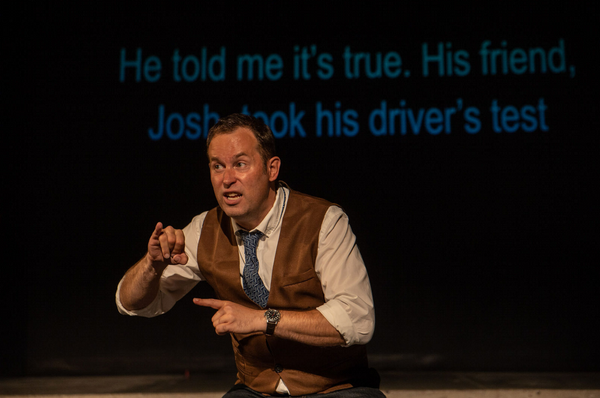
Photo: Andrew Williamson
From the stage to the page, the impact of Dodd’s dedication, advocacy and artistry over the last thirty years has earned him the Order of Canada, announced this past New Year’s Eve, honouring his commitment to fostering a more inclusive Canadian cultural landscape.
“I am proud that my community is getting the awareness it deserves,” says Dodd. “It helps with the progress for the recognition of Deaf culture and our specific arts styles, which also includes music, poetry, visual arts, storytelling and dance. It is a huge honour and very humbling.”
To look at the Canadian theatrical landscape today is to see the profound imprint of Dodd’s work — a legacy built on three decades of artistic innovation across both the Deaf and hearing worlds.
Dodd credits the blossoming of his creative spirit to several formative experiences, beginning with Edmonton’s Waldorf educational program, which integrates arts and play-based learning into the curriculum. This foundation was further strengthened in high school drama classes and, most importantly, through an “excellent” high school teacher who recognized his talent and encouraged him to continue his studies in university.
In his later teens and early adulthood, Dodd took advantage of a number of opportunities for emerging young playwrights, including the Citadel’s Teen Festival of the Arts, NextFest and workshops with Theatre Network and Workshop West.
At the U of A, Dodd found support and inspiration through his professors while exploring the full spectrum of theatrical craft. His studies ranged from playwriting, community theatre, voice, theatre design, stage tech and theatre history— the last taught by “the legendary Alex Hawkins”, says Dodd.
After graduation, his career began to take off. Teaming up with local actor and director Ashley Wright, they created a show for the Edmonton Fringe Festival called Silent Worlds, which was loosely built on his personal journey.
“The show was a huge hit and it earned three Sterling Awards for Outstanding Fringe Production, Outstanding Fringe Director and Outstanding Fringe New Work,” says Dodd. “Getting these awards early in my career was extra special and it helped me realize that I was on the right path.”
Other shows followed, including Deafy, his first comedy, but it was through his work as an adaptive technologist in the U of A’s Disability Services Office (now called Accessibility + Accommodations) that his role as a mentor and advocate began to flourish.
“The adaptive technologist at the time was looking for someone to train and to work alongside him,” says Dodd, who was hired in 2000. “I learned on the job over the course of 20+ years and eventually took over from him when he retired. I very much enjoyed my time supporting students, both because it involved my love of technology and secondly because it often involved creative ways of solving problems through innovative applications of technology. I have worked with thousands of students, and I’m grateful that I have been able to contribute to their success by helping them overcome barriers related to their education.”
In 2017, Dodd founded SOUND OFF, Canada’s national festival dedicated to celebrating Deaf performance and showcasing the artistry of Deaf creators from across the country. Central to the festival’s mission is a commitment to universal accessibility, ensuring a seamless experience for Deaf and hearing audiences alike. This March, SOUND OFF marks a significant milestone as it celebrates a decade of diverse and inclusive storytelling.
“I love giving opportunities to Deaf artists to hone their craft and present their stories to new audiences,” says Dodd. “There is still an under-representation of Deaf actors on our stages, and we don't have many scripts available to us, other than those written by our community, which feature authentic Deaf characters. I did not have many opportunities when I first started out, so it has been very rewarding for me to run the festival and to create new opportunities for existing and emerging artists.”
Now retired from the university but still a full-time playwright, the “proud stay-at-home dog dad” lives in Edmonton with his wife, a U of A alumna, and their daughters, one of whom is studying urban design in the U of A’s School of Urban and Regional Planning. He is quick to point out that he is still a full-time artist with half a dozen projects on the go.
“I am working on two plays, one being a new solo show and the other being a full-length, full cast drama,” he says, adding that he is also planning for future performances of his touring show, Deafy. Dodd is also working with a cultural association to diversify and strengthen the pool of ASL interpreters in the arts. He notes that a major barrier to entry is that most professional development remains inaccessible. “We try to counter that by providing accessible training opportunities within our community and by also pushing for greater inclusion.”
“It’s very important for us to be the authors of our own stories and to tell them from our own lived experiences,” says Dodd. “This is the essence of what we do as Deaf performers, writers and creators and which is why it is vitally important for us to push for more opportunities to be heard and represented on stage.”