Convocation 2026: Daniel Lee Whyte
Donna McKinnon - 4 June 2026
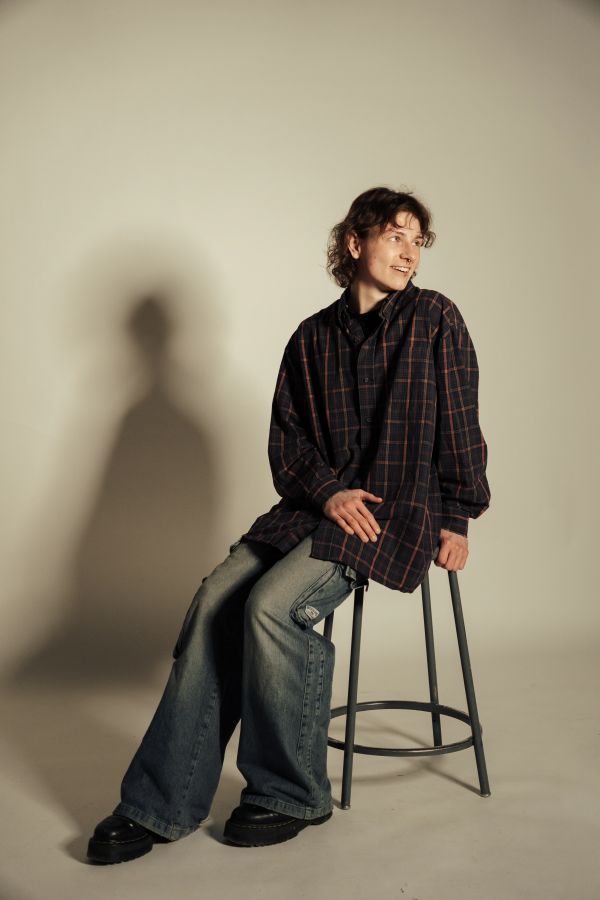
Image credit: Joy Jia
Originally a psychology major, Daniel faced the immense pressure of undiagnosed ADHD and a learning disability that made traditional, text-heavy coursework an uphill battle. By pivoting to a path directly aligned with his natural strengths, he found a home in fine arts — a program where neuro-inclusive learning styles and personal narratives thrive.
Here, art became more than just a major; it became a tool for survival and a method for processing the lived realities of being a trans person. His figurative art evolved into an interplay of oil painting and sculpture, light and shadow, the beautiful and the mundane, presenting the viewer with the ‘inconvenient’ realities of life in contemporary urban and domestic settings. By focusing his work on the intricacies of vulnerability and the structures of repeat victimization, Daniel has shaped his art into a mirror for the community, and for the self.
Earlier this year, Daniel was awarded the Elizabeth Greenshields Foundation Grant — a distinction that is particularly notable for an undergraduate. The grant supports emerging artists working at the forefront of representational art.
His commitment to highlighting systemic struggle extends beyond the studio to direct, community action. One of his outreach projects, which inspired others around him to contribute, resulted in the distribution of 780 pairs of handwarmers donated to organizations like 4B Harm Reduction and the Bissell Community Centre.
With an artistic practice rooted in radical empathy, Daniel leaves the program with a conviction that making the invisible visible is not just a personal catharsis, but a necessary step in ensuring no one is left behind by the communities they depend on.
Congratulations Daniel!
Where were you born and raised, and why did you choose the U of A?
I was born in Edmonton, then lived in Viking until 2008, when we moved to a farm outside of Bashaw. I stayed on the farm until I graduated high school.
I began my fine arts education in the Red Deer Polytechnic Fine Arts Diploma Program with the intention of later obtaining a Bachelor of Fine Arts at a local university, as I wanted to stay close to my family. I chose the U of A because many of my professors in Red Deer had either attended or taught at the U of A (Adrienne Dagg, James Trevelyan).
What drew you to this subject, and/or why did you choose the BFA program?
Making art or doing little creative activities was a huge part of my early childhood. I built a lot of tiny dwellings intended for fairies and small animals and built tiny furniture out of found objects. As a teenager I got into figurative work but stopped making art all together when I got into college.
I started in the Bachelor of Arts program, majoring in psychology. At the time, I was experiencing some personal challenges, my grades were suffering and I needed to make a change in order to continue attending post-secondary. I now know I had an undiagnosed learning disability and ADHD which made courses with a heavy focus on reading and writing especially challenging for me. I made the decision to follow my strengths rather than what I felt would be a more lucrative career path. The switch to the BFA program allowed me to learn through hands-on, experiential projects and doing what I love.
What was your favourite class and/or instructor?
Painting and sculpture are my favourite classes, though I've thoroughly enjoyed all the studio classes I've taken at the university. All of my instructors and professors have been excellent. They have had a significant impact on both my artistic practice and my personal life. I feel respected by my professors. These relationships make up a large part of the positive experiences I've had at the UofA.
Marilène Oliver helped me a lot this past year, I felt so encouraged by her. Marilene told me about the Elizabeth Greenshields Foundation Grant and helped me navigate my first grant application. She also wrote me a really touching letter of recommendation. I am so grateful for her help.
Did you take on any leadership or volunteer roles while you were a student?
In 2024, I began a personal outreach project where I distributed handwarmers to unhoused community members during my daily commute. In the beginning the project was self-funded, but I ended up getting a substantial amount of donations from my classmates and instructors! That year I was able to distribute 780 pairs of handwarmers with some boxes donated to local organizations like 4B Harm Reduction and the Bissell Community Centre. I am still distributing handwarmers, though no longer tracking distribution.
Did you face any significant challenges while you were a student, and if so, how did you respond?
As a student with a disability I took a reduced course load, which has resulted in a longer path to my BFA. This year I reached my maximum federal and provincial student loan limit. This, coupled with ongoing financial struggles and interpersonal challenges led to housing instability. I confided in Marilène who directed me towards the Elizabeth Greenshields grant.
I also reached out to the undergraduate advisor, Caitlin Wells, who was extremely helpful in assisting me in navigating available resources. In all, I utilized the emergency bursary twice as a student at the university.
The support I received from professors and other faculty on campus was integral to the completion of my studies.
In your artist’s statement, you say: “My work draws from my lived experience as a trans person. I focus on vulnerability, centering conversations around abuse in its various forms and repetitive victimization.” If you are comfortable sharing, can you talk a bit about your journey and perhaps the role of art in this journey?
Making art around the challenges I've experienced as a trans person is a tool I've used to process my experiences. I hope that making this process visible will help others in similar circumstances.
A lot of my work has been an attempt to convince myself that I deserve to be safe and what happened to me was wrong. Repeat victimization has been a big focus for me this year. For a long time I've been looking at the structures that allow abuse of vulnerable people. Now I am also investigating what it means to be a vulnerable person/what ‘makes’ a vulnerable person; specifically what experiences and circumstances have led to my vulnerability.
For most of my life, I believed that every challenge I experienced would make me more equipped to deal with the next one. However, this has proven to be false and learning about repeat victimization has been an important part of understanding how to better protect myself. People who experienced abuse in childhood, specifically trans people and cis women, are statistically more likely to experience intimate partner violence in adulthood. Similarly, victims of a sexual assault are more likely to experience another sexual assault than someone who hasn't.
To clarify, this isn't at all to say that I (or anyone else) had made the choice to be victimized or somehow have sought out danger. Rather, experiencing something awful still hurts you and will stay with you even if you are physically fine. Your body is focused on helping you survive, and it has learned to protect you in ways that may lead to more painful or traumatic experiences. Right now I am thinking mostly about a fawn response, but I believe this is also applicable to fight and flight, especially when considering how crucial it is to have a strong support network for people with PTSD and C-PTSD.
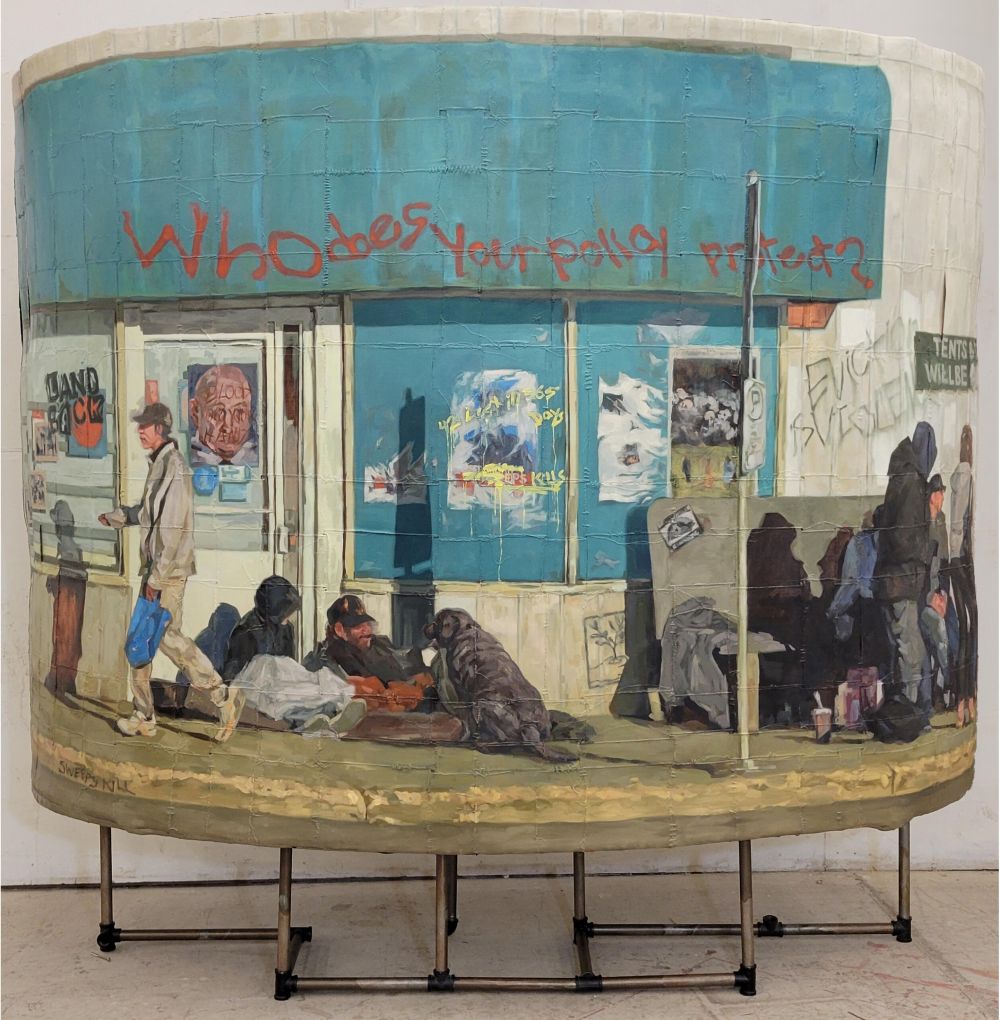
Related to this, you are not just focusing on your vulnerability in your art, but also drawing attention to the victimization of others. Specifically, I’m thinking of the painting “A Safe Neighborhood for your Neighbors” where you centre the unhoused. Can you share a few of your thoughts around why it’s important to have that wider and more inclusive lens in your paintings?
When I first came to the city in 2023 I felt very hopeless. I was seeing abject poverty up close at a larger scale than I had before, and I was learning about the violence inflicted on Edmonton's unhoused population via municipal leaders and EPS.
When I made that piece it felt very urgent; I was so disgusted by the decisions made regarding encampment sweeps and the lack of resources afforded to Edmonton's unhoused community members and the organizations that support them. The justifications offered for encampment felt like fear-mongering — warning housed citizens to avoid encampments and report them in order to protect their (housed) community members. It was so frustrating to see such a high volume of community advocacy being met with violence and continued abuse of vulnerable community members.
I found that many people who typically have a great deal of compassion for others still struggle to extend their compassion to people who are unhoused. I believe that misinformation, anti-poor legislation, and even the language local leaders use contribute to this, giving people a pass to detach from members of their community who need support.
Unhoused individuals are constantly being dehumanized. The process is initiated by the structures and organizations that have trapped them in inhumane circumstances and perpetuated by those who buy in. I was focused on insisting that my viewers see themselves in community with their unhoused neighbours in the hopes they would allow themselves to care, even though it is painful to acknowledge what is happening.
I love people so much and I feel so lucky when someone reaches out to me and I have an opportunity to help. It would be so devastating to be dependent on a community that has abandoned you and wants to pretend you don't exist. I wish this wasn't happening but pretending not to notice only makes it worse.
What would you say to someone considering or just beginning the BFA program?
I would say that I can't overstate the value of the community aspect! I've gotten so much from the time I've spent working with others and learning about their processes and what they care about.
Also I would say that it truly is a lot of work, and you really do get out of it what you put in, as in you are kind of working through your professional practice while you are completing your school work. I also would advise them to follow what feels good to make and what makes you excited because, from my experience, this is how you form your practice. Also listen to your classmates and spend time in the studio.
Finally, advocate for your needs and reach out when you need help. Your professors and advisors are there to support you in a holistic sense, beyond academic grades.
Lastly, what’s next for you?
For now I will be seeking out grants and taking some time off before I enter into graduate studies. My little brother and his fiancée are having a baby in September and I am really excited to spend more time with my family and help with childcare. I will be using the remainder of my Elizabeth Greenshields grant to support me as I navigate my practice outside of school.