As We Remember Them...
James Muir with Matt Bowes - 11 November 2026
Dr. James Muir joined the University of Alberta in 2006. He teaches Canadian, military, and labour history and in the Department of History, Classics & Religion and legal history in the Faculty of Law.
Dr. Muir's research interest is in Canadian legal history. His most recent book is a study of civil law in practice in eighteenth century Halifax. He has published on class and reception of law, procedure at the first session of the Supreme Court of Nova Scotia in 1755, the development of personal injury, tort and contract in nineteenth-century Nova Scotia and legal historiography. He has also worked on 20th century Canadian history, publishing on Manitoba premier Douglas Campbell and mid-century Albertan labour history.
The poppies start appearing a week before Hallowe’en. At first only a handful of people will be wearing them, including our politicians and similar public people. In the first week of November more and more appear until November eleventh, Remembrance Day; on the twelfth they almost all disappear, stored somewhere for next year or just tossed away. Why people choose to wear a poppy, if they can find one, is worth considering. To some who wear a poppy it is about the memory of wars past and soldiers long gone; to others it is about respect for our armed forces past and present. For some it is a symbol against war; to others it is a symbol of the necessity of war and sacrifice. Wearing a poppy may be an apolitical remembrance of the past or it may be a sign of willing belligerence. The poppy may be common, but it is not universally accepted in Canada. It, and Remembrance Day, have been controversial almost right from the First World War itself.
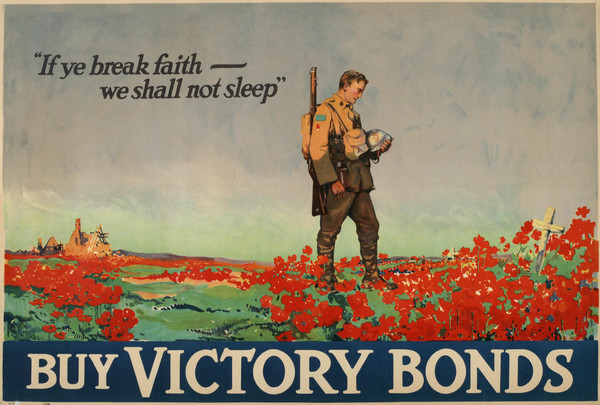
The poppy’s association with the First World War comes from Major Dr. John McCrae’s poem “In Flanders Fields,” written in a few moments between surgeries in May of 1915 during the Second Battle of Ypres. Ypres was a particularly bloody battle: it marked the first use by the Germans of chlorine gas; half of McCrae’s brigade were killed over the first 17 days of the battle. The red poppies grew wild in Belgium, and were blooming in the fields around his medical station as he worked and as his men died. McCrea quickly sketched out the poem to respond to his friend Alexis Helmer’s death on May 2nd ¹. Once done, McCrea set the poem aside, but a friend sent it to Punch magazine in England, where it first appeared in December. Newspapers, magazines, and books republished it all over the world. Its lines, or variations, and its symbolism were often quoted: “If ye break faith---we shall not sleep” proclaimed one Canadian Victory Bonds poster from during the war, portraying a soldier standing in a field of poppies and staring down at a single white cross ².
Nearly 620,000 people joined the Canadian Expeditionary Force (CEF) in the First World War while other Canadians served in the Navy and the British Flying Service. By war’s end, some 61,082 Canadian men and women in uniform had died and about 138,000 were wounded in battle, including 3462 amputees, more than 9000 who were identified at the time as suffering “shell shock” (psychological injuries, grossly undercounted), and about 170 war-blinded ³. Almost 1 in 10 of all Canadians served, and more than 2 in 100 were wounded or died. The war touched people in every community. Commemorating those who served and those who were wounded or lost became an imperative. Institutions, like the University of Alberta, made permanent memorials for all who had served, who died, or were wounded. On November 11, 1919 people around the British Commonwealth stopped work and observed two minutes of silence at 11 am to mark the first anniversary of the war’s end.
In 1921, both the poppy and Armistice Day became official. Anna Guérin first advocated wearing poppies in honour of the war dead as part of her international campaign for La Ligue des enfants de France et d’Amérique. At her encouragement, the Canadian Great War Veterans adopted the poppy in June 1921. The same year the Ontario Legislature made the Monday in the week of November 11 every year both Armistice Day and Thanksgiving.
Many veterans and others did not like pairing the two: Thanksgiving was a positive day, while recognizing the war should be solemn. Others noted that the name “Armistice Day” was insufficient---it marked the end, not the war itself, nor the sacrifices of those who served and their families. In June, 1931, Parliament split Thanksgiving away, renamed Armistice Day Remembrance Day, and placed it always on November 11 ⁴. Soon provincial governments followed.
Not all Canadians embraced Remembrance Day. For some it was just one more day when government forced businesses to close. Some people believed if it was a day off then people would take a holiday rather than observe the day. For others, having it a holiday seemed to demand observance, even from those who would rather not. A large number of Canadians, however, observed the day by wearing poppies and attending services, both religious and civic. Governments put restrictions on not just which businesses could open at all but what activities, from selling alcohol to closing house sales, could occur on the day.
After the end of the Second World War, Remembrance Day’s recognition was expanded to include the thousands of Canadians who served, were injured, and were killed in that war. In the years since, the Korean War, the Gulf War, and the campaign in Afghanistan have been added too, as have the peace-keeping missions in which Canada participated.
Does remembering and honouring the war dead mean opposing war? For some remembrance was an act of national pride, even jingoism; for others remembrance was a warning against new wars. Beginning in the UK in the 1930s, pacifists offered the white poppy as an alternative to the red one, symbolizing not just remembrance but also asserting opposition to new wars. In Canada some pacifists have adopted the white poppy as well ⁵. Others might still wear the red poppy, but recall the mantra of 1919, “never again.” At a large public service I attended in 1990, one of the speakers called out for us to clap for the men and women posted to Persian Gulf countries that fall in the lead-up to the Gulf War. From where I was sitting, I could see rows of Second World War veterans conspicuous in not joining in the clapping.
This year many of us are thinking about the four service members killed and 39 injured in the fire last month at CFB Wainwright. We should think of them again on April 28, the National Day of Mourning for workers injured and killed on the job. The fact that we should consider those so recently killed and wounded on both days emphasises the peculiarity of Remembrance Day: it is about one specific thing, and it is about a lot of only somewhat related things and people. It was first about remembering the toll of one, particularly awful, war. Over time it became about remembering more wars, and about honouring those who took part in or were touched by other wars. And then it was about honouring everyone who dons a uniform tied, in some way, to wars and potential wars. And it came to be a time to also honour any who fought in any armed force, including ones from other parts of the world. I do not begrudge any of the expansion, but I acknowledge that with each change, the meaning of the day and of the poppy ends up shifting.
The Royal Canadian Legion asks that Canadians wear poppies from October 24 until Remembrance Day. They still make poppies available, encouraging those who pick one up to donate to the poppy fund too. But the Legion has shrunk in numbers, and the distribution of poppies has shrunk alongside. Fewer people wear the poppy, and many who would cannot find one anymore. How Remembrance Day is recognised today depends largely on the province or territory. In Manitoba, for example, most businesses, including almost all retail businesses, must be closed between 9 am and 1 pm. Only employees in certain occupations are allowed to work. In Alberta, it is a statutory holiday, but all businesses can remain open all day. In Ontario, Remembrance Day is no longer a public holiday, although in Toronto the transit service still stops at 11 am to recognise a moment of silence ⁶. Before 2020, the University of Alberta hosted a large ceremony in the Butterdome that drew many serving members of the armed services, veterans, cadets, the Lieutenant Governor, cabinet ministers, city dignitaries, and more. Other ceremonies were held at City Hall and around the city tied to various legions. This year, the largest ceremony will be the one at City Hall, but it will be smaller than the Butterdome ones, and attendance at all continues to decline.
I still wear my poppy and my family and I used to go to the Butterdome service every year. But my reasons for wearing the poppy and attending the service are personal to me. I expect almost everyone who wears a poppy or attends a ceremony does it for their own, personal reasons. And the people who do not wear a poppy and do not attend ceremonies do so for their own, personal reasons too. Remembrance Day and the poppy have always been a mix of personal and civic choices. Knowing a little about the history of both should make us all more open to the choices we all make in how we recognise the day.
Notes:
1. John F. Prescott, “McCRAE, JOHN,” in Dictionary of Canadian Biography, vol. 14, University of Toronto/Université Laval, 2003–, accessed November 8, 2026, https://www.biographi.ca/en/bio/mccrae_john_14E.html.
2. Jonathan F. Death So Noble : Memory, Meaning, and the First World War (UBC Press, 1997), 199-201.
3. “The Cost of Canada’s War” Canadian War Museum, accessed 8 November, 2026, https://www.warmuseum.ca/firstworldwar/history/after-the-war/legacy/the-cost-of-canadas-war/ and Serge Marc Durflinger, Veterans with a Vision : Canada’s War Blinded in Peace and War (UBC Press, 2010), 2.
4. Vance, Death So Noble, 211-213.
5. See White Poppies, https://peacepoppies.ca/.
6. See: Employment Standards, Manitoba, https://www.gov.mb.ca/labour/standards/doc,remembrance-day,factsheet.html
Employment Standards, Alberta, https://www.alberta.ca/alberta-general-holidays
Ontario Public Holidays, https://www.ontario.ca/document/your-guide-employment-standards-act-0/public-holidays
TTC service to pause for two minutes of silence on Remembrance Day,” https://cdn.ttc.ca/news/2024/November/TTC-service-to-pause-for-two-minutes-of-silence-on-Remembrance-Day.