In Her Own Words: From BA to “Full Tilt Boogie Journalism”
Myrna Kostash, with Matt Bowes - 9 November 2026
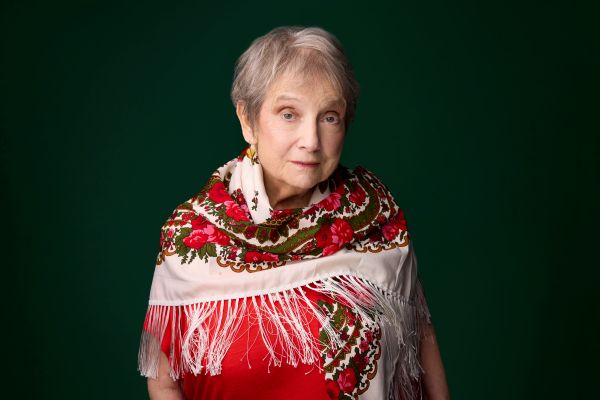
She is the author, among many other titles, of Bloodlines: A Journey into Eastern Europe (1993), which won the Alberta Culture and Writers’ Guild of Alberta prize for Best Non-Fiction and Prodigal Daughter: A Journey to Byzantium (2010), which received the 2011 City of Edmonton Book Prize and the 2011 Writers’ Guild of Alberta Wilfred Eggleston Award for Best Non-Fiction. Ghosts in a Photograph: A Chronicle was honoured with the Shevchenko Foundation’s 2024 Kobzar Book Award.
Kostash, who has served as president of the Writers’ Guild of Alberta and as chair of the Writers’ Union of Canada, has lectured and led writing workshops all across Canada. She was a founding member of early Canadian Studies programs in Eastern European universities. In 2010, she was awarded the Writers’ Trust of Canada’s Matt Cohen Award: In Celebration of a Writing Life.
First impressions
I was in a BA program [at the University of Alberta] in 1962, and I got my degree in 1965. I’d initially enrolled in the honors program, of course, as I was a super duper student coming out of Grade 12.
When it came time to decide what I would study as an Arts student at the U of A, of course it was the humanities, or in fact, modern languages. I was already studying Russian language for myself, and I’d been doing French at school, so I just moved over to do Russian as a major, French as a minor.
I only did one class of English literature, so in that sense I’m massively undereducated. I was taught by Wilfred Watson. That English course started with Beowulf, and ended with Samuel Johnson, so the rest of the development of English literature I was clueless about!
Social mores
There was this saying at the time, that a woman goes to university in order to get her “M.R.S.” I wasn’t impressed by this idea. There were some women who did psychology, because it’s about people, but it never crossed my mind to major in political science, sociology, or history.
I was aware that in choosing the Russian language as my major, I was not studying Ukrainian. It wasn't so much that I was sensitive to the Cold War environment as I was very sensitive to the sort of defensive nationalism of my own Ukrainian-Canadian community. And I said, “well, who cares about Ukrainian? Ukrainian was something you spoke at home. Not a world-class language or literature, so who cares?” Portentous words for me later on.
At the time, what having an arts education meant was, first of all, an achievement within the Ukrainian Canadian community. Both of my parents were school teachers, so it wasn’t like I was the first person to go to university. Although for a lot of people in my generation, that was true. I was the beneficiary of an ethnic community that valued education as soon as you could get it.
The prevailing wisdom at the time was that women were just going to university to go on and become a secretary, right? But my family was well-educated and it was expected of me as well. My father taught typing among other things at Vic High School. He had a BCom as well as an MEd, and he offered to teach me to type. Of course, back then I said “Never! I’m not going to spend my life at a keyboard.”
Well, guess what!
The last beatnik
The Sixties hit the U of A campus, namely with draft dodgers and radical professors filling out the ranks of our new humanities faculties. Quebec folk music groups would come through, and there was a frisson of what was going on over there at the time, at least if you were studying languages.
There was this mom-and-pop cafe famous for its cinnamon rolls where the Earls is now, called Tuck Shop, and Jon Whyte (BA ‘64) presided there. He was only on campus with me for about a year, and he went on to have a literary life of his own, but he would hold court in this cafe. I had such a longing and a yearning to be part of a group like that. I was really torn between the student radicalism, the social critique and budding feminist perspective, against the idea of joining a literary circle that had its own code.
I finished my BA in 1965, and at that time you fully expected there would be something out there for you to do. I mean, what’s the point of education otherwise? My parents and I agreed that I would start a graduate program at the University of Washington next.
In the summer they had a program for Russian language students, where you lived in a house called Russki Dom, with a roly-poly Russian-speaking woman who was the house matron. I stayed on in Seattle to finish the first year of graduate studies in Russian.
After one year at the University of Washington, I came back and worked for Mel Hurtig at his bookstore on Jasper Avenue. Onward to Toronto and an MA starting in 1968.
In spite of the fact that a grad studies counselor was skeptical that as a female grad student I would receive financial support, wasn’t I just going to get married and waste my education? In the end though, I did get a $4,000 fellowship from some corporation, with the condition that $1,000 of it went to the faculty I was going to be studying at, which ended up being U of T. So on the $3,000 that I had that year, full year as an academic at the University of Toronto, I saved $1,000 of it, which paid for my trip abroad.
And the reason I went abroad is I didn't know what to do with myself after the MA.
I didn't want to do a PhD, so I thought I’d go to Europe and write. I suppose that the option, if I was dropping out of academia, was to be a writer. Yeah. I'm not sure why, because I wasn't an English literature major, and I was not the least bit interested in doing anything more with the Russian language. I wasn't very good at it anyway.
Anyway, there I was, hitchhiking around Europe, and then decided I would write a novel. I started living in England for a while, and bought one of those coil-bound, lined notebooks, and I started writing my novel there.
Why a novel? The playwright Elsie Park Gowan (BA ‘30) had taught one of the creative writing classes at my high school (Ross Sheppard), and one time we were working on poetry and I decided I was going to write a beatnik poem, because I’d been reading A Coney Island of the Mind by Lawrence Ferlinghetti.
I wrote this poem, what I thought was a beatnik poem, and she just made fun of me. So that’s why I never pursued poetry.
The arts economy
The value I got from the arts degree though, in retrospect, is being embedded in the culture of reading, the culture of writing coherently, and clearly having something to say. Of course, for me that was the essay, which I discovered was my genre.
I’d seen an issue of Saturday Night at Margaret Laurence’s house in England, and I said “Well, I’ll try that.” That was with editor Robert Fulford, and he took it. And then he kept taking stuff that I was sending from Europe, which I now realize was deeply affected by the New Journalism.
This was basically what I was reading in Rolling Stone, and then you'd read it in the Village Voice or whatever they were writing in England at the time as well. Now I realize how exceptional it was that as a woman I was writing like this. It was a pretty sexist movement. My husband at the time called it “gonzo”, and also “full tilt boogie journalism”. I thought, yeah, that's me. I would go on to write a few books as well in this mode. I call it Writing With a Big Fat Attitude.
When I came back to Toronto, it was early spring of 1971 (I left in January ‘69). I made an appointment with Robert Fulford, thinking I could get a job at the magazine, and that's when he explained to me what the word freelance was, and my fate was set. I was never going to have a job. I was going to be a freelancer. It worked out very well for all of us in the '70s.
Who would believe this now? There were resources then that young people don’t have anymore. I freelanced in Toronto for three years before coming back to Alberta, and I already had a column in Maclean’s. I was running major features in Chatelaine, in Saturday Night! The biggie was the day I got the phone call from Fulford saying, "Myrna, could you go to Barcelona next week to interview Sinclair Ross?”
I said, “Yeah, let me check my calendar.”
This has something to do with my education and what we weren't reading at the time. Fulford, a decade older than me, was appalled by the fact that I didn't know who Sinclair Ross was until the women's movement, in which I was a participant in Toronto in the 70s, was talking about As for Me and My House as a piece of sexist, misogynist writing from the suspect male point of view.
And I did a really good profile. But I mean, nowadays there's no money for travel. Everything is online. And you do have to work by yourself anyway, and no one will take anything more than maybe 1,500 words. So I had a really good apprenticeship in being able to, I guess, have work as a writer. All that latitude we were given back then, the support, the number of publications, the context was Canadian cultural nationalism.
“Marie de la Prairie”
When it was very much my generation of the New Left running things in media, I did a report for This Magazine on what was going on in Belgrade, capital of Socialist Yugoslavia. In the early '80s, there was a repressive movement against extreme left wing students and professors, and they were being expelled and blacklisted and all this kind of stuff. They were critics of President Tito and the “Red Bourgeoisie.”
My friends in Belgrade were very much involved in what they called these “flying” universities. Word would go around, “so and so's giving a lecture at such and such apartment”, and then you know somebody gets busted.
But I wanted to write about all this and I thought I can't use my name because I'll never get back into Yugoslavia. So they said, "Yeah, we understand that. So, what name do you want to use?” I came up with Marie de la Prairie.
And they said they'll know who that is right away. So then I picked “Marceline Lavallee” or something like this. Why French? It was a nom de guerre. I wanted it to be French.
Anyway, so I had a good run as a magazine writer.
I see now that I’d started building a kind of a bibliography of writers whose work appealed to me. Rudy Wiebe’s (BA ‘56, Professor Emeritus) Temptations of Big Bear completely changed my perspective as a Western Canadian on Indigenous history. But the writer who completely changed my life as a nonfiction writer was Eduardo Galeano. But who reads him now? Are his books even in print? He was a big, hot, sexy beast on the left.
His book Days and Nights of Love and War showed me how I could do what I was struggling with on the first draft of Bloodlines: A Journey into Eastern Europe. That was the book in which I was determined to break out of New Journalism, and find myself a new way of writing nonfiction. Galeano assembled reportage, personal vignettes, interviews, travelogues, folklore, putting more of his personality in there, his thought processes, his dreams –not often present in New Journalism–but always writing within the Uruguayan socio-political context.
I didn’t pretend I was like Galeano, as he was persecuted in Uruguay as a left-wing writer, because nobody cared about what we were writing in Canada. No one was going to come storming through the door.
Much later on, when I did creative nonfiction writing workshops, I always titled them, from the late Annie Dillard. “astonishment in the world”, and for me, that's where my work begins. She’d written a small opinion piece in the New Yorker, with that phrase, and what it really means is curiosity.
I was constantly curious about the world around me and each of my books, everything I’ve written, comes out of this, my own moments of astonishment. And then: What is it in me that has been astonished? Creative nonfiction answers that.
Modern-day Myrna
What would I tell a young woman graduating today with a BA? First off, you can’t hitchhike the way I did. I did it with a male friend back in those days, but that immersive New Journalism method of getting your material, having the adventure, being abroad, and so on. It's not available anymore.
People can’t live on $3 a day as normal tourists, like I did. Paying fifty cents to sleep on the top of a hotel in Athens? It never occurred to any of us that we couldn't afford to pay rent, even if my income the first year writing magazine features in Toronto was $3,600, and I was supporting my husband. Paying $75 a month in rent.
That sense of open-ended horizons, that freewheeling attitude, it must have been because I had absolutely no anxiety about supporting myself down the road. That avenue is cut off, with the sheer unaffordability of everything.
A young Myrna now would actually have to find paid employment. Now there were always those writers who did have full-time jobs, and wrote in the mornings or evenings. There were also those women writers who married men who had the jobs, but then they had children. And there were occasionally women who wrote and had children, struggling as freelancers. So I would also say now, don't have children. It's much easier to support yourself without kids, like I did.
What you build for yourself, starting with your post secondary education, if you're lucky and you get to be nurtured in the humanities, is the discipline of reading. Do that, then you then build this incredible foundation for your life as a human being.
I know I'm sounding like something out of the propaganda department there, but it's true when I think about it. What you gain by reading books and loving books, loving your own solitude, being animated and excited by an argument that gets you going without fear of being trashed.
That’s the foundation of a good life, even if you end up working in something you didn’t expect, you've got the love of reading and just walling yourself around in ideas. Too many books, not enough time, as they say. But get started.