Komla Essiomle and the Advancement of Francophone Research in Alberta: A Historic Step Toward Equity in School Leadership
11 June 2026
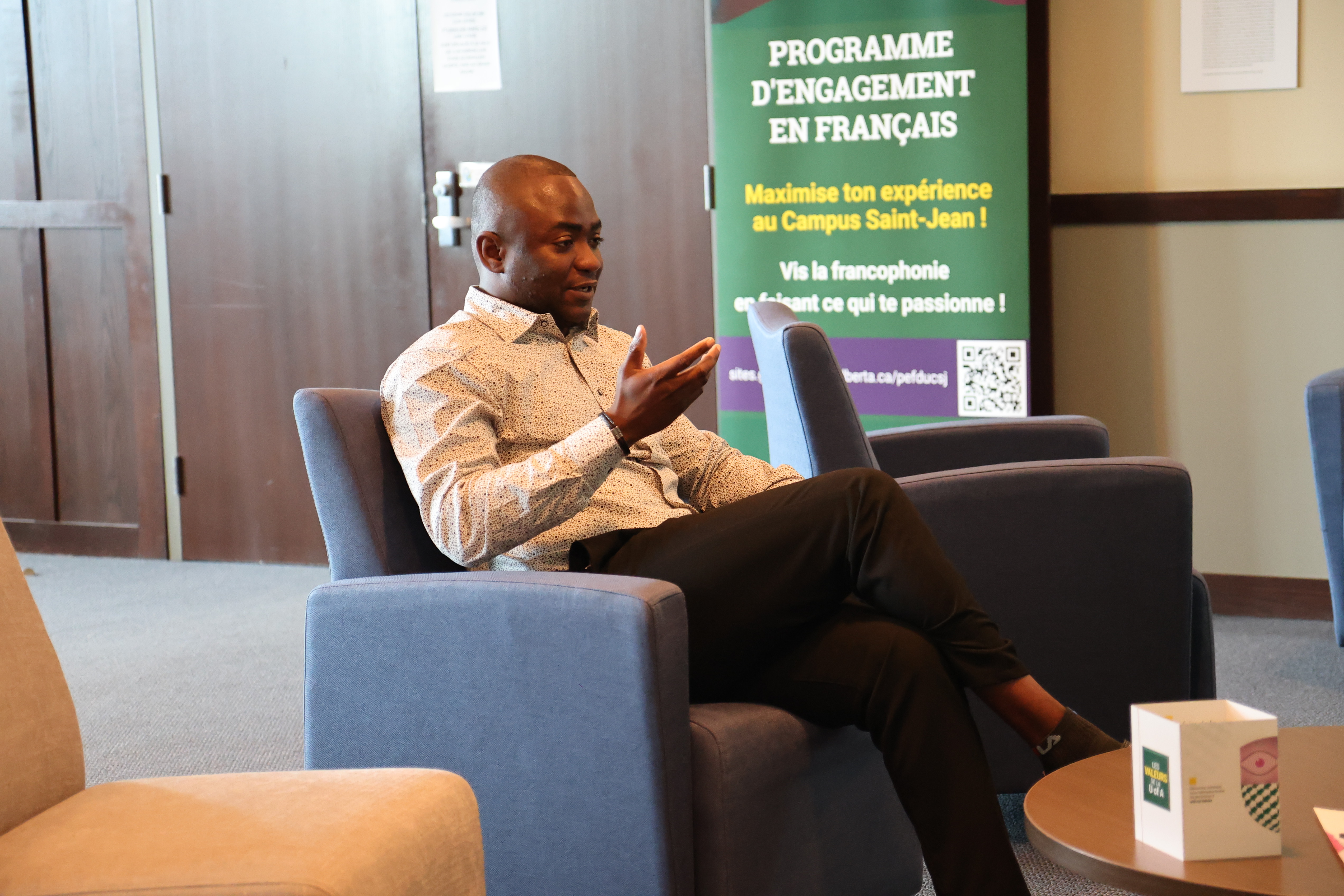
A historic moment for Francophone education: Komla Essiomle, the first graduate to receive a doctorate (Ph.D.) from the Faculté Saint-Jean. A major milestone that underscores the institution’s excellence and evolution.
Courtesy translation of the French article.
Alberta’s Francophone educational ecosystem is reaching a major milestone in its maturity and academic autonomy. With the very first conferral of doctoral degrees at the Faculté Saint-Jean, the University of Alberta’s transdisciplinary Francophone faculty, the province is no longer content to be merely a place of welcome or cultural transmission: it is now establishing itself as a hub for the production of high-level Francophone knowledge. It is against this backdrop of development that the official ceremony will take place on June 16, a date that will mark the expansion of an entirely French-language educational pathway, from pre-kindergarten to the doctoral level, within a predominantly English-speaking province. Komla Essiomle does not merely witness this historic institutional evolution: his career trajectory and the scope of his work brilliantly embody it, aligning perfectly with the Faculty of Saint-Jean’s tradition of fostering impactful leadership and driving change.
This commitment to combining academic excellence with social transformation is fully realized in the choice to conduct research in French, right at the heart of a predominantly English-speaking environment. Such an approach constitutes an act that is both scientific and highly symbolic, directly addressing issues of equity, legitimacy, and cultural vitality.
“Being able to conduct my research, then write and defend my thesis in French in Alberta is a symbol of cognitive justice,” says Komla Essiomle. “It proves that French is not merely a language of heritage or subalternity, but a language of science and critical reflection capable of deconstructing complex systemic dynamics.”
Beyond institutional ties, a clear synergy linked the subject of study to the faculty’s mission.
It was precisely this ambition that guided the researcher to the Saint-Jean Campus. Eager to pursue a graduate academic path in French—and since this program was not yet available at the time—Komla initially enrolled in the Faculty of Education at the University of Alberta. The transfer to Campus Saint-Jean took place as soon as the new PhD program in Transdisciplinary Studies was launched in 2024. The exceptional experience he had at this institution during his master’s degree, the effectiveness of his training, and the faculty’s recognized expertise in interdisciplinarity were the determining factors in this return to his roots.
Beyond institutional attachment, a clear synergy linked the subject of study with the faculty’s mission. As the beating heart of the Francophone community in a minority setting, Campus Saint-Jean closely monitors the province’s French-speaking demographic trends, characterized by a growing presence of people of African descent in its training programs. As the sole training centre for future teaching teams working in the province’s French-language and immersion schools, the institution serves as the ideal laboratory for this research. By advancing paradigms in school administration, this research continues the Faculty of Saint-Jean’s historic tradition of having a major impact on educational programs and positioning itself at the forefront of societal transformations.
This convergence of institutional and scientific aspirations translates into a success that extends far beyond the individual level. By officially entering the history of the Faculté Saint-Jean—the French-language component of one of the world’s top universities—Komla Essiomle feels a deep sense of pride and humility, a future that seemed hard to imagine when he left his home country. Much more than just an academic title, this milestone is seen as a collective victory that reflects the dynamism, resilience, and excellence of Francophone research in a minority context. By becoming the first person to receive this degree in Alberta, the researcher is paving the way for the next generation and serving as a source of inspiration for Francophone or Francophile students—whether Canadian-born or from immigrant backgrounds—encouraging them to believe in their ambitions and become agents of change.
To truly gauge this drive for change, one must delve into the heart of the thesis, whose scope is illuminated by a simple analogy: imagine that the school system is a large corporation tasked with training the members of tomorrow’s society. In Alberta, this system is welcoming an increasingly diverse student body. Yet the management team remains particularly homogeneous, and teaching staff with African immigrant backgrounds are almost entirely absent. Many of these professionals remain in the classrooms, despite having proven qualifications to hold leadership positions. The study specifically seeks to understand the roots of this barrier and to propose concrete solutions to address it.
The findings reveal that the career paths of immigrants are fraught with obstacles.
To analyze this phenomenon, the research involved interviews with ten teachers of African origin to compare their perspectives with archival data from fourteen predominantly white school administrations. The findings reveal that the career paths of immigrants are fraught with obstacles. Barriers arise as early as initial teacher training and persist during professional integration through challenges related to integration or pedagogical acculturation.
Nevertheless, some of these staff members manage to overcome these hurdles and advance to management positions. The secret to this advancement lies in a high degree of adaptability, but above all in the presence of a crucial alliance: mentoring or sponsorship within the school administration that believed in their potential and propelled their careers.
“At present, access to leadership positions relies more on sponsorship,” the researcher notes. “However, this support depends on individual, informal, and discretionary initiatives. To dispel the perception that professional advancement is a matter of co-optation rather than merit, school boards must formalize and provide a framework for this practice. ”
For these professionals, the French language is at once a vehicle for integration, a work tool, and a central element of identity. Conducting this research in French made it possible to capture the full subtlety of these life stories, to respect these voices, and to convey these experiences without the filter or distortion that a translation into English might have imposed.
These findings demonstrate that to build inclusive schools, it is not enough to passively wait for attitudes to evolve. Equity must no longer be viewed as a mere policy to be implemented, but as a management practice to be adopted by school leaders. The impact of this work is social, political, and managerial, and unfolds around three fundamental pillars:
- Integration as a springboard: Successful professional integration—facilitated by rapid tenure, robust mentoring, participation in an integration support program, consistent organizational support, and a supportive work environment—is the driving force behind the aspiration for leadership. The onboarding phase and the emergence of aspirations for career advancement are not isolated stages. They form a dynamic continuum that falls under the responsibility of organizations, not individual effort alone.
- Changing the vision of the leadership role: It is necessary to redefine the role of school leadership by shifting from administrative oversight to facilitating career trajectories. Making this a mandatory managerial competency, grounded in the School Leadership Quality Standards (SLQS), will ensure true equity and a transparent meritocracy within the education system.
- Providing a roadmap for genuine representation: The research goes beyond critical analysis to offer a conceptual and pragmatic roadmap for the Alberta Ministry of Education and school boards. The challenge is to drive a profound overhaul of organizational practices and to identify biases—whether conscious or unconscious—in order to eradicate the systemic barriers that hinder equitable career progression among teachers. In the long term, implementing these recommendations will enable a shift from purely descriptive representation to substantive representation of diversity in school leadership.
It quickly became clear that research would be the cornerstone of this career.
Behind the rigor of this data and these management approaches lies a remarkable human journey, marked by profound resilience. It all began in Togo, where Komla Essiomle developed an early fascination with understanding the surrounding social world and with academic rigor. It was there that the academic foundations were laid. This academic path, which led to a Master’s degree in Management Sciences at the University of Lomé, provided the necessary foundations while instilling values of perseverance and adaptability. Very quickly, it became clear that research would be the cornerstone of his career.
Driven by a constant desire to improve, he then set his sights on an international path. Canada then emerged as the obvious choice, recognized worldwide for its academic excellence, the expertise of its faculty, and the quality of its infrastructure. It was with this strong motivation that the journey continued at the University of Quebec in Montreal in 2016 for a degree in business strategy, before moving on to the University of Alberta in 2019.
The major challenge of this journey undoubtedly lay in the triple burden of balancing full-time doctoral studies, a full-time job, and family responsibilities. Completing transdisciplinary research requires absolute intellectual commitment, rigorous discipline, and unwavering perseverance. While it proved challenging to maintain a harmonious balance between these different spheres, reaching the graduation milestone represents the culmination of the sacrifices made. This achievement is a source of collective pride, shared with family, friends, and the supervisory committee, whose unwavering support made this marathon possible.
Today, the completion of this doctorate opens up new strategic perspectives, both for the researcher’s career path and for the future of Alberta society. Eager to translate this knowledge into concrete impacts, Komla Essiomle now aims to put this transdisciplinary expertise at the service of organizations to support them in optimizing their equity policies. Beyond technical skills, the doctoral program has helped him consolidate key competencies: complex problem-solving, analytical depth, critical thinking, and communication skills with diverse audiences. Already advancing professionally within the research ecosystem, he intends to fully leverage these strengths to propel his career, whether in his current roles or toward a faculty position.
Beyond a career plan, the very future of Francophone communities is at stake through the application of this work. By transforming the educational system to incorporate pluralistic leadership, Komla Essiomle’s research lays the groundwork for a society that is more just and representative of its demographic base. Since schools are the cradle of citizenship, diversifying their leadership provides strong role models for a diverse youth population. In the long term, the impact of this thesis will help redefine community life in Alberta, proving that genuine inclusion at the top of educational institutions is the cornerstone of a highly democratic, resilient, and forward-looking society.
“Komla Essiomle’s journey will remain etched in the annals of Campus Saint-Jean,” says Campus Saint-Jean Dean Jason Carey. “By transforming personal and systemic challenges into a roadmap for the future, this historic first degree embodies our deep commitment to diversity and inclusion. It is fully in line with our tradition of excellence in education, for it is by diversifying leadership at the top of our schools that we provide inspiring role models for new generations. This sense of belonging is the essential driving force for building public trust, thereby strengthening the foundations of an ecosystem where Francophone research asserts itself as a fully representative and inclusive community, a powerful vehicle for social change, and paves the way for a highly democratic society.”
Komla Essiomle’s doctoral thesis will be published and available starting June 16.