Professor Hassan Safouhi: A life dedicated to mathematics, education and the diplomacy of knowledge
20 March 2026
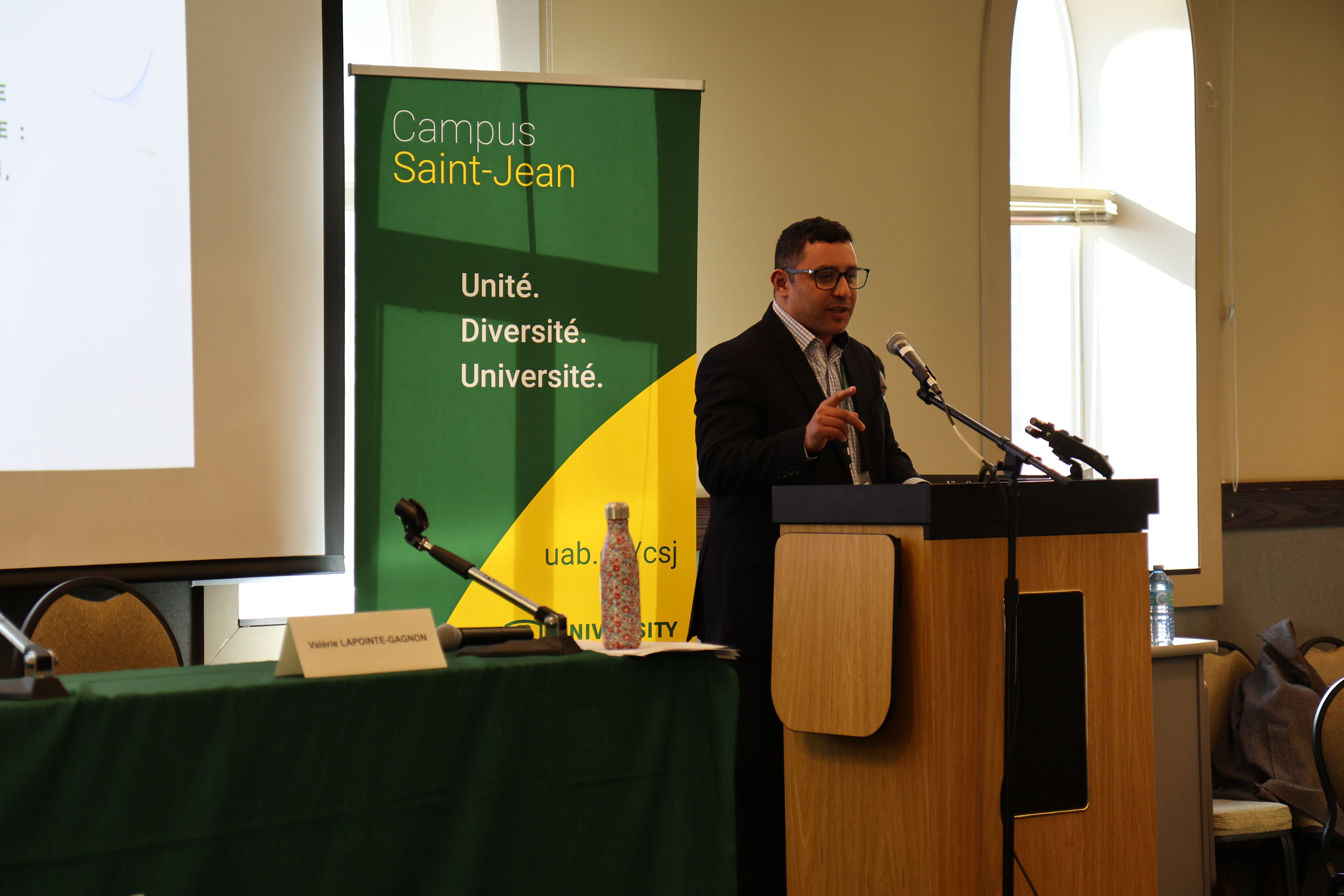
Le professeur Hassan Safouhi lors d'un Congrès du Campus Saint-Jean
Within Canadian universities, certain careers stand out for their rare ability to foster dialogue between disciplines and nations. Professor Hassan Safouhi’s career is one such example. An internationally renowned researcher and a leading figure at Campus Saint-Jean, the University of Alberta’s multidisciplinary Francophone campus, he has built his career on a foundation of absolute rigour: applied and computational mathematics. As the holder of the very first permanent mathematics post established at the Faculté Saint-Jean, he made his mark on the field from the very start of his research career. His postdoctoral studies under the supervision of the eminent mathematician André Joyal are often cited as an example of the excellence of his work; during this period, he published seven scientific articles in a single year. This pace, highly unusual in such a demanding discipline, laid the foundations for a career that now boasts more than 86 articles published in some of the most prestigious international journals.
For Hassan Safouhi, research is not a static pursuit. It remains, even today, the driving force behind his daily life. A leading researcher in his field, he has long received financial support from the Natural Sciences and Engineering Research Council of Canada (NSERC) for his research and innovation work. This trust from the Canadian government enables him to continue advancing his field whilst representing the University of Alberta on the global stage through plenary lectures he regularly delivers around the world. His intellectual influence has also been recognised through several honours, including the prestigious Killam Professorship, the McCalla Professorship, the Graduate Supervisor Award and the Best Paper Award in Computing, Education and Research from the American Society of Civil Engineering, as well as his appointment as an Expert in Applied Mathematics by the Agence universitaire de la Francophonie, in addition to his role as director representing the western provinces and territories within the Canadian Mathematical Society between 2011 and 2015.
However, to reduce Professor Safouhi to his research alone would be to overlook a vital aspect of his work: that of an educator and teacher. For him, teaching and passing on his knowledge is a mission of the utmost importance. His ability to explain highly complex concepts in simple terms and to motivate his students has been officially recognised with the Rutherford Award, the University of Alberta’s highest honour for excellence in teaching, as well as the Campus Saint-Jean Award for Excellence in Teaching, which he has received twice. Drawing on this dual experience as a researcher and teacher, he launched, in his capacity as Vice-Dean, a profound transformation of his institution. Under his leadership, a major reform of the arts and sciences programmes was carried out with great success. The central idea behind this reform is the introduction of an ambitious arts/sciences core curriculum, designed to break down the barriers between disciplines. This approach enables students, during their time at the Faculté Saint-Jean, to acquire not only technical expertise but also a solid general education. The objective is clear: to develop well-rounded talents, capable of adapting intellectually to integrate quickly and succeed in the world of work, and equipped with the necessary tools. By combining academic theory with experiential learning, this reform prepares future graduates to become citizens capable of thinking for themselves and sought-after professionals, ready to thrive in a constantly changing world. One of the cornerstones of this change is the introduction of study groups (ESETU). These are innovative working groups where students collaborate to analyse complex societal issues and propose concrete solutions. This creates a direct link between university courses, community engagement and the resolution of real-world problems.
Professor Safouhi was also behind the creation of the research apprentice programme, which encourages undergraduates to get involved in research, as well as the ‘Research and Creation Conversations’, a forum for the dissemination of scientific work; these two key initiatives continue to have a significant impact on the Campus’s educational provision and intellectual vitality.
This vision of a university open to the world naturally extended to the field of diplomacy. Hassan Safouhi has used his managerial responsibilities to help raise the profile of Alberta and Canada. Thanks to his network, he has succeeded in attracting world-leading experts in artificial intelligence to Alberta, such as Marc-Antoine Dilhac, Valentine Goddard and Joé Martineau, making his campus a major hub for technological research, particularly within a faculty operating primarily within an official language minority community
But it is above all in forging links between Canada and Morocco that his impact is most evident. As Morocco undergoes rapid industrial development under the Royal Vision, Professor Safouhi has become a vital link between the two countries. He has established long-term collaborations with key institutions such as Mohammed VI Polytechnic University (UM6P) and Sultan Moulay Slimane University (USMS). These partnerships are not merely words; they translate into concrete, funded actions. In particular, he has established research teams working on the mathematical modelling of infectious diseases. This programme, funded to the tune of $880,000, helps to strengthen the Moroccan healthcare system in the face of future global health crises.
Convinced that the future depends on the sharing of knowledge, Professor Safouhi personally secured a budget of $560,000 to fund research stays in Canada for 24 Moroccan PhD students. By giving priority to women, he is directly helping to train a new generation of Moroccan scientists to Canadian standards of excellence. This concrete commitment to the next generation naturally led to a broader ambition: the creation of the Canadian Association of Moroccan Professors and Researchers (ACPCM). Under his presidency, the association took on a strategic dimension thanks to close and privileged collaboration with the Ambassador of the Kingdom of Morocco to Canada, H.E. Ms Souriya Otmani. This dynamic partnership, founded on a shared vision of the diaspora’s role, has been the essential catalyst for the ACPCM’s development. Together, they have succeeded in transforming the expertise of professors of Moroccan origin across Canada into a major lever for influence and development, as evidenced by the success of the international conference organised to mark the 50th anniversary of the Green March.
The impact of this commitment has been recognised at the highest level. In particular, Professor Safouhi’s work was honoured with an award for his exceptional commitment to promoting and strengthening relations between Morocco and Canada, presented by Dar Al Maghrib (the Moroccan Cultural Centre in Montreal) in 2025. This distinction highlights his crucial role as a bridge between the two cultures. Furthermore, his personal invitation by His Majesty King Mohammed VI to the Throne Day celebrations last July is testament to the high regard in which he is held by the Royal Palace. This dual recognition, both institutional and sovereign, crowns the career of a man who has successfully used science as a diplomatic tool to bring nations closer together.
Despite this international success, Hassan Safouhi remains deeply humble. He always puts the success of his teams and the achievements of his students before his own accolades. Supported by his wife, Dr Nisrine Mokri, he has made Edmonton a home where his Moroccan roots can flourish fully, whilst proudly affirming his attachment to Canada. In short, he is not content merely to be a talented researcher and educator; he is the architect of a strong alliance, built on longevity and mutual respect. In doing so, he demonstrates that knowledge is the best tool for building lasting and shared prosperity between Canada and Morocco.